Being able to use a weapon within a karate kata does not mean the kata was originally designed for one.
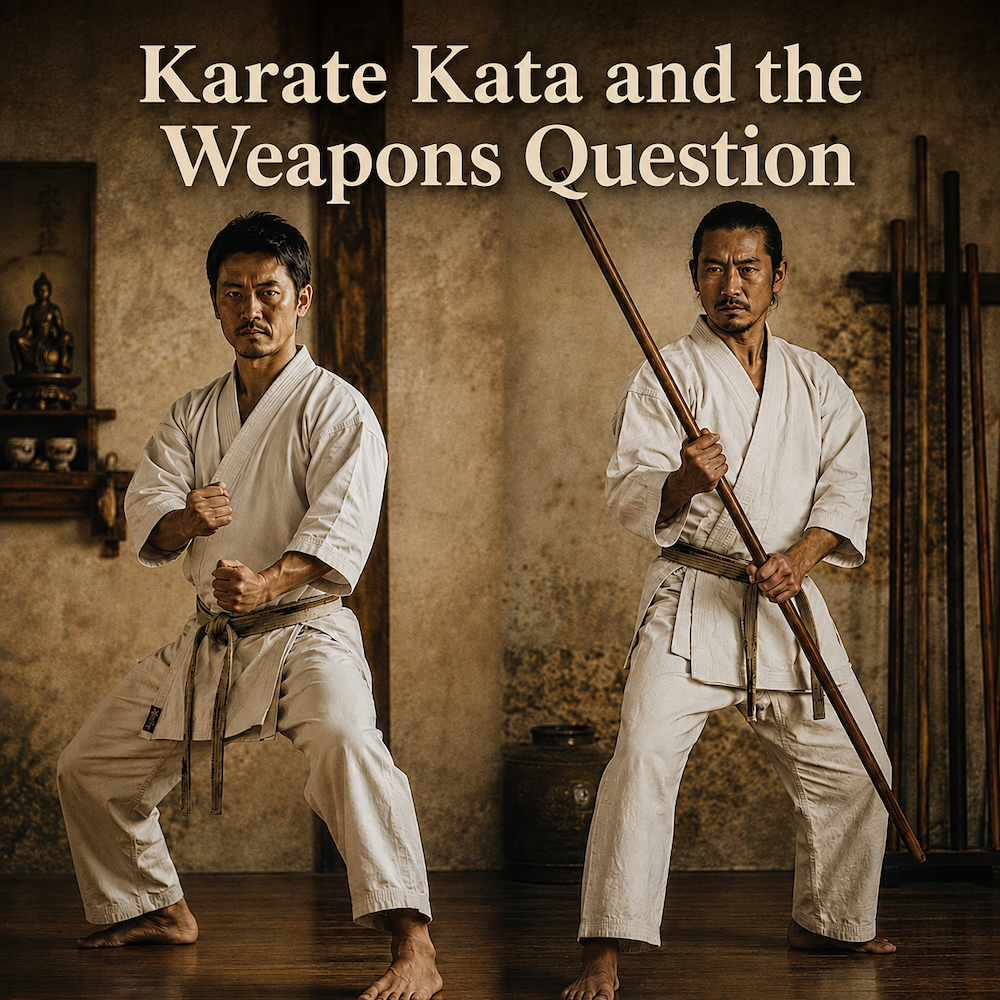
Someone commented recently that many karate kata could also be used with a weapon, and that they practice many of their kata with weapons.
I have heard this idea before. Put a bo, sai or tonfa into someone’s hands, perform the movements of a karate kata, and quite often it is possible to make something fit.
But I think we need to be careful about what that actually tells us.
There is a considerable difference between saying that a movement can be adapted to a weapon and saying that the kata was originally intended to be used with one.
I have no problem with the first claim.
The second needs evidence.
Okinawan karate did not exist in some imaginary world where everyone fought empty-handed. Weapons existed, as did everyday objects that could readily become weapons. People would certainly have understood the possibility of facing someone who was armed.
Many Okinawan practitioners also trained in both karate and kobudo.
But that doesn’t mean the karate kata were weapon kata.
Karate and kobudo may have existed alongside one another, but they were not simply the same kata performed with different things in the hands.
Kobudo has its own traditions and its own kata specifically concerned with the use of weapons. There are kata for the bo, sai, tonfa, eku and other weapons, with movements and methods appropriate to the characteristics of those weapons.
If a karate kata such as Seisan, Passai or Kusanku was originally intended to be performed with a particular weapon, then I think we need some historical evidence demonstrating that.
Simply showing that the movements can be made to work with a bo doesn’t establish it.
You can adapt movement surprisingly easily.
Give someone who understands a karate kata a stick and they will probably find ways of using it within movements they already know. The body mechanics, the stepping and some of the angles may transfer. Certain movements may suddenly suggest striking, receiving or poking with the weapon.
But similarity does not establish origin.
We have to be particularly cautious when working backwards from what we can make a movement do today. If I can take a movement from a karate kata and make it work with a sai, that demonstrates that I have found a way to use the movement with a sai.
It does not demonstrate that the person who created or transmitted the kata had a sai in mind. It tells us only that the interpretation is possible.
Historical intent requires something more.
None of this means armed attacks never happened, or that karate contains nothing that might help someone confronted by a weapon.
Of course it might.
But there is a considerable difference between acknowledging that possibility and claiming that the karate kata themselves were designed to be performed with weapons.
If someone was proficient with a bo, sai or another weapon, deliberately choosing to face them empty-handed would hardly seem the sensible option. The fact that many Okinawan martial artists trained with weapons as well as empty hands makes much more practical sense.
If weapons were available, learn to use weapons.
If you found yourself without one, then naturally you used whatever skills you had.
I think we should be careful about what we conclude when we put weapons into karate kata simply because we can.
There is nothing wrong with exploring it.
But if we then say, therefore this is what the kata was originally for, we have moved from experimentation into historical speculation.
For me, the existence of established kobudo kata actually makes the distinction clearer. If Okinawan martial artists wanted to preserve methods for using the bo, they had bo kata. If they wanted to preserve methods for the sai, they had sai kata.
So before accepting the idea that an empty-hand karate kata was secretly or originally a weapon form, I would want to see something more substantial than the fact that somebody today can perform it while holding a weapon.
Being able to make something fit is not the same as showing that it belongs there.
Karate practitioners certainly understood weapons. Some trained extensively with them. They also had to live with the possibility of encountering them.
But none of that requires us to turn karate kata into weapon kata.
We already have kobudo for that.
Help Keep Applied Methods Free
Applied Methods is independently written and freely available. If you enjoy the articles and would like to support the continued writing and upkeep of the site, contributions are always appreciated, but never expected.