
If karate is supposed to have relevance to self-protection, then the way we practice has to reflect the problems we may actually face.
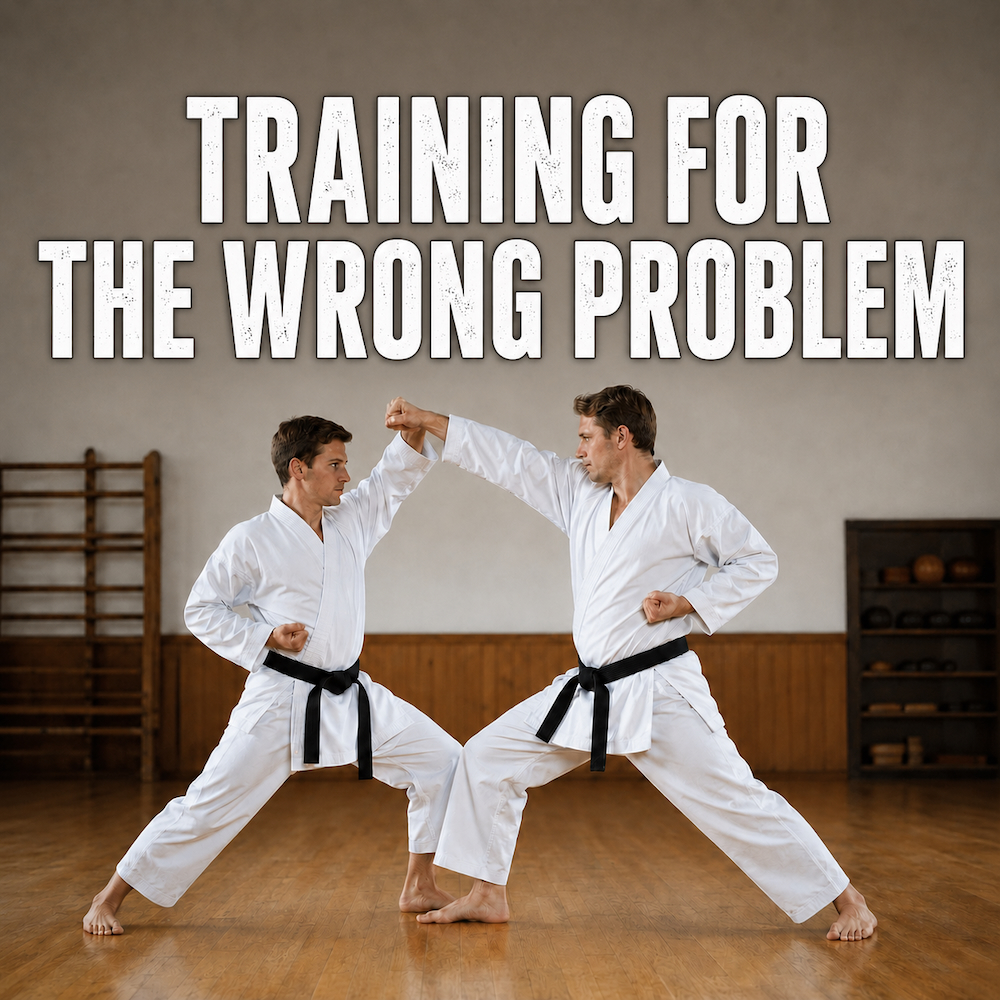
Someone commented on an article of mine where I had written about the realities of self-protection, particularly the fact that violence doesn’t usually conform to what is practiced in the dojo, it is often messy, fast and unpredictable.
I had used examples such as being attacked at an ATM, inside a car or bus, in a pub, or while sitting at a table in a restaurant. His response was that you cannot really train for those situations. You are unlikely to find that kind of training in an ordinary dojo.
To a degree, he was right.
We cannot recreate real violence in training. Nobody needs an actual carjacking, or somebody smashing a bottle across the room, to make training realistic.
But there is a considerable difference between accepting that limitation and deciding that context does not matter.
I’ve written before about block-and-counter training, fixed attacks and step-kumite. Sometimes a drill only works because both people are doing exactly what the drill requires.
The problem begins when we take a drill and claim it is preparing someone for something it does not remotely resemble.
Context matters.
If someone practices karate for sport, cultural interest, fitness, recreation or simply because they enjoy it, there is nothing wrong with that. Karate has developed into many different things for many different people.
But whatever else karate has become, its methods developed from a practical need. Function mattered.
Another person once told me that practicing karate with self-protection in mind was a waste of time because most people would probably never need to use it.
Perhaps they won’t.
But safety is not a permanent condition.
I have lived in areas where very little seemed to happen. Quiet streets, respectable neighborhoods, ordinary people going about their lives. Yet even apparently safe places occasionally produce violence, crime and behavior nobody expected.
A place can look completely normal until the moment it isn’t.
That doesn’t mean we should live frightened of what might happen. It simply means that the absence of violence yesterday does not guarantee its absence tomorrow.
If karate is advertised as having relevance to self-protection, then at some point we have to ask what that relevance actually looks like in practice.
We cannot reproduce real violence in the dojo, but training can still reflect some of its problems. That might mean starting from an awkward position, being seated, working close to a wall, dealing with poor balance, or simply not knowing exactly what the other person is going to do. Add pressure and resistance, make the attack less formal, and suddenly the practice begins to tell you something useful.
The point is to remove some of the cooperation and convenience that make techniques work so well in the dojo.
Karate itself has changed enormously over time. As it moved through Okinawan schools, into mainland Japan and eventually around the world, it was shaped by education, physical culture, budo ideals, competition, standardization and the expectations of different generations.
That evolution is not necessarily a bad thing. The problem comes when one version of karate is expected to satisfy every purpose.
And the question is not whether the practice is good or bad.
The question is: what is it for?
Functionality does not require us to throw away tradition, kata, formal training or anything else that makes karate what it is.
It requires us to understand what we are practicing, why we are practicing it, and what assumptions are built into the exercise.
If we want karate to retain relevance as a method of self-protection, then those assumptions occasionally have to be challenged.
Not because we can make the dojo identical to real life. We can’t.
But we can make our training closer to the problems we may actually face.
Functionality is not an addition to karate.
It is its foundation.
Help Keep Applied Methods Free
Applied Methods is independently written and freely available. If you enjoy the articles and would like to support the continued writing and upkeep of the site, contributions are always appreciated, but never expected.
Sensei Carter, thank you for this post.
What we are training FOR does indeed shape the training Way.
Pilots, to take one example, train for different situations.
Yes, what they all have in common is: fly the plane from Place A to Place B.
But: are they landing at the North Pole in the dead of winter? Or are they flying to a remote jungle outpost with short and unpaved runways? Or are they launching from, and hopefully returning to, an aircraft carrier? (And even then, are they launching to refuel other planes, to be an “eye in the sky,” or to engage targets on the ground or in the air with missiles?) Are they carrying passengers from London to New York? Are they spraying chemicals on crops from an extremely low altitude?
It’s all flying, but the training each kind of pilot gets can, and by necessity DOES vary according to the Main Goal. Therefore in training, scenarios specific to the Main Goal have to be in line with that Main Goal. A kick is a kick and a punch is a punch, but context matters.
Exactly. That is a very good analogy. The activity may have the same name, and even share many of the same skills, but the training has to reflect what you are actually preparing for. Context changes everything.