Why the movement between stances matters as much as the stance itself
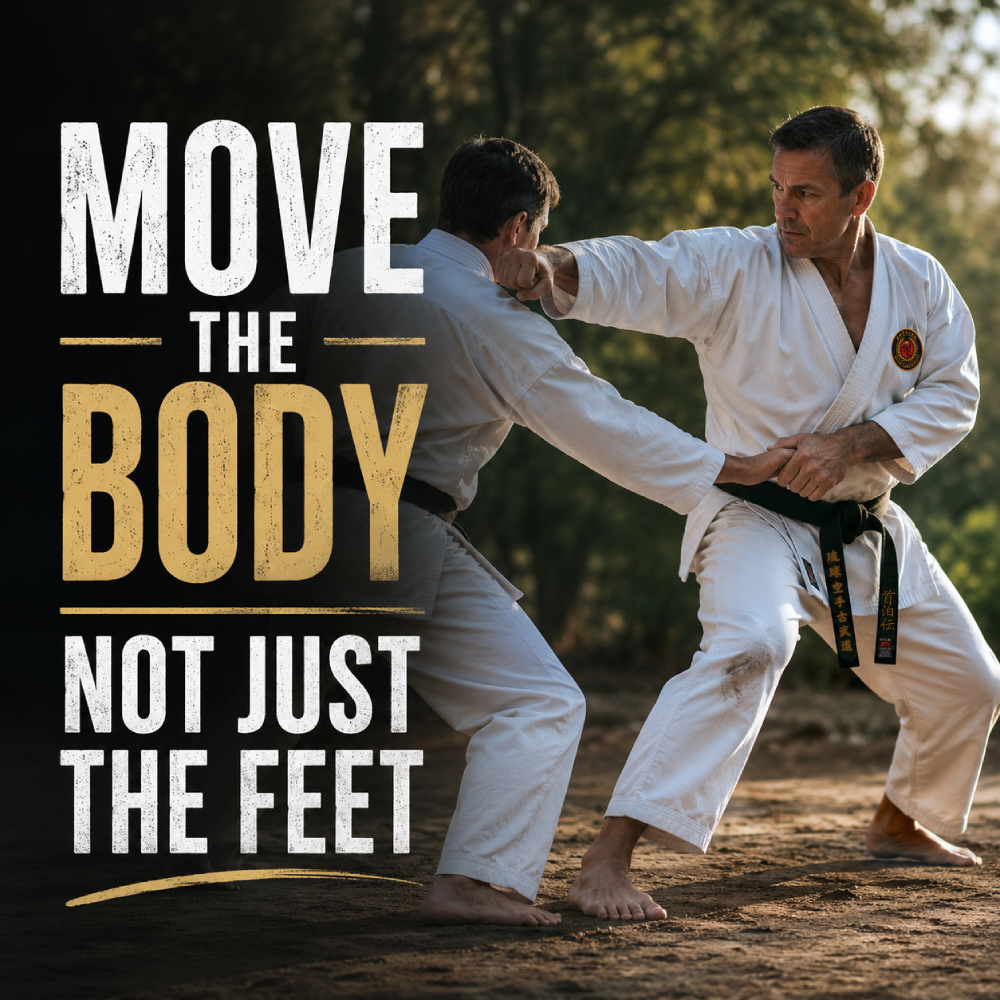
One of the things that can happen in karate is that we become very conscious of where the feet are going. We learn the shape of the stance, where the front foot should be, where the back foot should be, how wide the stance is and where the weight should sit. In concentrating so much on the feet, we can sometimes lose the natural way the whole body should move.
When we move quickly and with purpose, the body should be driven in the direction we want to go and the feet should support that movement. Think of a sprinter leaving the starting blocks. The body is driven forward from the ground and the feet then move to keep up with it. If we simply place the foot out first and then bring the body after it, the movement is slower and more segmented.
This also means we need to be relaxed before we move. If everything is already tight, we are effectively working against ourselves. We need enough tension to control the movement, but not so much that we are fighting against ourselves.
When striking, the same idea applies. The body movement should add to the technique. We do not want to step, settle into the stance and then punch. That may be useful when someone is first learning, because it allows them to concentrate on one thing at a time, but eventually the movement and the technique need to become one action.
The impact should happen while the body is still moving, not after everything has come to a stop. That way we are not relying only on the strength of the arm or leg. The movement of the body is contributing too.
Look at Mike Tyson in his prime. He often punched from a low, crouched position, driving up through the legs and using the movement of his whole body to devastating effect.
The same principle helps explain why there is so much stepping and body movement in kata.
If the purpose of kata was simply to teach us to stand strongly and punch, kick or receive, much of that movement would not be necessary. We could stay where we were and practice the techniques from a fixed position.
Naturally, we have to move because we need to reach another person, but the movement itself can also be part of the method. It can help us close distance, change angle, move around someone, take balance or drive into them.
It can also move us out of harm’s way.
That part is often overlooked. If someone is attacking my head, the most important thing is not simply that my foot moves. My head needs to move. If my body is the target, then my body needs to get out of the way.
The foot may move with it, but moving the foot while leaving the target where it was achieves very little.
Move the target, not merely the stance.
The receiving arm can work with that movement, but it does not have to simply stop the attack. It may be clearing, controlling, grabbing, pulling or pushing while the other hand is doing something else. This is where meotode, the use of both hands together, becomes important. The hands and the body work together as part of the same action, rather than one hand being given the job of dealing with the attack while the rest of the body waits.
Boxers do this naturally. They move the head and body, change the angle and use the feet to support that movement.
The same thing applies at close range. Sometimes the feet may hardly move at all, but the body still can. We can move forward, back or to the side, turn, shift our weight or change angle without taking what we would normally think of as a full step.
Again, the important thing is not simply where the feet finish. It is what the body is doing.
A common dojo exercise is to move from shiko-dachi into zenkutsu-dachi with a reverse punch and then return to shiko-dachi. This is usually understood as learning to use body movement to add power to the punch, but the return movement is important too. We are also learning to move the body back out of the way.
The same problem often begins when students are taught to step and then punch or receive. There is nothing wrong with separating the movements while someone is learning, but as soon as possible they need to be brought together. Otherwise, the stance movement can be halfway finished before the hand even begins to move.
All of this may sound obvious, but I still see very experienced practitioners who move sequentially. The feet move first, the stance forms and then the technique happens. They may have very strong-looking stances, excellent ‘kime’, but the movement itself has become unnatural and predictable.
We spend a great deal of time studying the positions in kata.
Perhaps we should spend just as much time studying what happens between them.
The kata do not simply teach us where to stand.
They teach us how to move.
Help Keep Applied Methods Free
Applied Methods is independently written and freely available. If you enjoy the articles and would like to support the continued writing and upkeep of the site, contributions are always appreciated, but never expected.