Tradition, memory, and the passing of karate from one generation to the next.
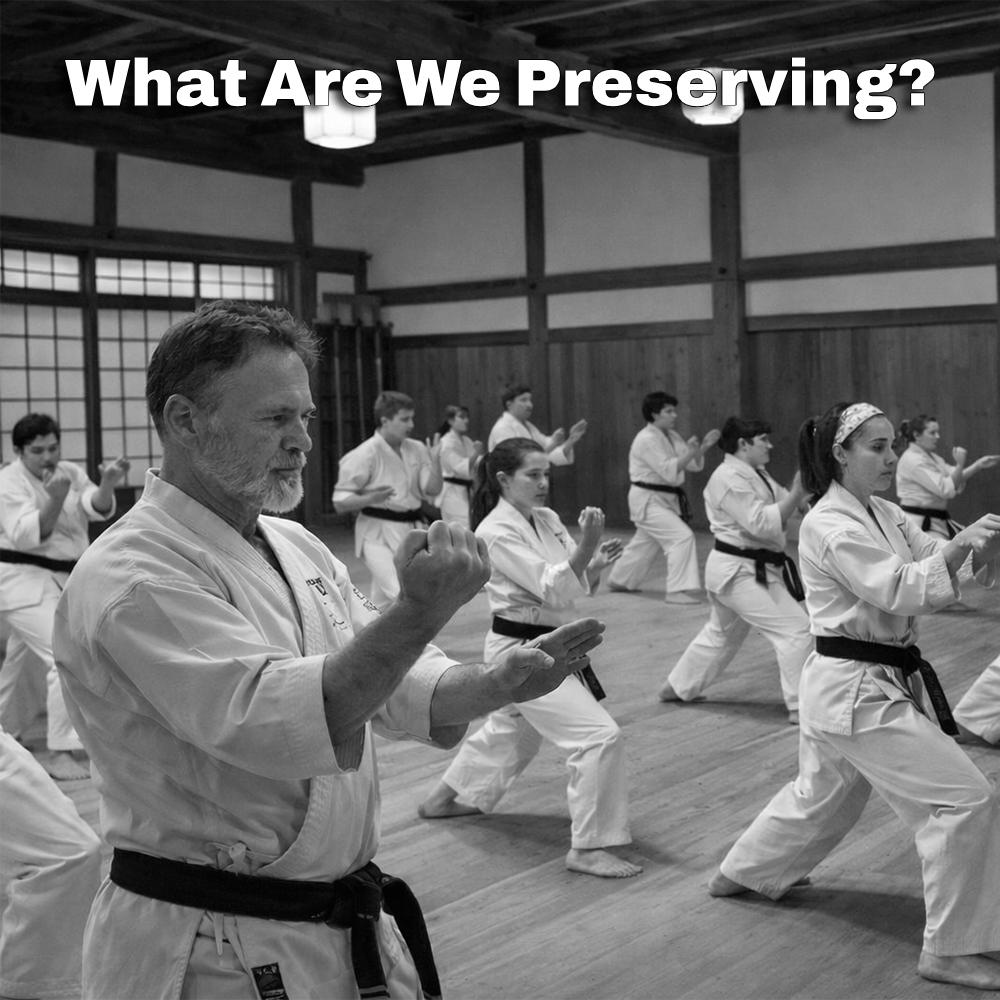
I’ve been practicing traditional karate for a long time now, and my appreciation of it hasn’t diminished. It’s the foundation of what I teach today, although my understanding of certain training methods and their practical application has changed considerably over those years.
These days, my teaching has a practical, pragmatic focus, particularly where civilian self-protection is concerned. Occasionally, though, we’ll revisit some of the exercises I learned decades ago. Sometimes it’s simply to do something different, and sometimes it’s to show students how I was taught. They understand what we’re doing and why.
Yet questioning a traditional practice is sometimes interpreted as rejecting tradition itself. I don’t see it that way at all.
We often speak about tradition as though it’s something fixed, passed unchanged from one generation to the next. But is that really what happens?
Every generation makes changes. A teacher adjusts a movement, modifies an exercise, adds something, or removes something they no longer consider necessary. Sometimes there’s a good reason for the change, or perhaps it’s a matter of personal preference.
And sometimes, it may simply be a matter of memory.
Back in the 1980s, a senior instructor occasionally struggled to remember movements in kata. Sometimes he would forget considerable portions, even an entire kata, and come to me asking if I could help him remember how it went.
That’s not a criticism. We’re all human, and our memories aren’t always as reliable as we’d like to believe.
Another senior instructor once insisted that a particular movement had to be performed differently from the way we’d been practicing it for years.
He was the senior instructor, so we made the change.
Now consider what happens next. That revised movement can become the accepted way of performing the kata. It’s taught to new students, who eventually pass it on to their own students.
At some point, it becomes tradition.
But which version was traditional? The one we’d practiced for years, or the one we were subsequently instructed to follow?
And how many times might something similar have happened throughout karate’s history?
I suspect considerably more often than we might like to think.
We sometimes imagine that what we’ve inherited has been carefully preserved through successive generations, with each teacher faithfully passing on what they received. But teachers are individuals. They have their own experiences, interpretations, preferences, and, occasionally, imperfect memories.
The karate we practice today has passed through the hands of many such individuals.
That doesn’t make the tradition any less valuable. But perhaps it should make us a little more cautious about claiming that a particular method or movement is the only correct way simply because it’s traditional.
This is particularly important when we’re discussing the practical application of karate. A method may have been taught for generations, but its age alone tells us very little about how well it addresses the problems of civilian self-protection.
When teaching, I often ask questions beginning with what, why, where, when, and how. I want students to examine what they’re doing rather than simply accept an explanation because it comes from their instructor.
Surely the traditions we’ve inherited deserve the same consideration.
Valuing traditional karate doesn’t mean we must preserve every method, interpretation, or explanation simply because that’s how someone taught it to us.
Tradition matters. It connects us with those who practiced before us, but it has never been completely untouched by change.
And perhaps that’s worth remembering the next time someone tells us, “This is the traditional way.”
Help Keep Applied Methods Free
Applied Methods is independently written and freely available. If you enjoy the articles and would like to support the continued writing and upkeep of the site, contributions are always appreciated, but never expected.