Anger, assumptions, and knowing when to respond.
Maybe it’s because I’m getting older, but I find myself thinking more about my own failings and just how fallible we really are.
When I was younger, I loved to fight. Boxing as a boy, competition, sport, I couldn’t get enough of it.
These days, I much prefer a quieter path. Avoidance whenever possible, staying out of trouble, and simply getting on with life.
If only I could manage that quite so easily when I’m behind the wheel.
I used to be remarkably calm when driving. Keeping a level head was part of my job. Yet these days, it seems I only have to drive a mile before some clown does something that makes me wonder how they ever passed their driving test.
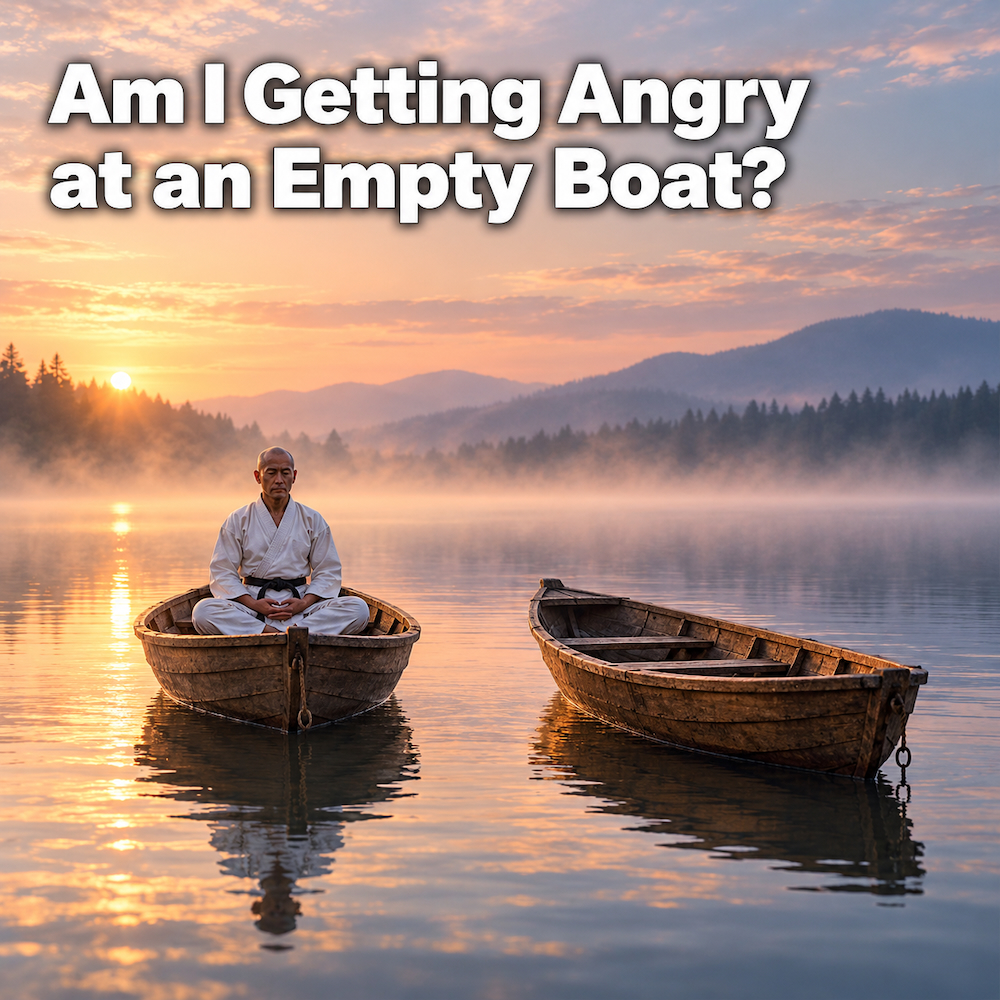
It reminded me of an old story about an empty boat.
A man is crossing a river when another boat drifts into his. He’s about to get angry, but then notices there’s nobody in it. Just an empty boat drifting along.
Now imagine someone had been sitting in that boat. He’d probably have shouted at them for being so careless.
Yet nothing about the collision has changed. Only his reaction to it.
I find that interesting, particularly when I think about my own reactions.
When someone cuts me up on the road, am I reacting to what has actually happened, or to what I think the other driver has done? Perhaps they were careless, distracted, or simply hadn’t seen me. None of that makes their driving any less dangerous, of course, but does getting angry make my situation any better?
And how often do we do something similar in everyday life? Someone says something we don’t like, behaves in a way we find irritating, or appears to disrespect us. Our reactions can be almost immediate, sometimes influenced more by what we think someone intended than by what actually happened.
There’s something here worth considering in our karate practice, too.
We spend years learning how to respond physically to another person. How to strike, how to control, how to deal with aggression. But how much time do we spend learning to notice our own reactions before they become part of the problem?
We can find ourselves getting angry at empty boats, responding to perceived threats that may not even exist, allowing anger to cloud our judgement when we should be thinking clearly.
Self-protection isn’t simply about knowing how to respond, but understanding when a response is necessary.
But there’s another side to this, too. Not every boat is empty.
I remember Bruce Lee talking about ’emotional content, not anger’. There’s an important distinction there. Our emotions are part of who we are, and sometimes they’re telling us something we need to pay attention to.
Perhaps the real difficulty isn’t in learning to suppress what we feel, but in understanding why we feel it and deciding what to do about it.
Being at peace with ourselves shouldn’t mean accepting everything that happens to us.
Of course, there are times when physical action is necessary. If violence is imminent and there is no safe way to avoid it, we may have to act decisively, even pre-emptively. That’s one of the reasons we train.
But surely knowing when action is necessary, and when it isn’t, deserves just as much attention?
And I don’t think this is something we ever completely master. We might become more aware of our reactions, perhaps even control them most of the time, but that doesn’t mean they disappear.
I know all this, of course. I’ve understood it for years. Yet tomorrow I’ll probably climb into my car, drive down the road, and find myself questioning the intelligence of another driver.
Which rather proves how much I still have to learn.
Pause. Observe. Let it pass.
The world moves as it moves. Being at peace, being quiet, is a skill too.
Or maybe I’m just getting old.
Help Keep Applied Methods Free
Applied Methods is independently written and freely available. If you enjoy the articles and would like to support the continued writing and upkeep of the site, contributions are always appreciated, but never expected.