Why concentrating on one part of the body may cause us to miss what is happening elsewhere.
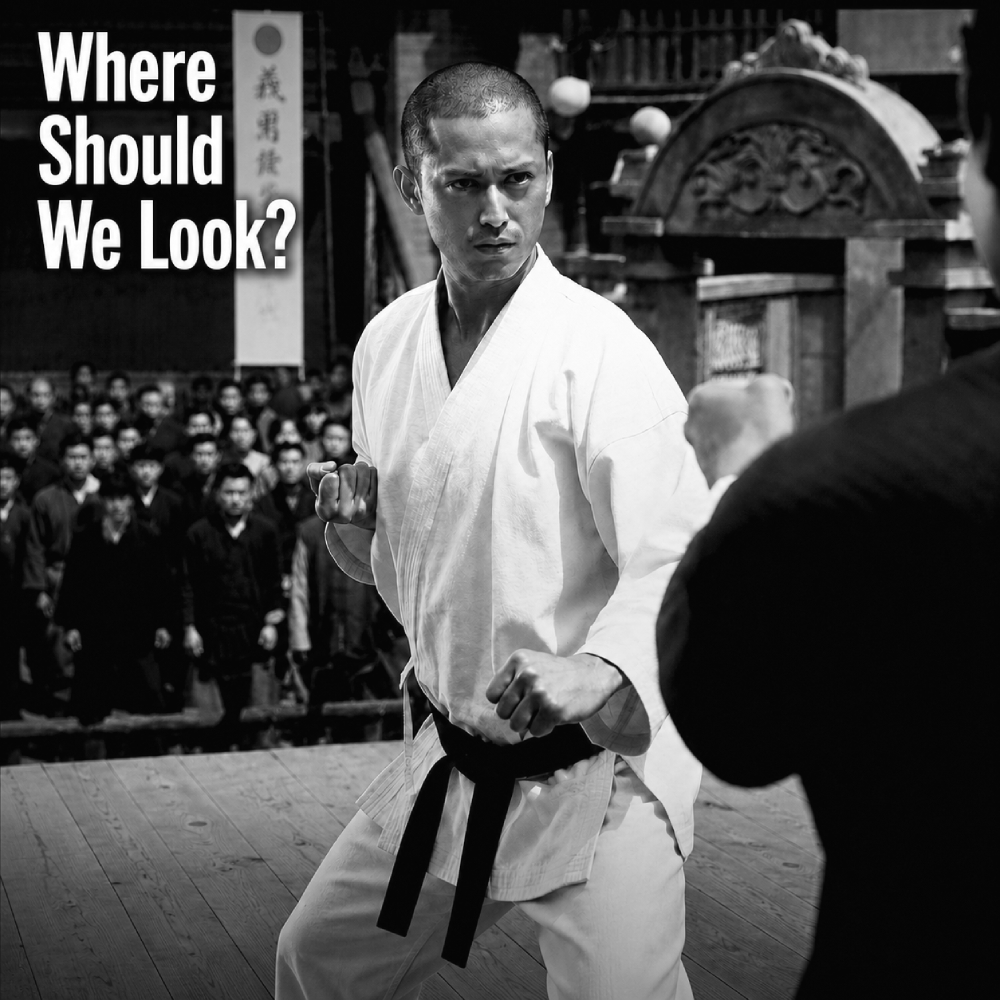
People often ask where they should look when facing another person, in sparring, drills or even in an actual confrontation.
Should they watch the eyes, or the shoulders, perhaps the chest, the hands, or even the feet?
There is usually a reason given for each answer. The shoulders may indicate a punch, the hips might suggest a kick, and the eyes are sometimes said to reveal intent.
Perhaps they do, but violence is rarely so easy to read.
A person may punch, grab, shove, reach inside a pocket, close the distance, or suddenly move away. There may be another person nearby whom we have not noticed. Concentrating on one part of the body can mean missing something more important elsewhere.
Stress complicates this further. When we believe we are in danger, our attention may narrow around whatever appears to be the immediate threat. We can become absorbed by one person, one hand, or one possible action and lose sight of the wider situation.
For that reason, I don’t believe in staring intently at any particular point.
We obviously have to face the person, but facing them is not the same as fixing our attention on their eyes or chest. A less concentrated gaze gives us a better chance of taking in the person as a whole while remaining aware of what is around them.
We are not trying to identify a named technique before it arrives. What matters is noticing that the situation is changing. Distance closes. Posture shifts. A hand disappears from view. Space appears at one side while another route becomes blocked.
These changes may offer an opportunity to move away, alter the angle, control an arm, place something between us, or escape towards a safer position.
Correctly identifying whether something was a punch, grab, or shove is not especially useful if the opportunity to act has already passed.
This is one of the difficulties with training ourselves to search for recognizable attacks. We become familiar with the scripted versions used in practice, then hesitate when real movement looks nothing like them. Outside the dojo, actions overlap, intentions change, and people rarely move in the way we expect.
Vision is only part of how we perceive danger. We may hear a change in someone’s voice, sense pressure through contact, notice their breathing, or simply feel that the distance has become uncomfortable. The body sometimes begins to respond before we have consciously understood what has changed.
So where should we look?
Generally forward, but without becoming fixated by one particular point.
Take in the person without allowing them to fill your entire awareness. Notice what changes and where space appears. Don’t wait for the movement to become a recognizable technique before responding to it.
The eyes may tell us something, but they are only one small part of the situation.
Learn to perceive rather than just see.
“Preoccupied with a single leaf, you will not see the tree. Preoccupied with a single tree, you will miss the entire forest.”
Quote often attributed to Takuan Soho
Help Keep Applied Methods Free
Applied Methods is independently written and freely available. If you enjoy the articles and would like to support the continued writing and upkeep of the site, contributions are always appreciated, but never expected.