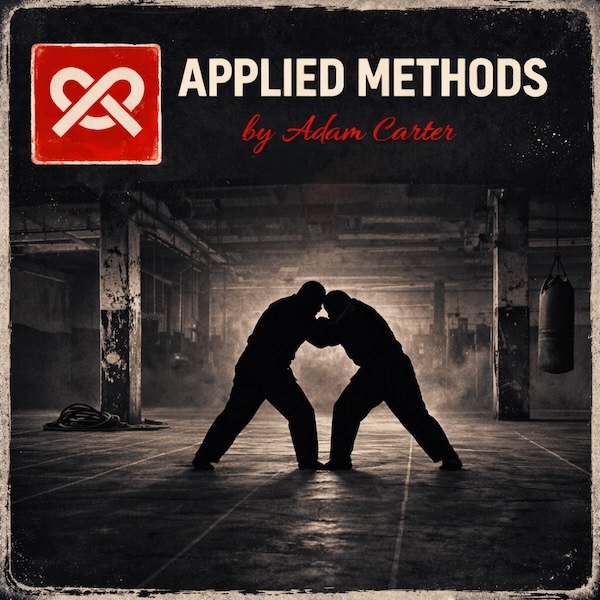
A fighting guard assumes an exchange.
A fighting guard assumes an exchange.
Self-protection should be trying to prevent that exchange from developing in the first place.
The context changes what the hands need to be doing.
A fighting guard assumes an exchange.
Self-protection should be trying to prevent that exchange from developing in the first place.
The context changes what the hands need to be doing.
Perhaps one of the biggest misunderstandings about kata is the assumption that the sequence is the lesson.
It may simply be the way the lesson was remembered.
Sometimes experience gives us better answers. Sometimes it gives us better questions.
I am beginning to think that stillness is something we have to relearn.
The world gives us very few opportunities to simply stop.
There are moments when doing less allows us to notice more.
A sound in the distance.
The rhythm of our breathing.
The feeling of the ground beneath us.
Things that were always there, but that we were too busy to notice.
Knowing how to perform a kick is one skill.
Knowing where and when that kick belongs is another.
Context, distance, balance, and timing matter just as much as technique.
A stance in karate is not just a position to be held.
It is a moment in movement.
The problem begins when we mistake the training shape for the final purpose.
Different bodies, different proportions, different levels of mobility, and different applications will naturally affect how a stance appears.
The question should not only be, “Does it look right?”
The better question is, “Does it serve the movement?”