What kakie can teach us about feeling pressure, recognizing openings and responding without relying on sight alone.
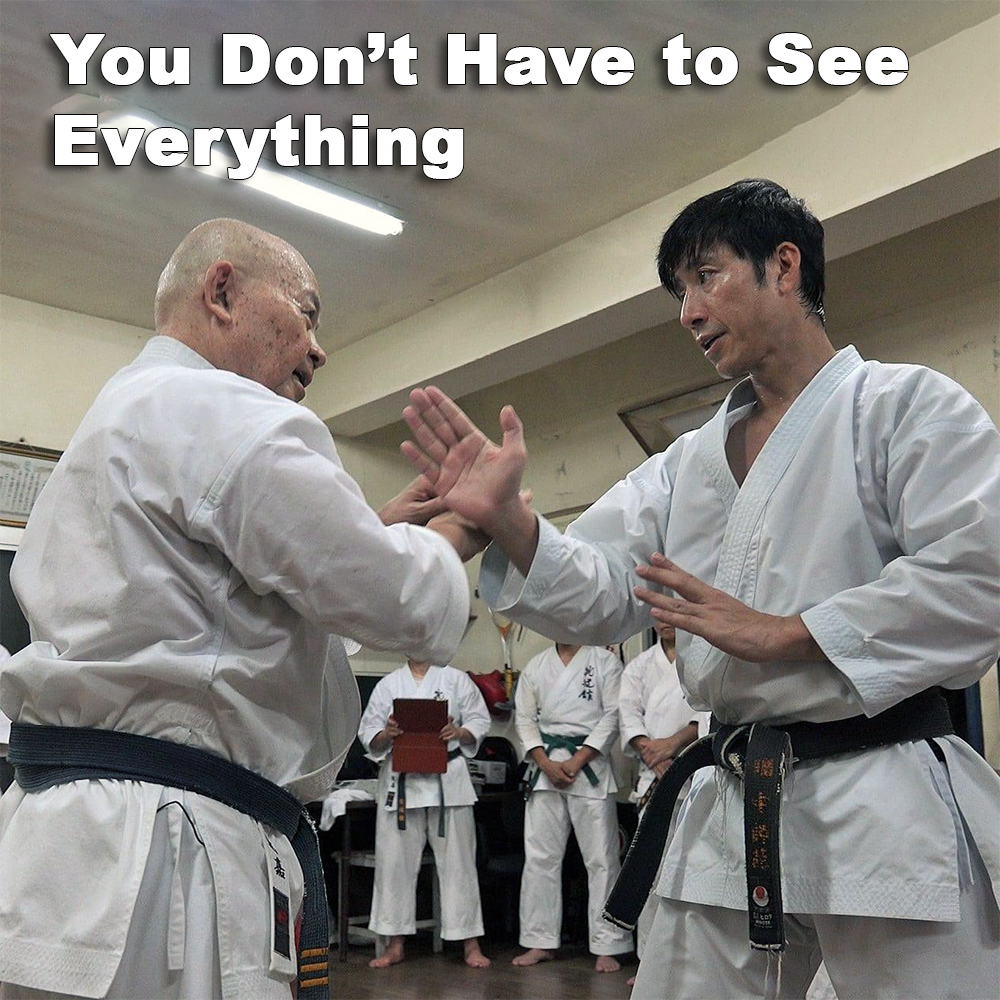
A few years ago I came across a quote from Minoru Higa sensei of Kyudokan Shorin-ryu that I found interesting.
“Kakie. You have to rely on your senses, not power. Targets open up during an exchange, so strike as they open up. You can sense what’s coming even if you’re looking away. It’s all about this feeling.”
There is a lot contained in those few words.
Kakie is often described as a form of pushing or sticking hands. Two people maintain contact, usually through the forearms, while pushing, pulling, redirecting and changing position. From the outside it can look like a fairly simple exercise.
But I don’t think the value of kakie is really in the exercise itself.
It is in what the contact tells you.
Once you are touching another person, your eyes are no longer your only source of information. You can feel pressure increasing or disappearing. You can feel someone stiffen, pull away, change direction or lose their structure.
None of that requires you to stare at the point of contact. I wrote recently about where we should look during an exchange, but of course our eyes are only giving us part of the information.
This is what I think Higa sensei is getting at when he says that you can feel what is happening even when you are looking away.
It’s not some mysterious ability to read another person’s mind. You are simply receiving information through touch.
And at close range, that information can arrive very quickly.
If someone pushes into you, something else may become available. If they pull an arm back, a space may appear. If they stiffen against one movement, their resistance can affect their balance or expose another area.
The important part is that you are not necessarily deciding beforehand what technique you are going to use. You are simply responding to what is there.
That line from Higa sensei, “Targets open up during an exchange, so strike as they open up,” is perhaps the most interesting part of the quote for me.
We often train combinations as though the whole sequence already exists. Block this, counter with that, then follow with something else.
But real exchanges are rarely that easy.
Positions change. People resist. Arms get caught. Distance collapses. Something you expected to be available suddenly isn’t, while something else appears that you hadn’t planned for.
Kakie can help us become more comfortable with that uncertainty.
But only if we don’t turn it into a strength contest.
If both people are simply trying to push harder than the other, much of the sensitivity disappears. You stop listening through the contact and start fighting against it.
That rather misses the point.
The same is true if kakie becomes an exercise that exists only for its own sake. Becoming very good at kakie is not necessarily the goal.
What matters more is whether the qualities it develops carry over into less cooperative training.
Can you recognize changes in pressure and remain relaxed enough to feel them? Can you respond without needing to reset and think, taking advantage of an opening when it appears rather than trying to force the technique you originally intended?
That is where I think kakie becomes much more interesting.
We often talk about seeing openings. Sometimes, though, you feel them first.
And perhaps that is the real lesson in Higa sensei’s quote.
Kakie does not simply teach us what to do.
It teaches us to notice what is already happening.
Help Keep Applied Methods Free
Applied Methods is independently written and freely available. If you enjoy the articles and would like to support the continued writing and upkeep of the site, contributions are always appreciated, but never expected.