A perspective on cross-training, experience and knowing when to look elsewhere.
Experience. How do we gain it?
Time spent with a good instructor is invaluable. There is no substitute for learning from someone who understands what they are teaching and can guide you through the mistakes that inevitably come with practice.
But what if you have an inquisitive mind? What if you begin asking questions that are not being answered?
At some point, you look elsewhere.
I have never agreed with instructors who demand complete adherence to their own rules and discourage, or even forbid, students from visiting other dojo or attending seminars run by people from different styles.
Students are entitled to make their own decisions, of course. But more importantly, serious students should eventually be exposed to different ideas.
The difficulty is deciding when. Because there is also a problem with training with other people too early.
Some time ago, a student joined us from a very different style. He didn’t have a great deal of experience in that system, but one thing had already been firmly ingrained into him.
Keep your hands up.
During several drills, he repeatedly placed both hands high on either side of his head. He had become accustomed to being told, quite forcefully, to keep them there.
In the context in which he had learned it, there may have been absolutely nothing wrong with that advice. But our objective in those particular drills was different.
We were working at close range, using the hands to grip, pull, push, turn and disturb balance. Keeping them high beside his head made that much harder.
The habit itself wasn’t necessarily wrong, just misplaced.
That, for me, is one of the difficulties with cross-training.
I encourage it. I have done it throughout much of my own training. Together with other senior grades, I regularly visited dojo from different styles and attended seminars whenever there was something worth exploring. Boxing had also been part of my own training from an early age.
But I think a student needs some grounding first. There has to be enough experience to recognize what they are looking at.
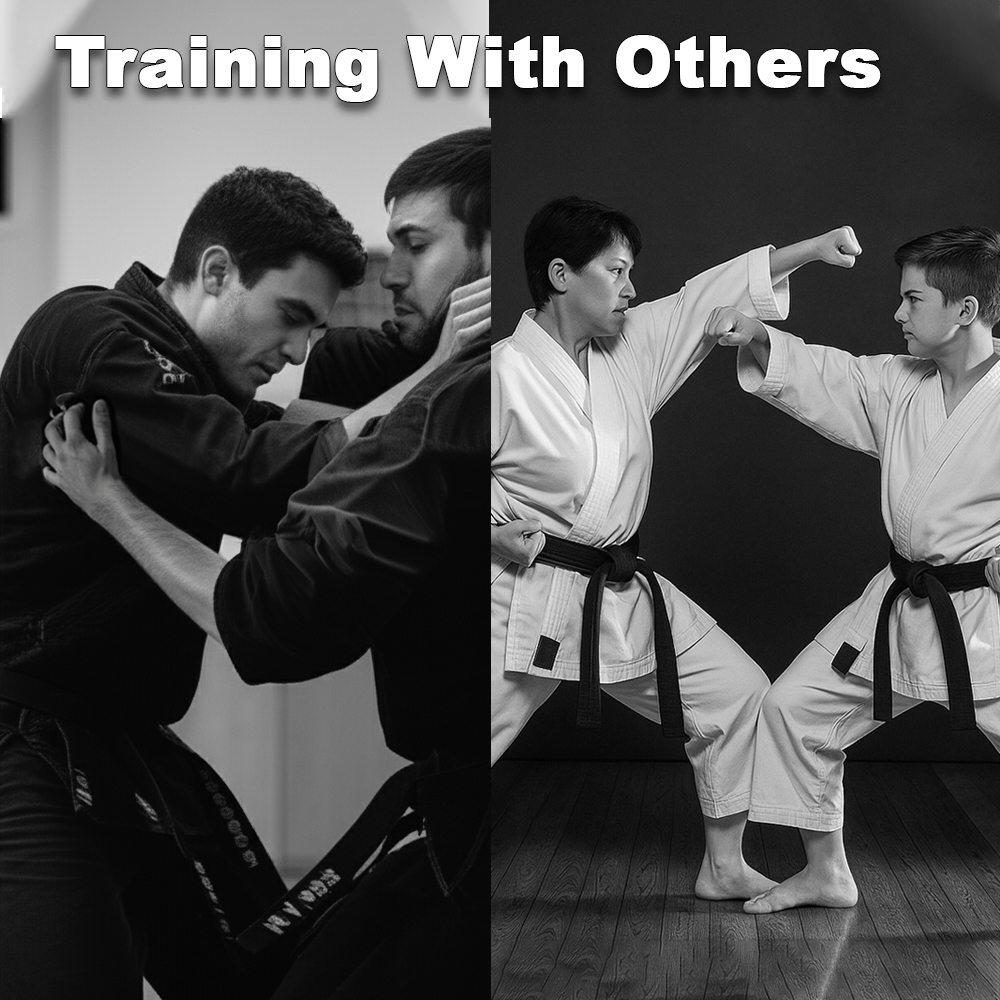
Cross-training does not always mean visiting another karate style either. There can be real value in stepping into something that deals with a problem your own training does not address particularly well. Judo can expose you to a different emphasis on gripping, balance and throwing, even where those things already exist within karate. BJJ can give you experience of ground control that may otherwise be missing. Boxing can sharpen timing, distance and dealing with punches under pressure.
But again, timing matters. If a student is still struggling to understand the basics of their own practice, adding several completely different systems can simply give them more information they are not yet equipped to make sense of. Once there is a reasonable foundation, though, those other methods can become extremely useful because the student has something to compare them with.
Without that, visiting several different instructors can become little more than collecting information. One person says keep your hands here. Another says keep them somewhere else. One says move this way. Another tells you the opposite.
The beginner may not yet have enough understanding to know that both answers can be correct. They may simply belong to different problems.
Cross-training should not mean replacing one set of unquestioned instructions with several competing sets of unquestioned instructions. The value comes from understanding why different people make different choices and whether what they do makes sense for the purpose they are training for.
There are organizations that discourage students from training elsewhere, and I can understand some of the reasoning. Beginners can easily become confused, especially when they are being shown things that conflict with what they are already learning.
There is, however, a difference between giving a beginner some stability and keeping an experienced student inside a closed system indefinitely. At some point, a serious practitioner should be able to look outside their own dojo and see how other people train, what they do differently, and perhaps discover that some of the assumptions they have worked under for years are not shared by everyone else.
Training with others does not automatically make us better, of course, but neither does staying in one place. The important thing is having enough grounding to judge what we are being shown rather than simply adding another method to the collection.
Perhaps that is where experience really begins to matter.
Help Keep Applied Methods Free
Applied Methods is independently written and freely available. If you enjoy the articles and would like to support the continued writing and upkeep of the site, contributions are always appreciated, but never expected.