Why a technique that works so well in modern karate may not always be the best choice for self-protection.
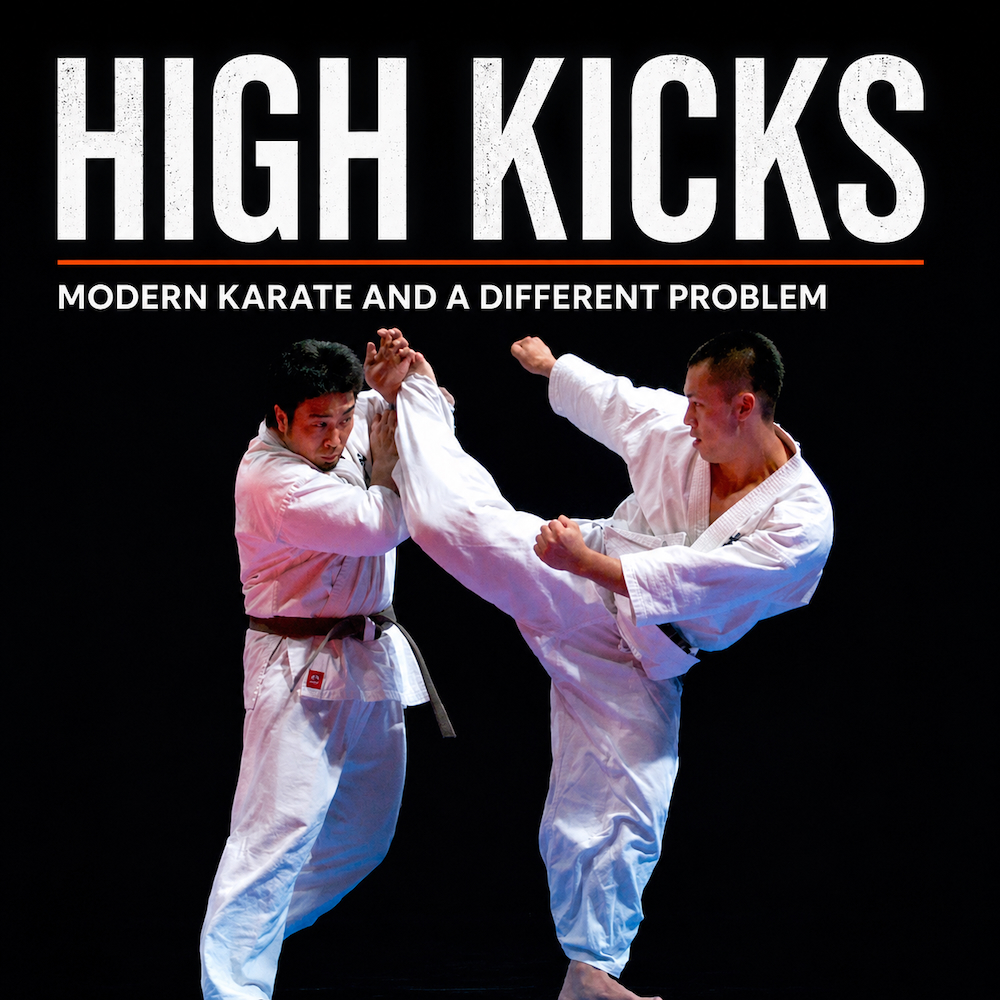
In my younger days, high kicks were something of a speciality of mine. I was very flexible and used them regularly in the dojo and in competition, often with considerable success.
If you had told me then that high kicks didn’t work in the real world, I would probably have argued with you.
In fact, I would still argue with you now.
They clearly can work.
I know several karate-ka who work on the doors and are very capable of using high kicks outside the dojo too. A fast, powerful kick delivered by someone who knows what they are doing can have a devastating effect.
So perhaps the more useful question is not whether high kicks work. It’s whether they are a particularly sensible choice for self-protection.
One kick that illustrates this rather well is mawashi geri.
The round kick has become such a normal part of karate that we hardly give it much thought. Walk into almost any modern dojo and you are likely to see it practiced in kihon, on pads and in kumite. In competition it can be extremely effective, particularly when delivered quickly to the head or into the thigh.
Yet, for all its prominence in modern karate, mawashi geri is not found in the older kata.
There are theories about where it entered modern karate, including the suggestion that it may have been influenced by French savate. Whether that can ever be established with certainty is another matter, but the absence of mawashi geri from the older Okinawan kata is difficult to ignore.
That contrast is interesting.
The older kata certainly contain kicks, but they are relatively few and generally low, direct and economical. We do not see kata filled with the high kicking actions that have become so familiar in modern karate.
That does not mean the old karate practitioners knew nothing of such kicks, nor does it mean every possible technique had to be recorded literally within kata.
But perhaps it tells us something about changing priorities.
Competition created a very different problem.
In a tournament, I know who my opponent is. There is usually space between us. The floor is flat. I am facing one person. There are rules governing what we can and cannot do, and both of us understand those rules.
Under those conditions, kicking is extremely effective.
Taking one foot from the floor for a fraction of a second to deliver a fast mawashi geri may be a perfectly reasonable exchange. But self-protection presents a different set of circumstances.
Most confrontations do not conveniently begin at kumite distance. They often begin much closer, perhaps at ordinary conversational range. The ground may be uneven or slippery, and there may be furniture, walls, curbs or other people around you.
You may not even know whether the person in front of you is the only person involved. In that environment, balance and mobility become extremely valuable. Every time we kick, however briefly, we surrender one of the two things keeping us attached to the ground.
That does not make kicking wrong. It simply changes the calculation.
Short kicks to the shin, ankle or lower leg, stamps to the foot, and similar actions can make considerably more sense at close range without requiring the space or commitment of a high kick.
None of this means mawashi geri should disappear from karate.
It is an excellent technique for the environment in which it is often practiced, and modern karate has produced some extraordinarily skilled kickers.
But perhaps its prominence tells us something important.
Methods tend to develop around the problems they are being asked to solve.
As karate became more concerned with competition, free sparring and longer-range exchanges, it is hardly surprising that techniques particularly suited to those conditions became more prominent.
And once those techniques became familiar, it became easy to assume they had always occupied the same place within karate.
The question, then, is not whether a high kick can work. We already know that it can.
Perhaps the better question is whether it is the right choice for the problem in front of us.
Help Keep Applied Methods Free
Applied Methods is independently written and freely available. If you enjoy the articles and would like to support the continued writing and upkeep of the site, contributions are always appreciated, but never expected.