
When testing becomes more about endurance than understanding, it may be worth asking what the student is actually learning.
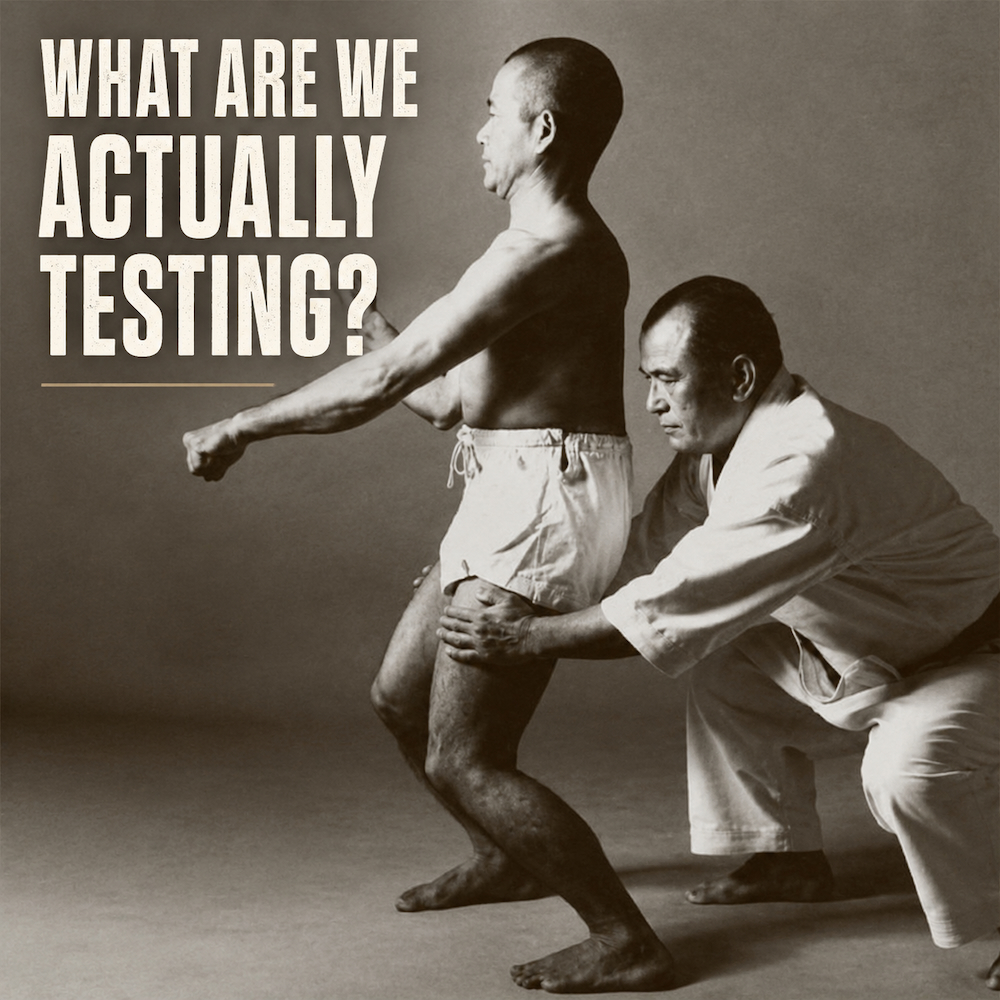
Sanchin kata is practiced in several karate traditions, and the testing associated with it is commonly referred to as shime. The person performing the kata may have their posture, balance, tension, breathing and structure checked as they move.
And sometimes they get hit.
There is nothing inherently wrong with that. The question is what the hitting is supposed to achieve.
I have watched Sanchin testing where that distinction seems to have become blurred. The practitioner stands there while somebody slaps, punches and kicks different parts of their body, sometimes with considerable force. Occasionally a shinai or some other implement is introduced.
It can look impressive.
But what are we actually testing?
If I hit someone hard enough and they remain standing, I have established that they can take the hit. Perhaps that is something I wanted to know.
But have I helped them understand Sanchin?
Or have I even helped them understand how to take a hit?
They are different questions.
Any testing should provide information the practitioner can use. If there is weakness in the posture, I want them to feel where that weakness is. If their structure collapses under pressure, I want them to understand why.
Is their alignment poor? Are they holding their breath in a way that interferes with movement? Is unnecessary tension appearing somewhere in the body?
The test should help expose it.
That requires rather more than simply hitting them harder.
Good testing, to my mind, is closer to investigation.
Pressure can be introduced progressively. The student can be pushed or pulled from different directions. Their posture can be checked while stationary and while moving. Resistance can be applied against the movements of the kata.
Impact can be introduced too, but it becomes another means of examining the structure rather than the whole exercise.
Most importantly, the student has to be able to learn from what happens.
If every test produces a sudden shock and an instinctive reaction as they are hit, there is very little opportunity to examine anything. The student may become better at enduring the test, but endurance and understanding are not necessarily the same thing.
The intensity should change with the person being tested as well.
A beginner does not need to prove they can withstand the same pressure as someone who has practiced Sanchin for twenty years.
The purpose is not for the instructor to demonstrate how powerful they are. The teacher already knows they can apply more force to a less experienced student. There isn’t much to learn from proving it. The useful part is finding the point where the student’s structure begins to fail.
Then we have something to work with.
Perhaps the foot shifts, or the knee collapses inward. Perhaps the pelvis changes position, the shoulders rise, the breathing stops, or tension appears where it isn’t needed.
Now the student can make an adjustment.
We can test it again.
Did it improve?
That, for me, is where shime becomes interesting.
The tester and practitioner are not really opponents at all. They are working together to discover something. One provides a problem and the other studies the effect it has on their body.
The aim isn’t to break the structure simply because you can. Anyone can have that effect on someone who is standing still.
It is to find where it breaks so the practitioner can build it better.
There is certainly a place for hard training. There may even be a place for being hit hard. I am pretty familiar with both.
But we should be clear about why we are doing it.
If the purpose of an exercise is study, then the test needs to give the student something worth studying.
Otherwise, all we may have demonstrated is that one person can hit and the other can endure it.
And I’m not sure that tells us very much about Sanchin, or anything else for that matter, because eventually everyone fails when they are hit hard enough.
Help Keep Applied Methods Free
Applied Methods is independently written and freely available. If you enjoy the articles and would like to support the continued writing and upkeep of the site, contributions are always appreciated, but never expected.
Outstanding article Adam.
The real objective and methodology of Sanchin Shime has been lost unfortunately.
Thank you for writing this.
Thank You. I appreciate your kind words. All the best.