
What resistance reveals about the difference between learning a method and being able to use it.
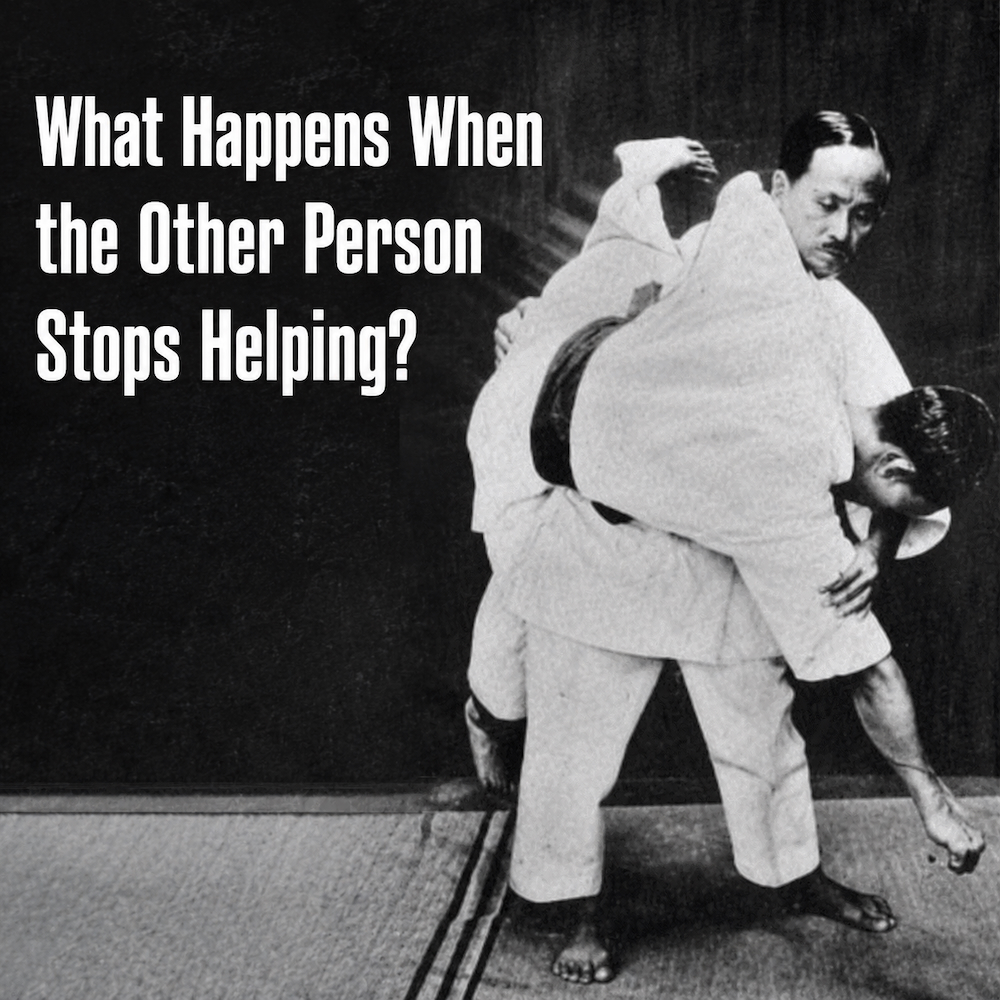
If we say that what we teach has a self-protection purpose, then sooner or later our training partner has to stop helping us.
Of course, when someone is first learning a drill there has to be some cooperation. They need the chance to understand what is happening and what they are trying to achieve.
That doesn’t mean standing there like a mannequin, but there isn’t much point in trying to overwhelm somebody before they have even got the idea.
I remember two fairly burly students of mine working on a drill a little while ago.
They started slowly enough and everything looked fine. Then the pace began to creep up. A bit more strength went in. Then a bit more again.
Before long, neither of them seemed particularly interested in the drill anymore. Neither wanted to give anything away and it turned into what I can only describe as a very rough wrestling match.
Everything they had just been working on disappeared.
They hadn’t forgotten the drill. Only a few minutes earlier they had been doing it perfectly well. What changed was the pressure and the resistance.
So the question becomes, what happens to a method when the other person stops helping you perform it?
That is something I think we have to include in our training. A lot of things work when the partner maintains the position we need. Nobody tries to recover their balance or spoil what comes next.
It’s useful while we are learning, but sooner or later some of that cooperation has to disappear. And this is where I think another problem can creep in.
Resistance doesn’t mean doing exactly the same technique harder and faster.
If the other person starts moving, resisting or changing what they are doing, then what we do may have to change as well.
That seems obvious, but we don’t always train that way.
Sometimes techniques are treated almost as though they have to be preserved, as though it is set in stone. You start with movement one, then movement two, then movement three, regardless of what the other person is doing.
But people don’t behave like that.
If I pull you, you will probably react to being pulled. If I knock you off balance, you will try to regain it. If something lands, your posture and position will change.
That changes what is available next. The original technique may still be there, but it might not be. Something else may present itself instead.
For me, that is where the training starts to become useful. Not when we can make a technique look good on somebody who is helping us, but when we can keep working when things stop going according to plan.
That doesn’t mean throwing two people together and telling them to fight it out. My two students demonstrated pretty clearly where that can end up.
Resistance has to be introduced gradually, otherwise strength and competitiveness can take over and the whole purpose of the drill gets lost.
But it does have to be introduced. Sometimes your partner needs to make things awkward. And sometimes what we were trying to do should fail.
Because failure tells us something.
It may show that the idea needs adjusting, or that another option was available. Or it may simply show that under a little more pressure we went straight back to whatever felt most familiar.
That is useful information too.
We cannot recreate real violence in the dojo, and I don’t think pretending that we can is particularly helpful. But we can make the training less cooperative and get a bit closer.
And at some point we should.
Otherwise, we may only be finding out how well our methods work when the other person allows them to.
Help Keep Applied Methods Free
Applied Methods is independently written and freely available. If you enjoy the articles and would like to support the continued writing and upkeep of the site, contributions are always appreciated, but never expected.
Good article. Resistance training is vital, and increasing it slowly is also key, but resistance knowing what the technique is is tricky too. If i know what youre trying to do i can probably stop yiu easily, that leads to sparring, and thats not really what you want for self defence. Tricky!
2 points here… The problem with “set moves” when studying together, the opponent knows what’s coming.
Secondly if you control the enemy before they arrive, they cannot attack. Many schools do the I punch you punch routine, but the deeper study is control before you get there, so they don’t have a punch …