Training should refine natural movement, not replace it with something artificial.
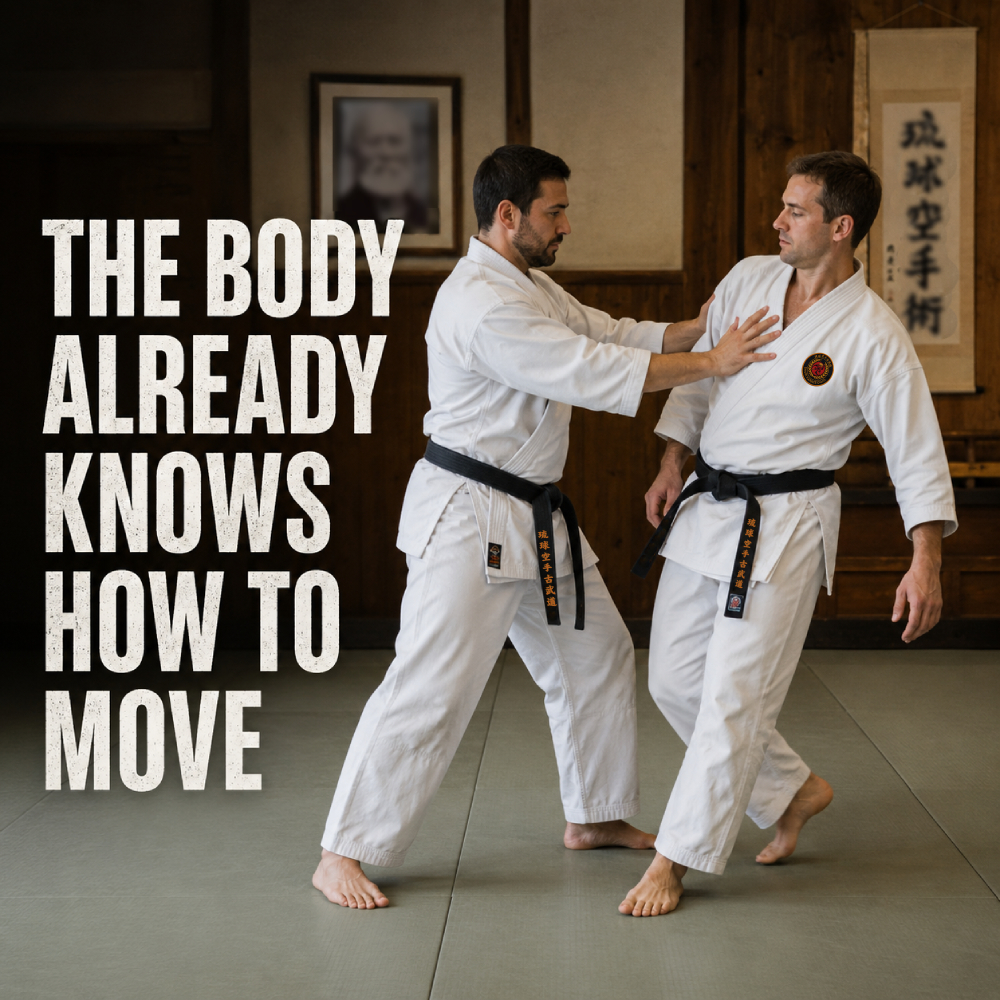
There are some things nobody really teaches us.
Lose your balance unexpectedly and your body will immediately try to save you. A foot moves, your arms come out, you twist, bend, step or grab something.
You don’t stop to think about it, or tell yourself where the foot should go or what angle the knee should be at. You just try not to fall over.
Sometimes it works, sometimes it doesn’t, but the response is already there.
I think we forget this when we train.
We can become so concerned with teaching people the correct way to move that we overlook the fact that the body already knows quite a lot about movement.
Nobody had to teach you how to duck when a ball came towards your face, or that if someone pushed you hard enough, you needed to move your feet.
You knew.
Of course, natural doesn’t mean perfect.
That’s where training comes in.
Training should improve what is already there. Make it faster, stronger, better balanced, better timed and more useful.
But sometimes we seem to do the opposite.
We teach people positions.
Put your foot here. Turn it to this angle. Bend the knee this much. Put the hand there. Make the stance longer, no, more. Lower. Wider.
Then we spend years practicing those positions until they begin to feel natural.
But they weren’t natural to begin with.
Think about that for a moment.
If someone suddenly shoved you backwards, would your body drop into the stance you have spent years practicing?
Probably not.
It would move however it needed to move to stop you falling over.
And that doesn’t mean the stance is useless. It means perhaps we should understand why the stance is there in the first place.
A stance isn’t somewhere to stand. It is what happens while we are doing something.
Pulling someone. Pushing them. Turning them. Striking them. Trying to keep our balance while taking theirs.
The position comes from what you are trying to do.
Not the other way around.
I think this matters with kata too. Too often we try to make the body fit the kata. Perhaps we should sometimes let the purpose of the movement decide how the body moves.
If I am pulling someone off balance while hitting them, I don’t need to think about whether my stance is inch perfect.
I need to move them.
If I am trying to hit before they can hit me, I don’t need to think about building the stance first.
I need to hit them.
The body will organize itself around that goal, especially if the training has taught it how to do so efficiently.
That is where practice matters. Not because the body knows nothing, but because it already knows something.
We are trying to improve that something.
I sometimes wonder whether we make martial arts harder than they need to be because we spend so much time teaching people how they are supposed to move instead of giving them a problem and letting movement develop from it.
That doesn’t mean anything goes. It doesn’t mean technique doesn’t matter. It means technique should help natural movement, not fight against it.
Perhaps good training is not about teaching the body an entirely new language.
It’s about helping it speak the one it already knows, just a little better.
Help Keep Applied Methods Free
Applied Methods is independently written and freely available. If you enjoy the articles and would like to support the continued writing and upkeep of the site, contributions are always appreciated, but never expected.