What repetition teaches us, and what can happen when something changes.
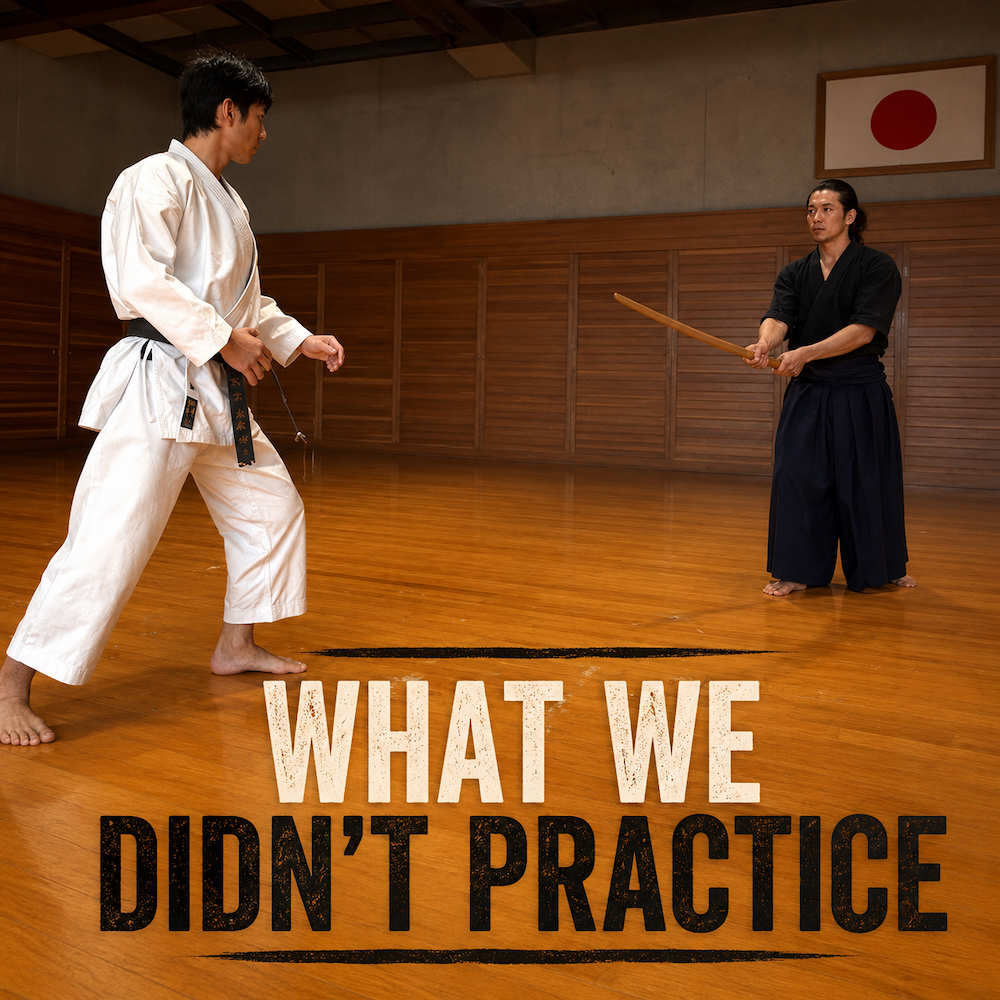
When I opened my dojo back in the UK in the 1980s, it was located in an athletics gymnasium.
We had advertised around the village for a few weeks beforehand, hoping to generate some interest, and by the time opening night arrived we had a mixture of people who had already decided to join us and others who had simply come along to see what we were doing.
My brother and I decided we needed a demonstration. And, being young martial artists, naturally we didn’t choose anything sensible.
We decided to demonstrate empty hand against a katana.
You know what’s coming, right?
We wanted to show some of the spectacle and fantasy through which martial arts were often popularized at the time. We weren’t pretending that somebody wandering around the village with a samurai sword was a particularly pressing self-protection concern.
We wanted it to look impressive.
For weeks beforehand, my brother and I practiced the demonstration using a bokken.
The sequence was carefully rehearsed. He would attack, I would evade and counter, eventually ending with me taking him to the floor, disarming him and finishing by striking back at him with his own sword.
It looked good. At least we thought it did.
The intention was that when we performed it publicly, we would replace the bokken with a real katana.
As the demonstration got closer, though, a little voice started nagging at me.
A bokken can hurt you. A katana, on the other hand, can do something considerably worse.
There was one particular part that concerned me. At the end of the sequence my brother would be lying flat on his back while I took the sword from him and struck downward towards his head.
At every practice session I told him the same thing.
“Remember, when we do this with the live blade, keep your head flat on the floor. Every time.”
And he did. Every single time.
Nevertheless, a few days before the demonstration I changed my mind.
We weren’t going to use the katana.
My brother was disappointed. He was the one using the sword and, after weeks of practice, had become pretty confident with the whole thing.
Perhaps we both had. Provided everything happened exactly as we had practiced it.
On the night, the demonstration went really well. Right up until the final part.
I took my brother to the floor, disarmed him and struck downward with the bokken exactly as I had done countless times before.
Except this time his head wasn’t flat on the floor.
It was perhaps two inches higher.
Maybe nerves got the better of him, or perhaps he instinctively lifted his head to see what was happening. Maybe he just wanted to watch that part of the demonstration himself.
Whatever the reason, those two inches were enough.
I hit him hard across the forehead with the bokken. There was a very distinctive crack, and everyone watching gasped as they heard wood against wood.
My brother survived with a bruised forehead and, fortunately, little more than injured pride.
I also learned something.
We had practiced that demonstration over and over again. We knew the movements, the timing, the distance. We knew exactly what the other person was going to do.
And that was the problem.
We had rehearsed everything except something different happening.
Every martial art uses drills, and that alone should tell us that drills have value.
They do.
A drill is a learning environment. It allows us to isolate something and work on it without all the uncertainty that would otherwise surround it. We can develop timing, coordination, balance, mechanics, recognition and movement through repetition.
That’s useful. In fact, it’s necessary.
But repetition does something else too. It creates familiarity, and familiarity can quietly become expectation.
If the same attack comes from the same distance, with the same timing and the same rhythm, followed by the same response, we become increasingly good at operating within those conditions.
That doesn’t necessarily mean we are becoming increasingly good at dealing with what happens when those conditions change.
Sometimes the change doesn’t need to be dramatic.
A foot is somewhere slightly different. The person is a little closer, or the attack comes faster than expected. Maybe they move when they usually remain still.
Or someone’s head is two inches higher than it has been during every previous repetition.
Suddenly the familiar answer may no longer fit the question.
This doesn’t make drills useless. Far from it.
The problem comes when we become highly skilled at performing the drill but forget what the drill was supposed to help us develop.
And that distinction matters.
The other person has to be where they are supposed to be.
But someone who is untrained doesn’t know where our drill says they should be. They don’t know what movement is supposed to come next.
And occasionally, even when they do know, they still do something different.
My brother certainly did.
We had practiced that demonstration hundreds of times. What we hadn’t practiced was his head being two inches higher.
Perhaps that is one of the things drills should eventually teach us. Not simply how to repeat the answer.
But how to recognize when the question has changed.
Help Keep Applied Methods Free
Applied Methods is independently written and freely available. If you enjoy the articles and would like to support the continued writing and upkeep of the site, contributions are always appreciated, but never expected.