Sometimes self-protection is not about what you can do physically, but whether you can prevent the situation from becoming physical at all.
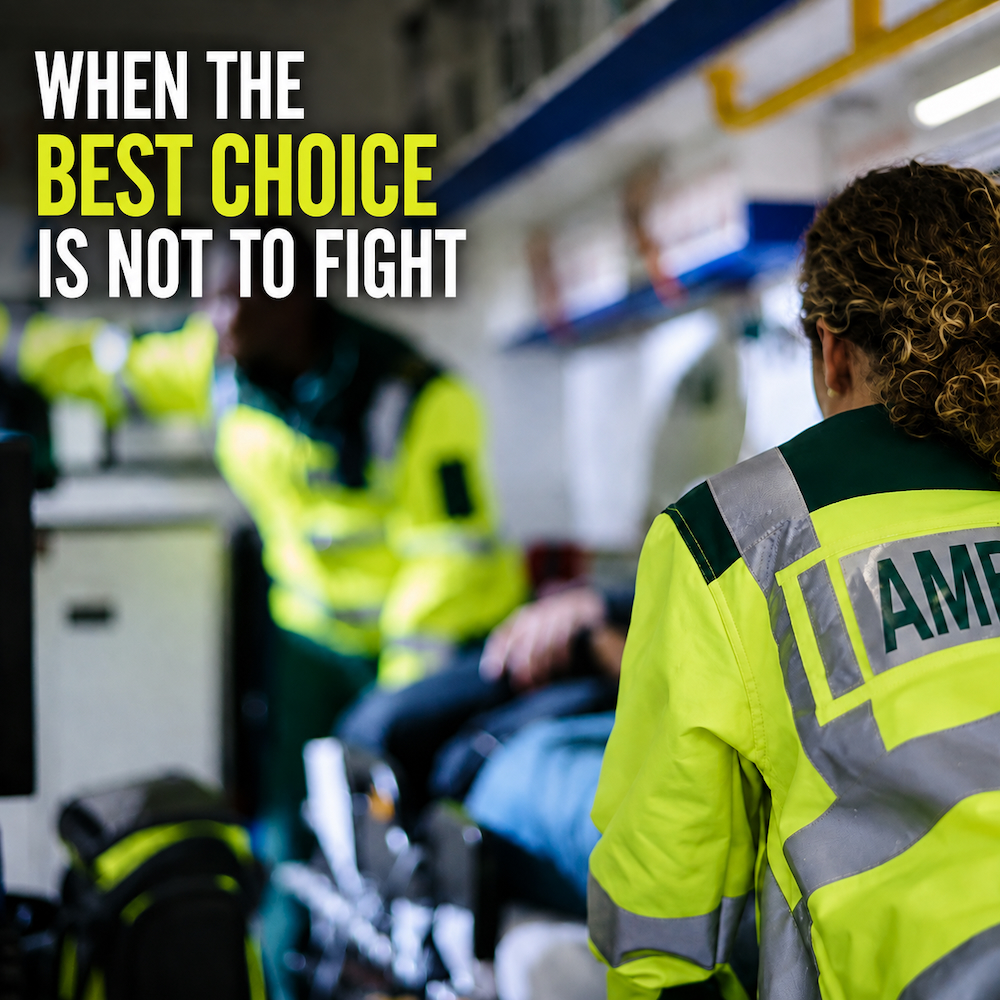
Choosing your battles wisely isn’t just a saying. Sometimes it is a practical skill, and one that can mean the difference between escalation and resolution, between staying safe and making an already difficult situation worse.
When I joined the ambulance service and began my training, one part of the curriculum was conflict management. It wasn’t a huge focus, more of an additional module, but it was something we were expected to understand. By that point I had already been training in martial arts for more than four decades, and the instructors were well aware of my previous career background.
During one of the sessions, the trainer approached me with a scenario.
“You’re about to go into this room blind,” he said. “You won’t know who or what is in there, but no matter what happens, you are not permitted to use your previous skills.”
In other words, I was being told not to fight back.
At first it sounded almost ridiculous. Here I was with decades of martial arts training and other experience behind me, being deliberately told not to rely on any of it. But that was precisely the point of the exercise. They weren’t trying to teach me how to win a confrontation. They were trying to teach me how to manage one without allowing it to become physical in the first place.
The ambulance service actively discouraged us from using physical skills unless there was no other option. Our job was to treat people, not fight with them, and becoming physically involved could easily make an already difficult situation worse.
That did not mean ignoring danger or pretending that violence could not happen. Unfortunately, health workers regularly find themselves in volatile and sometimes dangerous situations. Friday and Saturday nights could be especially interesting, although almost any shift could produce something unexpected.
Alcohol, drugs, fear, anger, confusion and heightened emotions could all be part of the situation we were walking into. Sometimes you had very little idea what was waiting for you on the other side of a door.
That was where the conflict management training became important. The temptation when you sense trouble can be to prepare immediately for confrontation. Your attention changes, your posture changes, and your tone of voice can change too. The other person may notice all of it, and without meaning to, you can begin contributing to the very confrontation you are trying to avoid.
The skill was learning to remain aware without becoming confrontational.
Maintain distance where possible. Watch what is happening. Communicate clearly. Avoid unnecessary challenges. Reduce the temperature of the situation rather than raise it.
I remember one Saturday night call in particular. We had been called to a man who had collapsed in a public square, but when we arrived we found ourselves surrounded by an angry and heavily intoxicated crowd.
It was not a comfortable situation, and there were plenty of reasons to become defensive. It would have been very easy to let adrenaline start making decisions for us, but fighting with the crowd would have achieved nothing. We still had a patient who needed help.
So we talked to them, stayed calm and avoided turning their aggression into a contest. Eventually the situation settled enough for us to concentrate on the person we had actually been called to help.
There was nothing spectacular about it. Nobody was thrown to the ground, nobody was restrained, and no clever martial arts technique saved the day.
Sometimes a successful outcome is the confrontation that never happens.
I think this is something worth remembering in martial arts. We spend a great deal of time learning what to do when physical conflict begins. We learn how to strike, control, escape and protect ourselves, and all of that can matter.
But what happens when the situation requires something else?
What happens when hitting someone would make matters worse, when walking away is available, or when your ego wants to respond but there is no real need to?
What happens when the safest solution is simply to remain calm, create distance and refuse to be drawn into someone else’s aggression?
Those are self-protection skills too.
Perhaps one of the problems is that martial arts can make physical answers very easy to imagine because we practise them constantly. When confrontation appears, those answers are already familiar to us.
But having the ability to fight does not mean fighting is always the best option.
Sometimes the greater skill is recognizing that there is no battle worth having.
So perhaps the question is not simply, what can you do when somebody becomes aggressive?
It is also this:
What are you going to do when the situation demands a no-fight approach?
Because if physical confrontation is the only answer our training gives us, our options are probably much narrower than we think.
And for those working in healthcare, one point should not need saying at all: aggression and violence toward health workers are never acceptable.
Help Keep Applied Methods Free
Applied Methods is independently written and freely available. If you enjoy the articles and would like to support the continued writing and upkeep of the site, contributions are always appreciated, but never expected.