
How the development of Karate-Do changed the way kata is taught
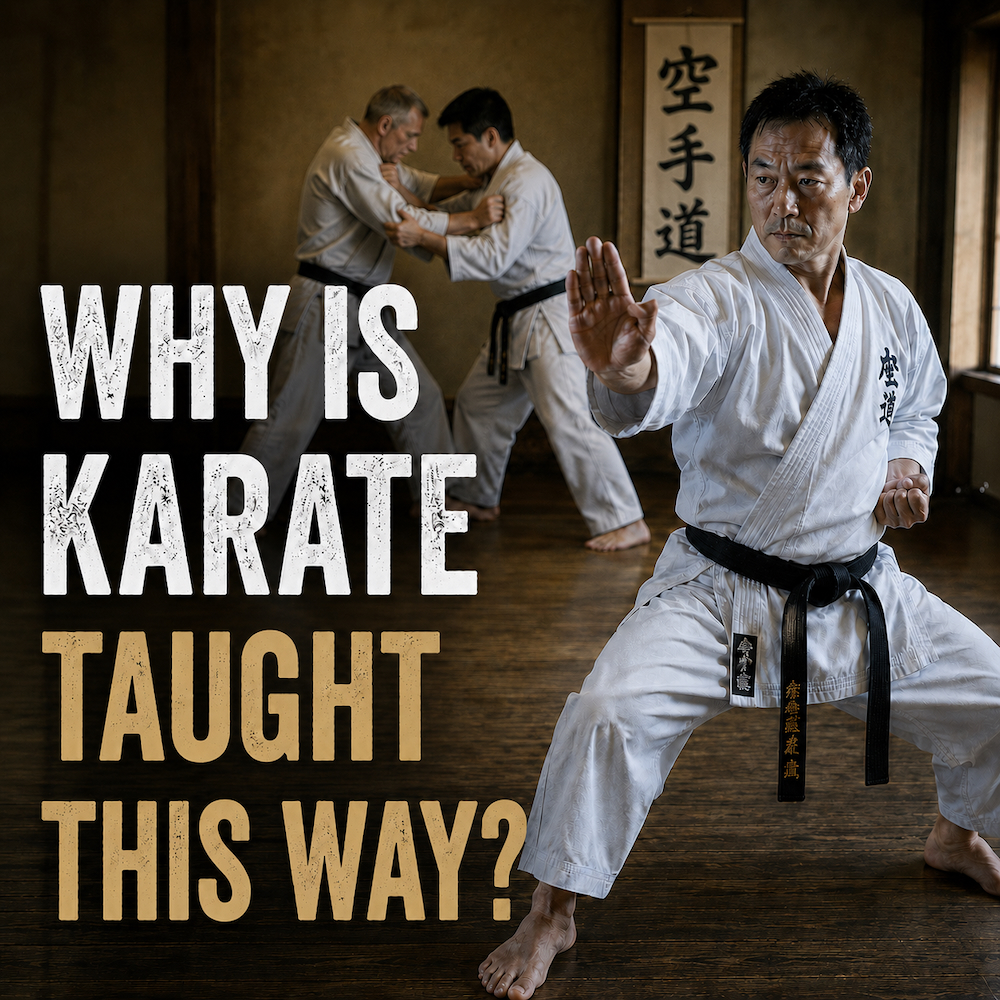
Because this is how Traditional Karate-Do developed.
If someone who knows little about karate asks what we practice, we are often quick to explain that it is not simply fighting. There is discipline, refinement, etiquette, history and personal development. It can improve concentration, health, confidence and character.
There is nothing wrong with any of that.
But many practitioners also want to believe that what they practice contains highly effective fighting methods. We want karate to be both things at once: a sophisticated art concerned with personal development and a practical method capable of dealing with violence.
Perhaps it can be both.
But they are not necessarily the same thing.
Karate did not always exist in the form in which most people practice it today. As it moved into schools, universities and wider public practice, its priorities changed.
It became teachable to larger numbers of people, more structured and standardized, and suitable for regular practice. Physical education, discipline, character development and eventually competition became increasingly important.
Karate became Karate-Do.
That transition allowed karate to spread throughout Japan and eventually around the world.
But when the purpose of something changes, the way it is taught usually changes with it.
And this brings us to kata.
The kata remained. The movements and sequences remained. But the method by which people learned from them did not necessarily remain intact.
For many practitioners today, kata is primarily something to learn, remember, improve and perform at the next grading.
Then, separately, we attempt to explain what the movements might mean.
That may be almost the reverse of how the practical information originally developed.
If kata preserved methods that arose from two-person practice, then the movements are not necessarily the method itself. They are a record of the method.
And possessing the record is not the same as knowing how to read it.
This may explain something I have wondered about for many years.
Why can someone spend decades practicing kata yet still find many of its movements difficult to explain in a practical context?
Perhaps the problem is not the kata, but the way we have been taught to interact with it.
We become very good at learning the choreography while assuming that understanding the choreography will eventually reveal the method.
But it may not.
To understand kata practically, we may need a different skill: the ability to take the movements back into partner practice, test them, question them, alter distance and position, introduce resistance and discover what the movement is actually doing.
In other words, we have to learn how to learn from kata.
I was talking recently with a senior karate instructor about science and belief, and something from that conversation stayed with me.
If we are discussing science, we can argue about evidence. We can examine the information, challenge the methodology, produce other evidence and perhaps change our conclusions.
Belief is different.
Someone may simply say, “That is what I believe.”
The problem comes when something we believe starts to be treated as fact, simply because it has been repeated for long enough, because our instructor taught it to us, or because we want it to be true.
Karate is particularly vulnerable to this.
Someone shows an application for a kata movement. It looks plausible. Their instructor taught it to them, and their instructor learned it from somebody else. Eventually the explanation acquires history and authority.
But none of that demonstrates that the explanation represents the original purpose of the movement.
The important question is whether we are prepared to test it.
Kata comes from a martial tradition, and I believe its movements preserve practical methods. But that does not mean every explanation we attach to those movements is necessarily correct.
We can find ourselves working backwards from belief. We decide what a movement means, then search for a way to make that explanation work.
That is very different from testing the movement and allowing the evidence to lead us toward an answer.
That is not really investigation.
It is confirmation.
The pioneers who helped develop modern Karate-Do accomplished something remarkable. They helped transform a relatively localized practice into an art capable of being taught to huge numbers of people across generations and cultures.
But we should not assume that nothing changed in the process.
When karate changed, its methods of teaching changed, and the relationship between kata and application may have changed with them.
The kata survived.
That does not automatically mean that every practitioner inherited the method by which those kata were once understood.
So perhaps the question should not simply be:
Why don’t people understand kata?
Perhaps a better question is:
Were they ever taught how to learn from it?
Because learning a kata and learning from a kata are not the same thing.
If the practical information contained within kata originally came from two-person methods, then standing alone and repeating the sequence more accurately will only take us so far.
At some point, the movements have to be returned to another person. They have to be questioned and tested.
Only then do we begin to move from practicing the record toward understanding the method it preserves.
So why is karate taught this way?
Because Traditional Karate-Do is taught this way.
Help Keep Applied Methods Free
Applied Methods is independently written and freely available. If you enjoy the articles and would like to support the continued writing and upkeep of the site, contributions are always appreciated, but never expected.
Very useful note.