
Why awareness should remain after the technique has finished
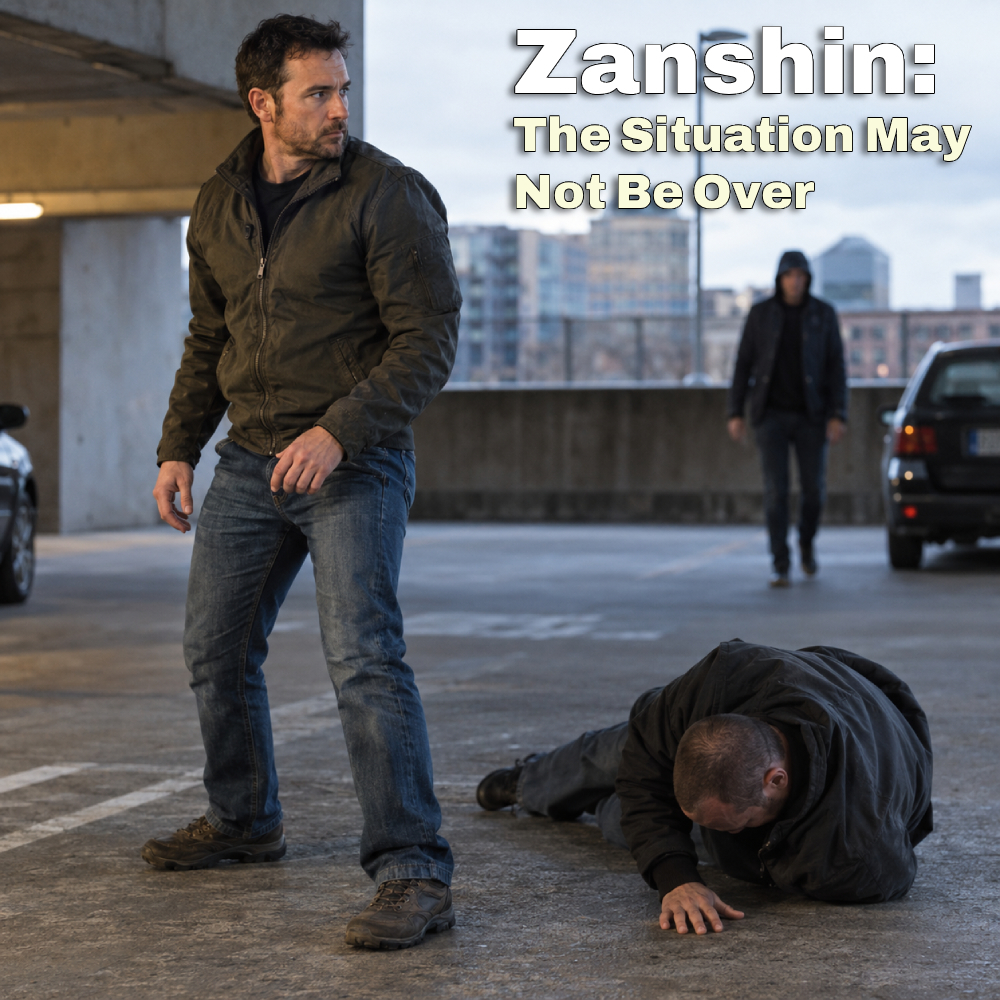
Zanshin (残心) is often translated as “remaining mind” or “lingering mind.” In martial arts, it refers particularly to maintaining awareness and readiness after an action has been completed.
However, it is often explained simply as staying alert or being aware.
And of course, awareness is important throughout. Before something happens, while it is happening, and afterwards. So when instructors use zanshin as a general reminder to “be aware”, I understand what they mean.
But zanshin has a more particular emphasis. It is the awareness that remains. The action has taken place, but mentally and physically we have not simply switched off.
As an example, someone throws a punch. You respond. But that isn’t necessarily the end.
You put someone down. That isn’t necessarily the end either.
You create space and manage to disengage. Even then, the situation may not be over.
The other person may get back up. There may be someone else involved. A weapon may appear. You may suddenly realize that you have been injured. The environment around you may have changed in a way you did not notice while everything was happening.
The movement may have finished.
But the situation may not have.
This is where I think zanshin becomes particularly relevant to self-protection.
In training, it is very easy to become conditioned to artificial endings. A technique is completed, the partner stops, and everyone resets. We return to our starting positions and do it again.
There is nothing necessarily wrong with that. Training has to be structured somehow.
But problems begin when the structure of the drill starts to influence the way we think.
If we become accustomed to the idea that a successful movement means the problem is finished, we may unconsciously begin to expect the same thing outside the dojo.
Reality does not always cooperate.
A punch may land and have very little effect, or a throw may put someone on the ground without removing the threat. The person who appears finished may suddenly continue, or someone you did not even know was involved may step in.
This is one of the reasons I dislike thinking of kata movements as isolated techniques with clear beginnings and endings.
The movement is only one part of an interaction.
What matters is what happens next.
That may mean continuing to control the other person. It may mean moving away, changing position, finding an exit, checking the environment, or simply recognizing that what you just tried didn’t work.
Zanshin, then, is not about posing after a technique or looking serious and focused.
It is about not mentally switching off simply because you have completed the movement you intended to make.
In training, people are often taught to finish a sequence, apply kime, hold the final position, and then demonstrate zanshin. Done properly, that can reinforce continued awareness and composure.
Awareness should not suddenly begin after the technique.
It should remain throughout the whole exchange, allowing us to recognize whether the situation has changed, whether what we attempted actually worked, and whether anything further is required.
That does not require tension or hypervigilance. In fact, excessive tension can make awareness worse. A person who becomes fixated on one thing may fail to notice everything else.
Zanshin is better understood as continued engagement with the situation, without assuming the problem has been solved simply because a movement has been completed.
Because in self-protection, one of the most dangerous assumptions we can make is that the situation ended simply because our technique did.
What is it about zanchin (sanchin to me) that teaches that? Do you see it in the many repeated techniques? Or in specific techniques within the kata?
I’m fascinated that kata always have more doors to open beyond the last one.
I think there’s confusion on your part between zanshin and Sanchin. I’m not referring to Sanchin kata. Zanshin is the awareness and readiness that remains after an action, which is what the article is about, not kata.