Why familiar mechanics can mean different things in different contexts
The commonality of technique across the martial arts is that they all make use of biomechanics and the strengths and weaknesses of human anatomy. Where the various arts differ is in the rules, the goal and, most importantly, the context for which they are trained.
In competition, tournaments and consensual fights, you have agreed to engage. You are trying to win, and both people understand, at least broadly, what is taking place.
Self-protection is different.
The aim is not to win a fight. It is to deal with a dangerous situation as quickly as possible and, where possible, escape from it. If physical action cannot be avoided, the encounter is not consensual. You did not agree to fight.
That difference in objective changes the tactics.
There may be common movements and common mechanics, but that does not mean every method applies equally well in every situation. The body may move in similar ways, but the problem being solved can be very different.
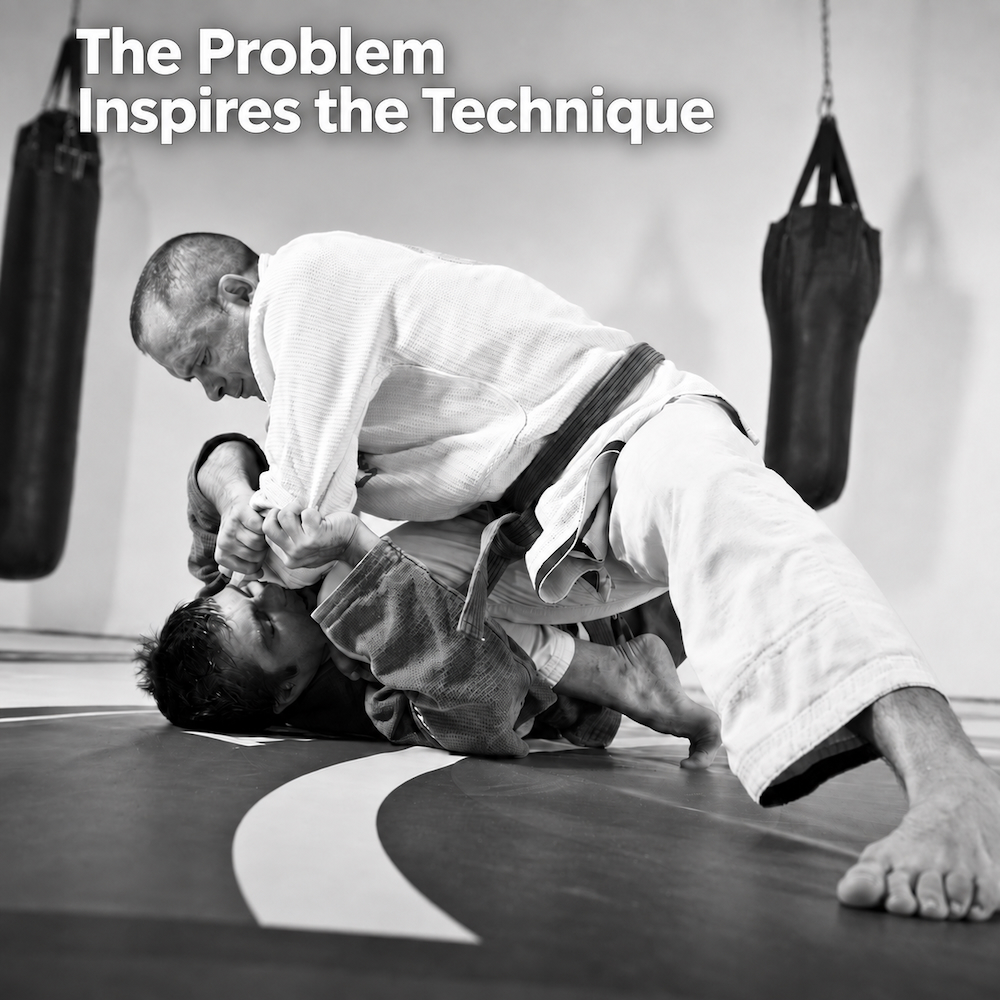
The problem inspires the technique.
Many martial methods developed as answers to particular problems. If a method survived, it was usually because someone found a useful way of applying familiar mechanics to the circumstances they faced.
The circumstances matter.
A person standing in front of you with their hands raised, ready to exchange punches, presents one kind of problem. Someone grabbing your clothing, crowding you against a wall, attacking unexpectedly or preventing you from leaving presents another.
The mechanics available to the human body have not changed, but the tactical demands certainly have.
Early in martial arts training, we often work from relatively favorable positions. We know an attack is coming. We have space. Our hands are prepared. We may already be in some form of fighting stance.
That is useful for learning.
But it can also become limiting if we begin to assume that every movement must be understood from that same position.
If we only understand a technique by its outward appearance, it is easy to see everything as simply punching, kicking and blocking. Looking instead at the mechanics and principles behind a movement gives us a better understanding of where it may be useful and, just as importantly, where it may not.
A common technique does not mean a common approach.
Sometimes the same movement can have several related applications. The mechanics remain much the same, but the emphasis changes according to distance, position, intent and what the other person is doing.
This is why the phrase, “that wouldn’t work in…” can sometimes miss the point.
Perhaps it wouldn’t. Maybe it was never intended to.
A movement designed for one problem should not automatically be judged by how well it solves another.
Not everything can be applied in the same context, and not every method should be expected to work everywhere in exactly the same way.
Understanding context is part of understanding the method.
The same mechanics may appear in sport, training and self-protection, but the objective, priorities, risks and tactics can be very different.
What do you see in the photo above?
A grappling position?
Or do some of the body mechanics look more familiar than they first appear?
The context may change, while the mechanics remain remarkably similar.