Why getting it right once is only the beginning
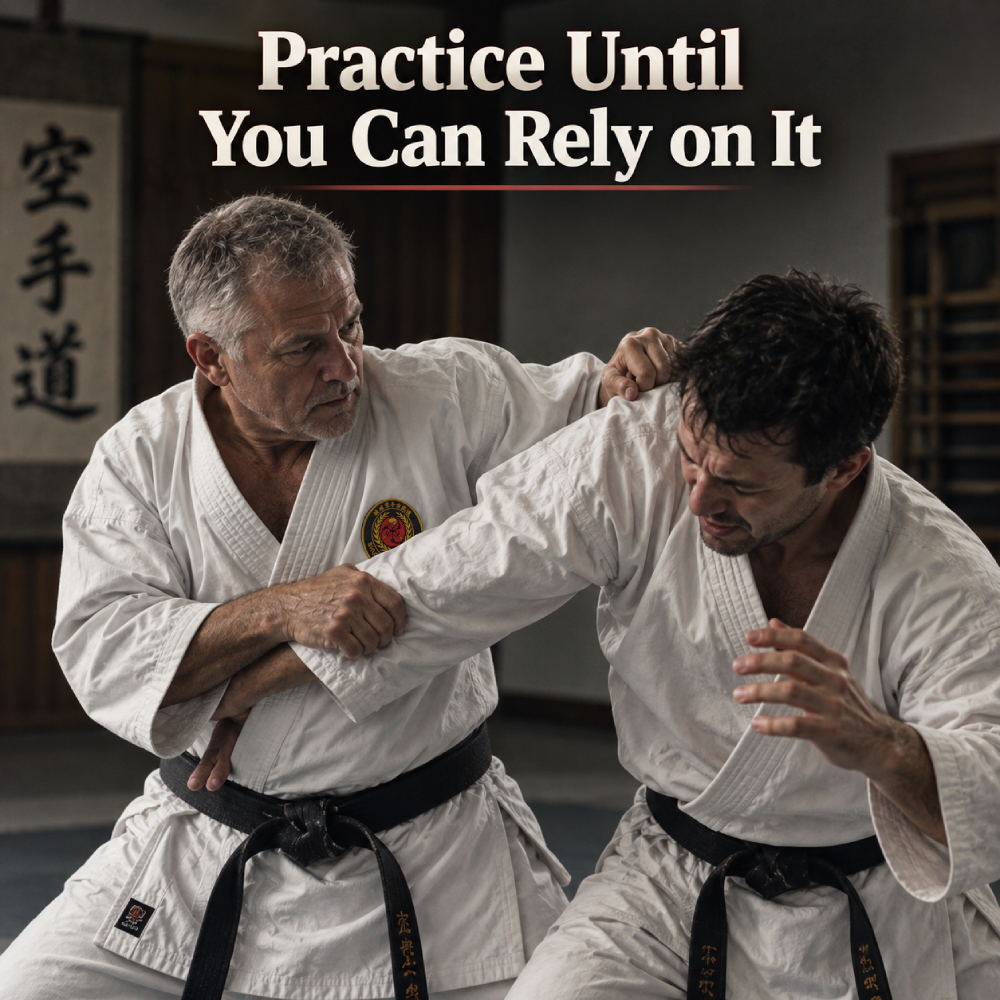
One of the things I’ve learned over the years is that there is a considerable difference between being able to do something and being able to rely on it.
When we first learn a skill, there is usually a point where everything finally comes together. The movement works, the drill makes sense, we complete the kata without hesitation. That first success feels important, and it is, but it can also be misleading.
I see students do this quite often, moving their attention elsewhere once they have achieved that first success.
But getting something right once only proves that you were capable of doing it once. It does not necessarily mean that you have learned it well enough to reproduce it consistently, and it certainly does not mean that you can rely on it when the circumstances change.
For years I have used the phrase:
Don’t practice until you get it right. Practice until you can’t get it wrong.
I still like the sentiment behind it, although these days I would probably qualify it a little.
There will always be circumstances in which we get something wrong. Fatigue, fear, surprise, poor positioning, resistance, or simply dealing with someone bigger, stronger or more determined can all change what happens.
No amount of practice makes failure impossible. The real objective, therefore, is not to reach a point where we literally cannot get something wrong. It is to practice until the skill becomes reliable enough that we have a reasonable chance of using it when we need it.
That requires more than repetition.
Repetition is important, particularly when learning something new. We need enough good practice to become familiar with the movement. But endless repetition under exactly the same conditions can create another problem: we can become very good at performing the drill without necessarily becoming good at using the skill the drill was intended to develop.
Once the basic movement is familiar, the conditions need to change. The partner moves differently, the distance alters, resistance increases, the attack does not arrive exactly as expected. Eventually, some pressure is added.
And somewhere in that process, things begin to fail.
Failure shows us what doesn’t work. It gives us something to learn from.
I believe that good training should also develop a culture of contingency.
If a primary tactic fails, that failure should not cause panic. Training should help us become accustomed to that possibility, maintain clarity under stress, and continue working from whatever position we find ourselves in.
That should not bring everything to a stop.
The important question is what happens next.
If students are only ever successful in training, they can easily develop the impression that success is how things are supposed to unfold. When something fails under pressure, the failure itself can become the surprise.
I would rather students experience that uncertainty in training, where a failed attempt can become the starting point for the next decision rather than a reason to freeze because the first action didn’t work.
This is where practice begins to move beyond simply reproducing a movement and towards developing an adaptable skill.
A student performing a technique perfectly against a compliant partner may understand the mechanics extremely well. But if the movement disappears the moment the partner resists, there is still more work to do.
This is why I have always been uncomfortable with the idea that capability is enough.
Capability is useful. It tells us that the student can perform the skill. But being able to do something and being able to depend upon it are not quite the same thing.
Skill develops through continued practice, but that practice should also develop with us. In the beginning we may need cooperation, then variation, resistance and uncertainty. Eventually we need enough pressure to discover whether what we have learned remains available when things become difficult.
This does not mean every repetition has to become a fight, nor does it mean beginners should immediately be thrown into resistance they are not prepared for. There is a progression.
If training never moves beyond the conditions in which the skill was first learned, we may become extremely competent at performing the exercise without ever discovering how dependable the skill really is.
That, for me, is the important distinction.
Practice is not simply about accumulating repetitions. It is about taking something we can do and gradually turning it into something we can rely upon.
And part of that reliability comes from learning what to do when things do not go according to plan.
So perhaps the old saying still works, provided we understand what it really means.
Don’t stop because you got it right once. Keep going until what you have learned is no longer something you merely remember how to do, but something you can reasonably expect to be there when you need it.