A small symbol of identity, belonging, and the responsibility that can come with representing your dojo.
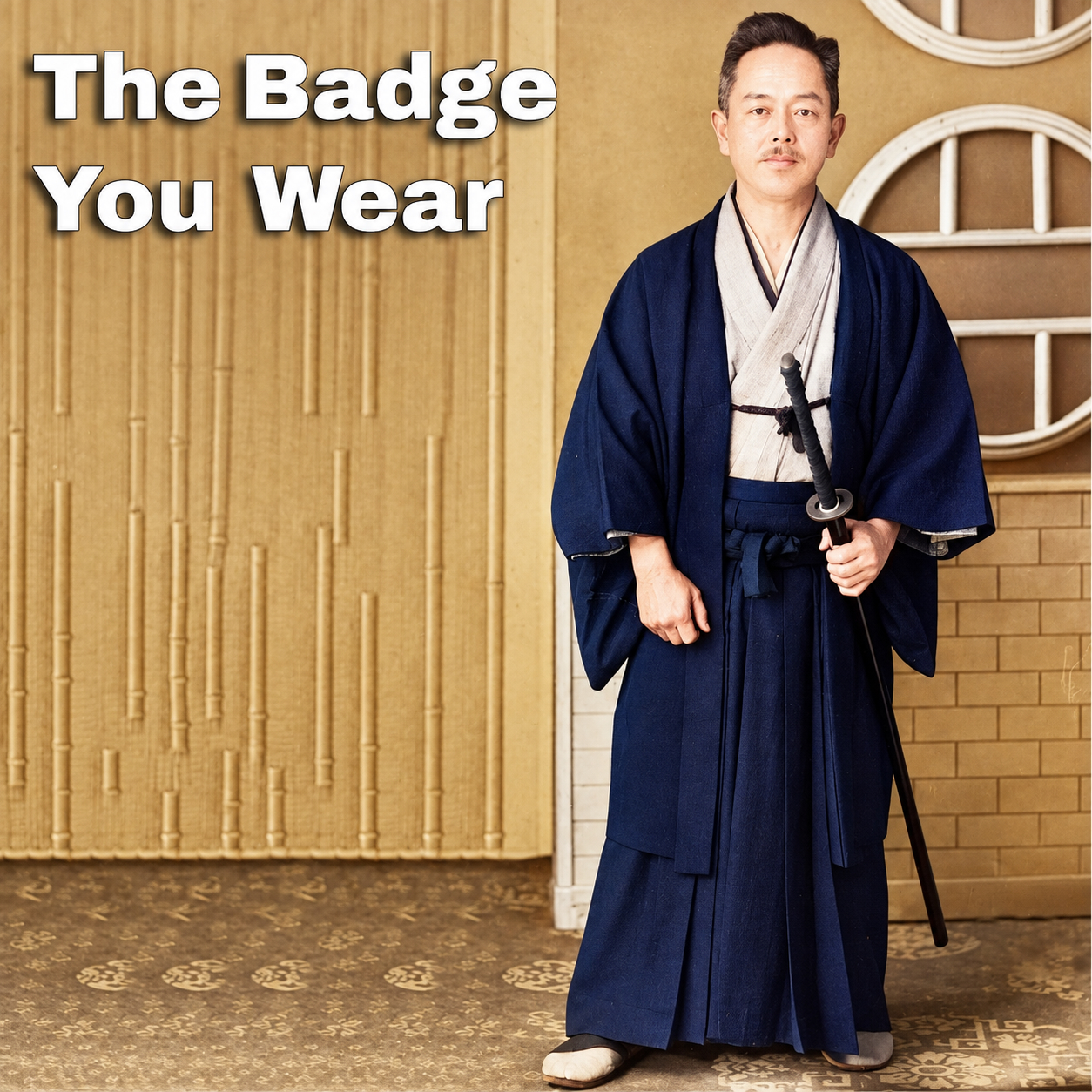
There is nothing particularly remarkable about a small piece of embroidered cloth sewn onto a keiko-gi, and yet, for many martial artists, the dojo or association badge carries considerable meaning.
It identifies where we train, who we train with, and often something of the history or lineage behind what we practice. Some badges incorporate a family crest, kanji, a personal symbol, or an image chosen to represent the principles or character of a particular dojo.
The modern martial arts badge should probably not be treated as though it is a direct continuation of some ancient warrior tradition. But the idea behind it is certainly an old one. People have long used symbols, crests and emblems to identify families, groups, affiliations and communities. In Japan, family crests, or kamon, served precisely that kind of purpose. The dojo badge can be seen in much the same way today: a visible sign of belonging.
Personally, I have always taken some pride in wearing mine. I have also always tried to make sure it was positioned correctly on the keiko-gi, not because there is anything sacred about the badge itself, but because of what it represents to me.
It represents my dojo, the people I have trained with and learned from, and the years of training that have gone into creating whatever understanding I have today. Perhaps most importantly, it reminds me that when I wear it, I am representing more than myself.
I have designed several dojo and association badges over the years, and that process taught me something about their significance. The choice of shape, wording, kanji, symbols and imagery is rarely completely arbitrary. Ideally, the design says something about the history, values or identity of the group it represents, and once students begin wearing that badge, they become part of that identity too.
That does not mean the badge somehow makes someone loyal, respectful, humble or of good character. Martial arts training does not automatically produce those things, and neither does wearing an emblem. But a symbol can still serve as a reminder.
When we wear the badge of our dojo, our behavior reflects upon the people and organization whose name we are carrying. How we conduct ourselves in the dojo matters, how we treat training partners matters, and how we represent our martial art outside the dojo matters too.
Of course, a badge only means something if the person wearing it allows it to. For some, it may simply be part of the uniform, with little thought given to what it represents. And if someone has no particular concern for good character, either inside or outside the dojo, no badge, rank, title or tradition is going to change that.
A symbol can remind us of certain standards, but it cannot make us live by them.
Perhaps that is the real value of the badge. Not as decoration, not as a status symbol, and certainly not because wearing one somehow connects us to an imagined warrior past. Its value comes from what we choose to let it represent: a dojo, a teacher, training partners, a history, and a responsibility to represent those things well.
It may only be a small piece of cloth, but sometimes small symbols carry a great deal with them.