
Why judging martial arts technique by appearance alone can miss the point.
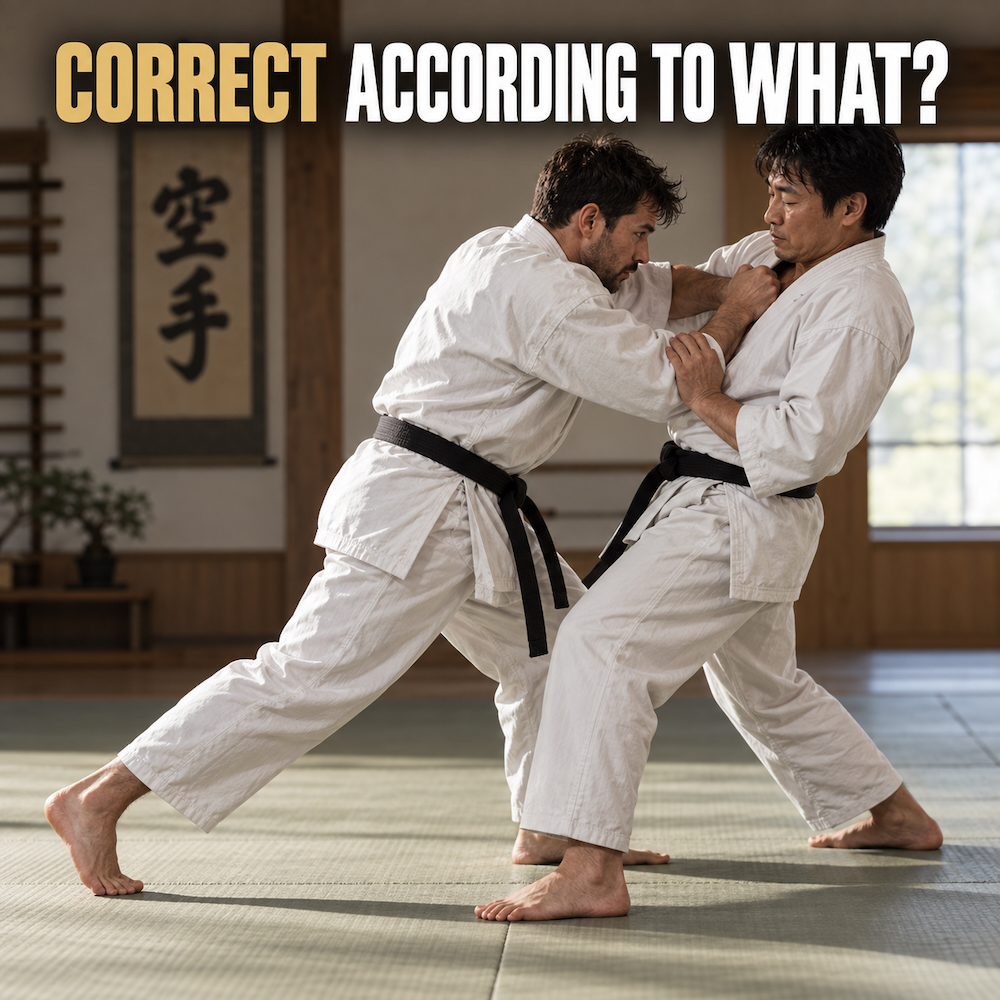
One of the problems with discussing martial arts technique is the tendency to describe movements as simply “right” or “wrong”.
I recently saw an image on social media comparing what it described as right and wrong technique.
It showed the heel of the rear foot lifted, which was stated as wrong. The body was leaning forward, so the posture was wrong. The weight was not evenly distributed, so the balance was wrong. The arm was not fully extended, so the punch was wrong.
But before deciding whether any movement is correct, surely we first have to ask:
Correct for what?
A movement does not exist in isolation. It is being used to solve a particular problem, against a particular person, at a particular distance, for a particular purpose.
Change the problem and the movement may change with it.
A rear heel lifting may be undesirable if the intention is to hold a particular static position. But if someone is driving their body forward, closing distance or transferring momentum into something in front of them, the heel may rise quite naturally.
Likewise, weight does not have to remain evenly distributed between both feet simply because a diagram tells us that this represents good balance. Human beings constantly transfer weight when they move. Walking, running, throwing, pushing and striking all involve changes in weight distribution.
Balance is not the same thing as symmetry.
Being balanced means being sufficiently stable to perform the task in front of you and, where necessary, to continue from it.
The same applies to posture.
There are certainly circumstances where excessive forward lean leaves someone vulnerable or compromises their ability to move. But that does not make an inclined torso universally incorrect. If someone is driving into another person, resisting pressure, controlling a limb or trying to prevent themselves being pulled backwards, their body position may look quite different from the posture expected during formal practice.
The important question is not whether the position looks good.
It is whether it serves the purpose.
Yet martial arts instruction can sometimes become heavily concerned with reproducing particular shapes. There is nothing inherently wrong with giving students reference points while they are learning.
The problem begins when the reference point becomes the objective.
A teaching model that was intended to help someone learn a movement can gradually become a rule about what the movement must always look like.
Then we start correcting the appearance rather than examining the function.
That distinction becomes particularly important when we move from solo practice into working with another person.
The other person changes everything.
They move and resist. Their height, weight and position are different. Distance changes. Your feet may not land where you expected them to. Contact may alter your posture. The movement that looked perfectly organized when performed alone may become considerably less tidy when another human being is involved.
That does not necessarily mean the movement has deteriorated.
It may mean that it has become real.
For me, this is one of the reasons realistic drills are so important. They allow us to move beyond simply reproducing the outward appearance of technique and begin discovering what the movement is actually trying to accomplish.
Once we understand the problem, we can judge the movement by more useful standards, rather than whether the final position matched some idealized idea of what the technique should look like.
There are certainly better and worse ways to move. Biomechanics, structure, balance and efficiency all matter.
But none of those things can be separated from context.
A movement is not correct because it looks correct.
It is correct because, in that particular moment, it does what it needs to do.
Recently watched a video from Bas Ruten discussing this very problem. Fighting is an active, moving, and fluid thing. Actually striking, kicking, or throwing a real person is not something performed with Euclidean geometry and harmonic form. Karate–much like some other Asian arts became a performance not a fighting style