
What if learning another kata was meant to mean learning another way of dealing with the problem
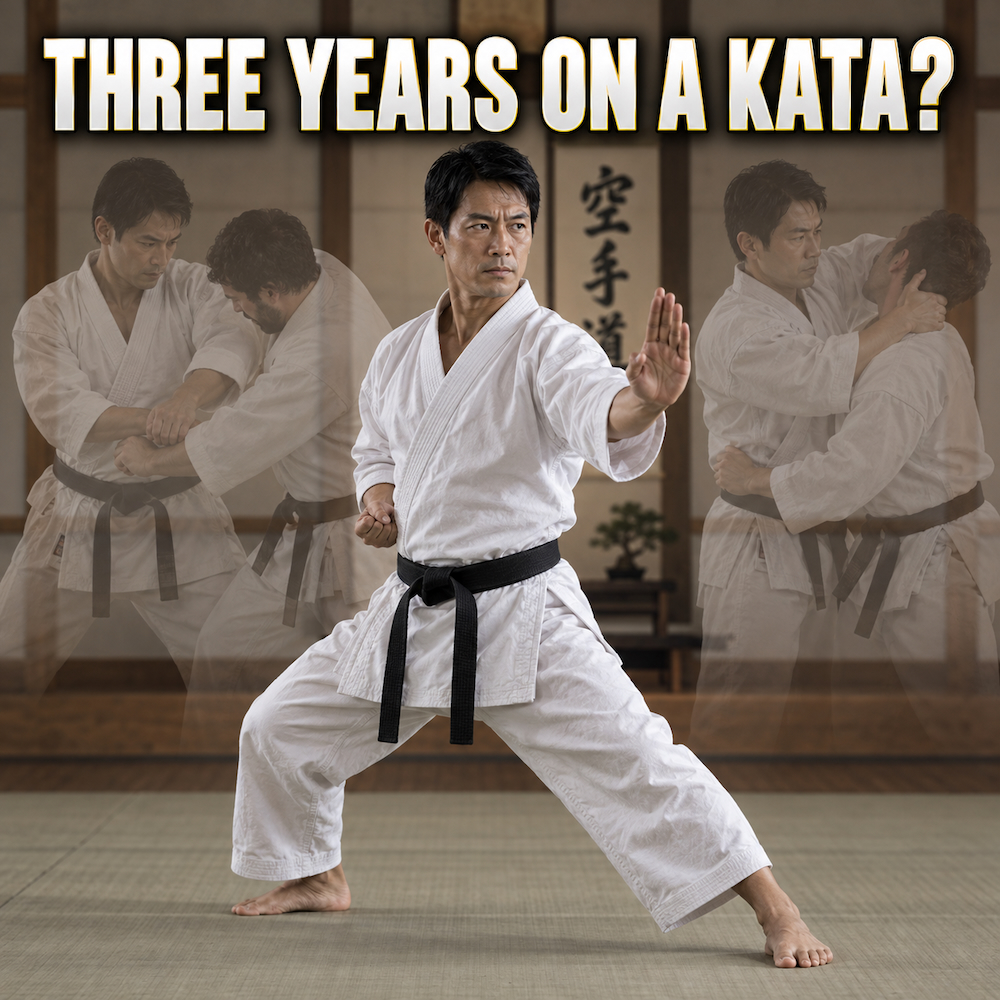
When we began karate, we learned “the basics”. Stances, punches, kicks and blocks were practiced individually, often up and down the dojo floor. Later, we were introduced to kata.
The basics have to come first. We have to start somewhere. The problem comes when we give those movements a fixed meaning without first understanding the context in which they are being used. A rising block becomes a rising block, a lower block becomes a lower block, and a stance becomes a stance.
Then, when the same movement appears in a kata, that is naturally what we see.
We have already decided what it is.
So when we learn a second kata, we bring that same understanding with us. The pattern may be different, but we continue to see the movements through the vocabulary established during our early training.
I believe the two-person drills preceded the kata. Certainly, the idea that someone first created a solo sequence and only afterwards tried to work out what the movements might be used for makes little sense to me.
If the lesson originally began with another person, then the important part was the problem being dealt with: position, balance, control, timing, pressure and the way we responded to what the other person was doing.
The solo movement we practice today came later as a way of remembering and rehearsing that lesson, and those solo movements were eventually brought together in kata. What we now practice as “the basics” may therefore be only part of something that was originally learned in context.
Seen that way, kata becomes something quite different.
It is a record of information that once had a context, yet today we often learn the record first and then try to work backwards to discover what it records.
We learn the kata pattern, become increasingly proficient at performing it, and then ask what the movements might mean. Because our understanding was built on the basics we learned first, naturally we use those same basics to interpret what we see.
And so every kata begins to look increasingly similar.
A different sequence of movements, different embusen, perhaps a different rhythm, but underneath it all we continue to find the karate we already know.
That is where I think something important can be lost.
I believe the differences between kata matter. They were not simply different arrangements of the same collection of techniques. They came from different teachers, different periods and different approaches, and those differences are part of what was preserved.
Perhaps each kata also has a particular theme. Not necessarily one specific attack with one specific answer, but a particular way of dealing with a problem. One kata may emphasize controlling someone at close range, another may make greater use of movement and position, while another may emphasize balance, pressure or a particular way of receiving and responding to force.
Take Naihanchi as a simple example. Its movement naturally lends itself to close-quarter positioning, controlling limbs, disrupting balance and working with someone directly in front of us. Another kata may ask us to move more freely, change angle or position ourselves differently. The point is not that one is better than another, but that they may be asking us to develop different skills.
If that is the case, then learning another kata should mean learning something more than another sequence of movements. It should mean exploring another set of problems and another way of dealing with them.
If we approach every kata using the same movement, the same mechanics and the same assumptions we learned during our first few years of karate, we risk making them all say the same thing, perhaps removing some of the very differences that made them worth preserving.
This brings me back to the old expression:
Hito kata san nen – one kata, three years.
Three years seems an extraordinarily long time if the objective is simply to memorize and polish a solo pattern.
But if the pattern is only the reminder, and the real study lies in understanding the situations, principles, movement and partner work behind it, then spending three years practicing those things until they become familiar enough to use suddenly sounds rather more reasonable.
We could learn the choreography of many kata in that time. Learning sequences is not particularly difficult; understanding what they preserve is another matter entirely.
You will consistently hear that we should “practice the basics”. Repetition is important and I understand the reason for it. But if every new kata is approached using exactly the same movement, interpretation and assumptions we already possess, then we may simply be collecting more patterns without necessarily collecting much new knowledge.
We can each use kata as we choose. For the next promotion or for competition. We can interpret them as an extension of our basics. Or we can use them to develop another skill set, perhaps several.
We tend to see karate as this big lump of stuff that is homogeneous, just more of the same thing throughout, rather than a well-reasoned collection of different approaches.
All kata express karate, but they can also be very different in form and function. Perhaps that means we should invest the time and effort to learn each kata’s lesson individually, rather than making every kata conform to the karate we already know.
Help Keep Applied Methods Free
Applied Methods is independently written and freely available. If you enjoy the articles and would like to support the continued writing and upkeep of the site, contributions are always appreciated, but never expected.
Well, considering that prior to Itosu, a kata was synonymous with a system, spending a long time on a single kata was logical.
Yes, and if a kata preserved a particular approach or body of fighting knowledge, then spending several years understanding and developing those skills makes considerably more sense than simply perfecting the solo pattern.
It’s also worth considering how karate had been changing throughout the years. Some concepts we see in the older kata like naihanchi could be represented by very different ways in more modern kata i.e. pinnan series. None of the martial arts were ever frozen in time, they were evolving and finding better ways of dealing with the same problem. Good examples of this are both Judo and BJJ, judoka from 100 years ago wouldn’t recognise half of the techniques modern judo uses.