Different cultures, familiar methods, and why the answers don’t always have to come from somewhere else.
Whenever the practical application of karate is discussed, someone inevitably suggests bringing techniques in from another martial art. Judo for its throws, Aikido for its joint locks, or perhaps BJJ for its groundwork. There’s nothing wrong with learning from other systems, but why do we so often assume that these methods have to come from somewhere else?
I’ve written many times about karate’s broader methods of controlling, unbalancing, locking, and throwing an opponent. But there’s another aspect to this that I find interesting. We seem to have become so accustomed to associating particular methods with named martial arts that we sometimes forget people can discover similar solutions to the same problem independently.
Think about wrestling. Across Britain, different forms of wrestling were practiced in Scotland, Cumberland and Westmorland, Cornwall, Wales, and elsewhere, just as wrestling was practiced in ancient Greece and Rome. The traditions developed in different cultural settings, sometimes influencing one another, but they all dealt with a familiar problem: how to control another human being and put them on the ground.
People didn’t need to know what Judo was to discover a hip throw, a trip, or a way of upsetting someone’s balance. They could find those answers for themselves. So why, when we recognize a similar movement in karate, are we so quick to suggest that it must have come from somewhere else?
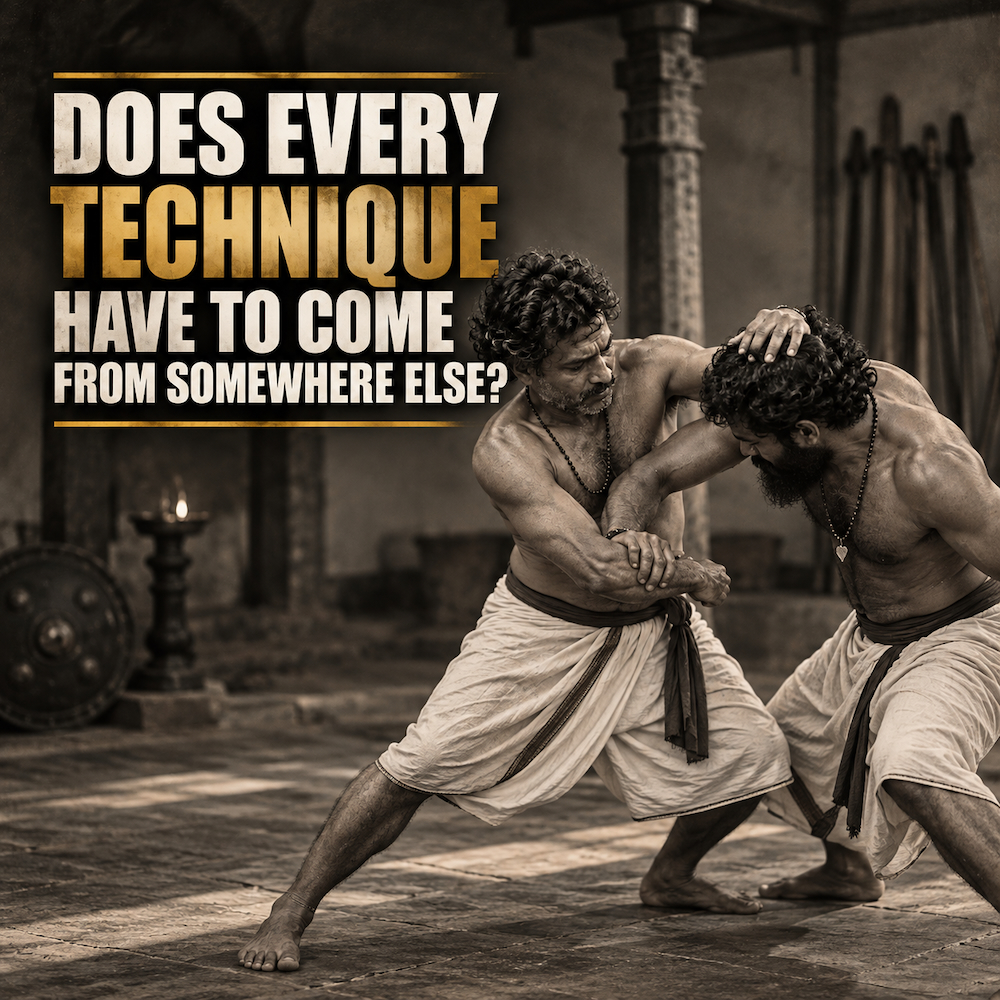
Consider India, too, where Kalaripayattu has roots that predate not only modern Judo and Aikido, but also karate as we recognize it today. Its traditions encompass striking, grappling, joint manipulation, and other methods of combat.
Across the world, different cultures developed their own approaches to physical confrontation. They didn’t all have to learn from a single source. While there was certainly exchange between cultures, people could also discover similar methods independently because they were dealing with the same human body and the same fundamental problems.
Joints move in particular directions, balance can be disrupted, and a person who is pulled or turned beyond their ability to maintain their posture is likely to fall. These are physical realities, not principles belonging exclusively to any one martial art.
Karate, when approached as a means of civilian self-protection, has a major priority. We don’t want to be on the ground trying to restrain someone. We want to remain on our feet, deal with the immediate threat, and create an opportunity to get away. That doesn’t mean we have no use for grappling, joint control, or throwing. Quite the opposite. It means those methods are employed with a different objective in mind.
A throw used to score in competition, a throw used to establish control, and a throw used to create an opportunity to escape may involve similar mechanics, but the intended outcome is different. The purpose influences how the method is applied, the risks we’re prepared to take, and what we intend to do next.
And this brings me back to karate’s basics.
Perhaps the problem isn’t that the methods are missing. Perhaps it’s that the way those basics are commonly practiced no longer provides the opportunity to understand what they can do. If a student spends years punching and blocking empty air, or responding to predetermined attacks with equally predetermined defenses, it’s hardly surprising that they may struggle to recognize the broader possibilities within the movements.
Martial arts have influenced one another throughout history, and karate is no exception. But recognizing a movement from another system doesn’t establish where it originated. Similarity alone isn’t evidence of borrowing.
Over the years, aspects of karate’s wider practice have been lost, neglected, or simply left out of the way certain styles are taught. If an instructor has never been taught how to apply a particular method, looking to another martial art may be the only practical way for them to develop that understanding. There’s nothing wrong with that. But we shouldn’t confuse where someone learned a method with where that method originated. Just because an instructor learned a throw from Judo doesn’t mean the same principle wasn’t already present in karate.
And even when we do learn from another system, we need to consider the purpose for which we’re training. Judo, Aikido, and BJJ have developed their methods with different priorities and approaches. We can learn from their experience without necessarily adopting those same objectives. A method learned within a sporting context, for example, may need to be approached differently when applied to civilian self-protection. We need to consider not simply how the movement works, but why we’re using it, what happens immediately afterwards, and whether it helps us achieve our objective of getting away safely.
Perhaps, before deciding that something needs to be imported into karate, it’s worth taking a closer look at what we’re already practicing. Not simply at the outward appearance of a movement, but at the problem it might be addressing, the principles involved, and the training required to make it work.
If something is missing from our own training, that doesn’t necessarily mean it is missing from karate itself.
After all, a method doesn’t become a Judo throw simply because someone recognizes it from Judo. And it doesn’t stop being karate simply because someone else has given a similar movement a different name.
The physical problem came first. The systems, names, and classifications came later.
Help Keep Applied Methods Free
Applied Methods is independently written and freely available. If you enjoy the articles and would like to support the continued writing and upkeep of the site, contributions are always appreciated, but never expected.