
When unrealistic attacks, compliant partners, and inherited explanations are mistaken for practical bunkai.
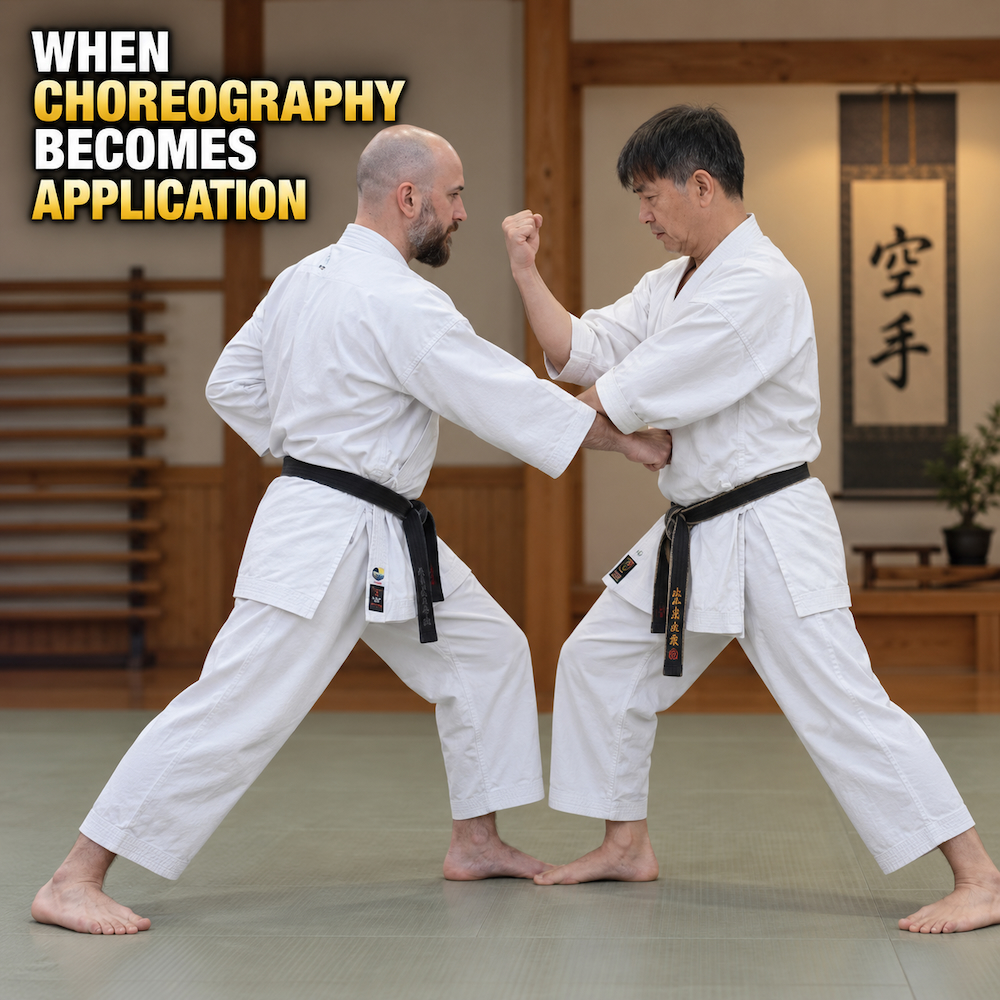
Every day on social media, you can see short video clips of karate practitioners, some holding quite senior dan grades, demonstrating what is presented as bunkai.
And some of it is dreadful.
With the amount of information available today, I sometimes wonder why practitioners continue producing demonstrations that are so obviously choreographed, unrealistic, and detached from the problems karate was originally intended to address. These videos may be seen by thousands of people, so what exactly are they trying to demonstrate?
I watched another example today that was little more than choreography. A typical karate stepping attack was offered in exactly the right way, the defender responded with a sequence of movements, and the attacker conveniently remained in place while everything unfolded.
Then we wonder why karate is ridiculed by practitioners from other fighting disciplines.
The problem goes deeper than poor bunkai.
Too many people practice karate without much interest in understanding what it originally was, what influenced it, why it developed, or the circumstances in which it was intended to be used. Others may simply ignore those questions altogether, perhaps because looking more deeply risks challenging what they have believed, practiced, and taught for years.
Techniques are then learned superficially, detached from context and purpose, and passed on in exactly the same way.
Much of what is practiced today is essentially school karate.
We know that karate changed. This isn’t speculation. Itosu, Funakoshi, and others wrote about karate’s development and its introduction into the education system. Training became more structured and increasingly suitable for large groups, physical education, character development, and eventually competition.
Those developments helped karate spread, but they also changed the way it was practiced.
The problem is that many instructors never look further back.
They learn the karate handed to them by their instructor, who learned it from theirs, and assume that what they inherited represents the whole story. The movements are preserved, the terminology is repeated, the explanations are passed down, and very few questions are asked.
In The Matrix, taking the blue pill means returning to the comfortable reality you already know. The story ends, and you continue believing what you have always believed.
Karate has plenty of blue pills.
For many years, particularly in the West, Japanese instructors arrived and showed practitioners “the way.” Their authority was rarely questioned. If that was how Sensei performed a movement, that was how it was done. If that was the explanation given for a kata movement, that became its meaning.
But we should have moved beyond that by now.
Many practitioners have.
They took the metaphorical red pill and began looking further. They researched karate’s history, studied older training practices, examined violence itself, questioned conventional explanations, trained with resistance, and explored what happens when another person doesn’t cooperate.
They discovered that the rabbit hole goes considerably deeper.
A comment I received recently illustrated the problem perfectly. In response to a discussion involving grappling at close range, someone said that grappling was difficult and that they would simply stick with “block and counter.”
But real violence does not allow us to choose the range or type of engagement we prefer.
An attacker does not have to cooperate with the range your training prefers.
That thinking only makes sense when the encounter itself has already been arranged around a particular method of training.
And this is where the distinction between consensual fighting and criminal violence matters.
The violence dictates the problem.
Your training does not.
We cannot simply dismiss the parts of violence that do not fit comfortably into our preferred training method.
This does not mean that everybody has to practice karate for the same reason.
Over time, karate has become many things to many people, and that isn’t necessarily a problem.
The problem begins when we stop acknowledging the differences.
Historically, karate did not emerge because people needed another recreational activity. Its roots lie in dealing with physical confrontation. Whatever else karate subsequently became, violence sits somewhere at the beginning of the story.
When that is forgotten completely, the movements can remain while their purpose disappears.
And choreography gradually becomes accepted as application.
This becomes particularly difficult to understand when senior dan grades demonstrate karate in this way. Rank should surely bring greater questioning, greater investigation, and a deeper understanding of context, not simply greater proficiency at repeating the explanations we were given as beginners.
Karate hasn’t simply changed.
It has divided into different purposes.
Some of those purposes are now a considerable distance from the circumstances that originally shaped the art. That is simply part of karate’s development.
But if we want karate to retain any connection with its life-preserving roots, then at the very least we should be honest about what we are practicing, what problem it is intended to solve, and what it is not.
Help Keep Applied Methods Free
Applied Methods is independently written and freely available. If you enjoy the articles and would like to support the continued writing and upkeep of the site, contributions are always appreciated, but never expected.
Sensei Carter, thank you for this post.
If a practitioner, of any sport or “movement art,” gets benefits from the movements he/she practices, this may be enough of a reward. In that case a movement pattern may not necessarily have to accurately reflect what REALLY happens in a contest of free wills against a resisting opponent.
But if, as I think you’re saying, the practitioner BELIEVES the movement actually DOES accurately reflect what REALLY happens against resisting opponents, then I’m reminded of what Nobel Prize winning physicist Richard Feynman said:
The first principle is that you must not fool yourself — and you are the easiest person to fool.
—-“Cargo Cult Science”, adapted from a 1974 Caltech commencement address; also published in Surely You’re Joking, Mr. Feynman!, p. 343
I am a person who has often fooled myself, and sometimes continue to do so.
Maybe the best thing about training any martial art is, it can disabuse a person of his foolish tendencies, if only he actually WANTS to find out exactly where his ignorance is located.
Thank you. Yes, that is exactly the distinction I was making. There is nothing wrong with practicing karate for health, enjoyment, competition, or any other reason. The problem starts when a cooperative movement is presented as though it reflects what happens against someone who is resisting and has their own intentions.
The Feynman quote is very appropriate too. We can all fool ourselves, especially when something supports what we have believed and practiced for years. Good training should challenge those assumptions, not protect them.
All the best.