At some point, an instructor has to stop waiting to be shown every answer.
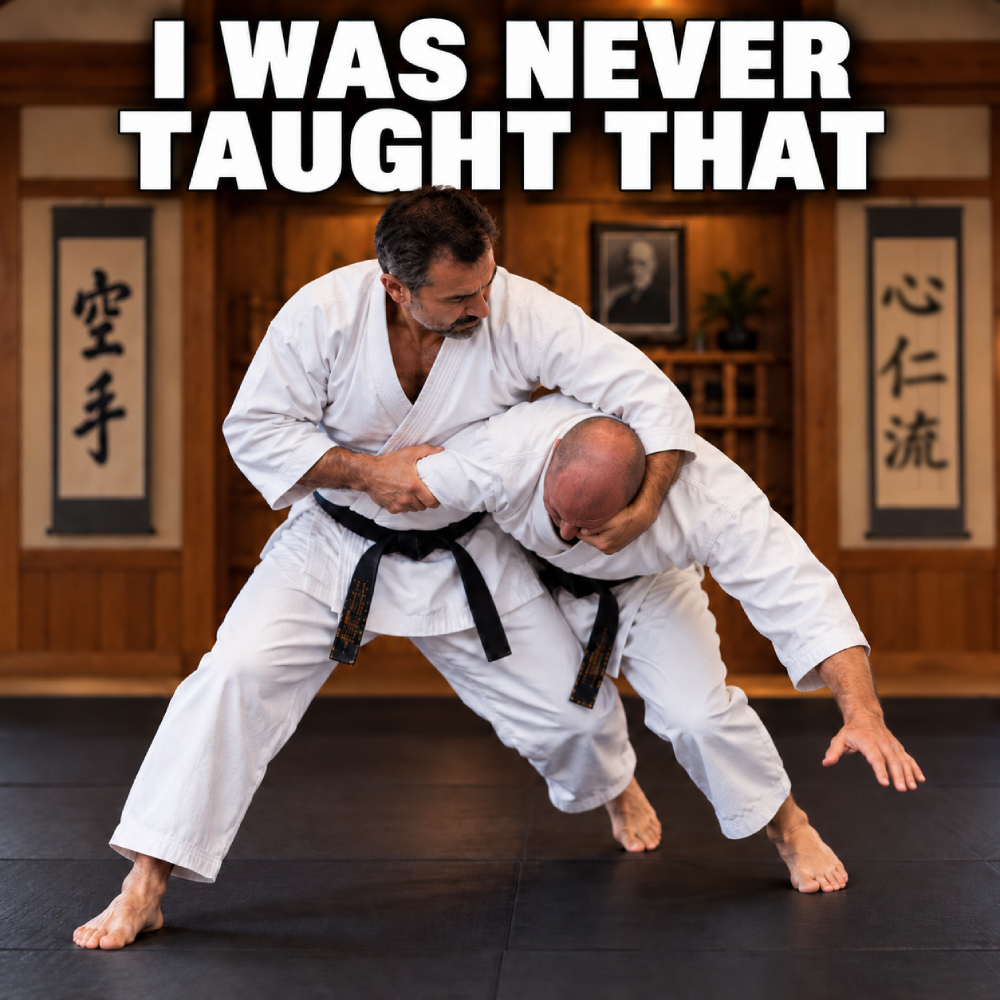
One phrase I hear quite often in martial arts discussions is, “I was never taught that.”
Usually it comes up when people are talking about methods they feel have been missing from their karate. Throws, limb control, grappling, close-range work, or whatever else happens to be under discussion. The conclusion is often that these things have to be brought in from somewhere else because they were never taught within their own training.
Sometimes that may be true. There is nothing wrong with learning from other martial arts, and there is a great deal that karate practitioners can gain from people who specialize in areas such as Judo, wrestling, boxing or Brazilian Jiu-Jitsu.
But I do sometimes wonder whether “I was never taught that” becomes a little too convenient.
At what point, particularly as an instructor, do we become responsible for finding some of the answers ourselves?
Teaching isn’t simply passing along everything your teacher passed along to you. At some point you have to investigate, test, think and develop your own understanding. Otherwise you aren’t really continuing the learning process; you’re preserving somebody else’s lesson.
That doesn’t mean inventing increasingly complicated techniques and then claiming they must have been hidden in a kata. Nor does it mean ignoring the knowledge of people who have spent years becoming highly skilled in another discipline. It simply means being prepared to explore what is actually happening between two people.
Take throwing as a simple example.
Much of karate is taught at a distance where people exchange punches and kicks. If that is where most of your training takes place, then throwing can easily appear to belong to another martial art.
But move much closer.
Once you are chest to chest, shoulder to shoulder, or controlling an arm while your body is close to theirs, certain things become fairly obvious. If you turn their upper body while stopping their lower body from following, their balance changes. If your foot blocks theirs while you continue moving them, they may fall. If you shift your hips into their space while controlling their upper body, another possibility appears.
You do not necessarily need someone to give the movement a Japanese name before you can recognize what is happening.
The human body only moves in so many ways.
If you spend enough time working closely with another person, trying to control posture, balance and movement, certain solutions begin to present themselves. A trip is a trip. A turn of the body combined with control of the upper torso can become a throw. Pulling, pushing, twisting and obstructing somebody’s movement can disturb their balance.
People have been discovering these things for a very long time, often independently of one another.
Of course, recognizing that a throw is possible is not the same as becoming good at throwing. This is where training matters. You have to practice it against another person. They have to resist. You have to discover what works reliably and what only works because your partner is cooperating.
Someone with years of Judo experience may show you details that would take much longer to discover by yourself. That knowledge is valuable.
But there is a difference between learning from somebody else’s experience and believing that nothing can exist in your karate until somebody from another martial art teaches it to you.
That is the part I find difficult.
If you have been training for thirty or forty years and teaching other people, surely some responsibility now rests with you to investigate the material in front of you.
What happens if the distance closes, or a punch doesn’t finish the encounter?
If someone grabs you, can you control their arm, move their posture and create another opportunity?
And what changes when you stop thinking in terms of named techniques and simply look at the problem you are trying to solve?
These are not particularly mysterious questions.
In fact, this is one of the reasons I prefer thinking in terms of movements and principles rather than collections of techniques. If you understand balance, posture, movement, control and distance, the possible applications begin to expand naturally.
You are no longer waiting for somebody to hand you another technique.
You are learning to see.
For a beginner, “I was never taught that” is perfectly reasonable. They are there to be taught.
For an experienced instructor, I think the answer eventually has to become more complicated.
Your teacher gave you something to work with. They may have provided excellent instruction, incomplete instruction, or simply the material that was available to them at the time.
But they could never give you every answer you might need for the rest of your training life.
At some point, the responsibility becomes yours.
You have to ask questions and test ideas. You have to discard things that do not survive pressure and continue working on the things that do.
That doesn’t mean abandoning what you were taught.
It means continuing it.
Help Keep Applied Methods Free
Applied Methods is independently written and freely available. If you enjoy the articles and would like to support the continued writing and upkeep of the site, contributions are always appreciated, but never expected.