What happens when a position of succession becomes a title of status?
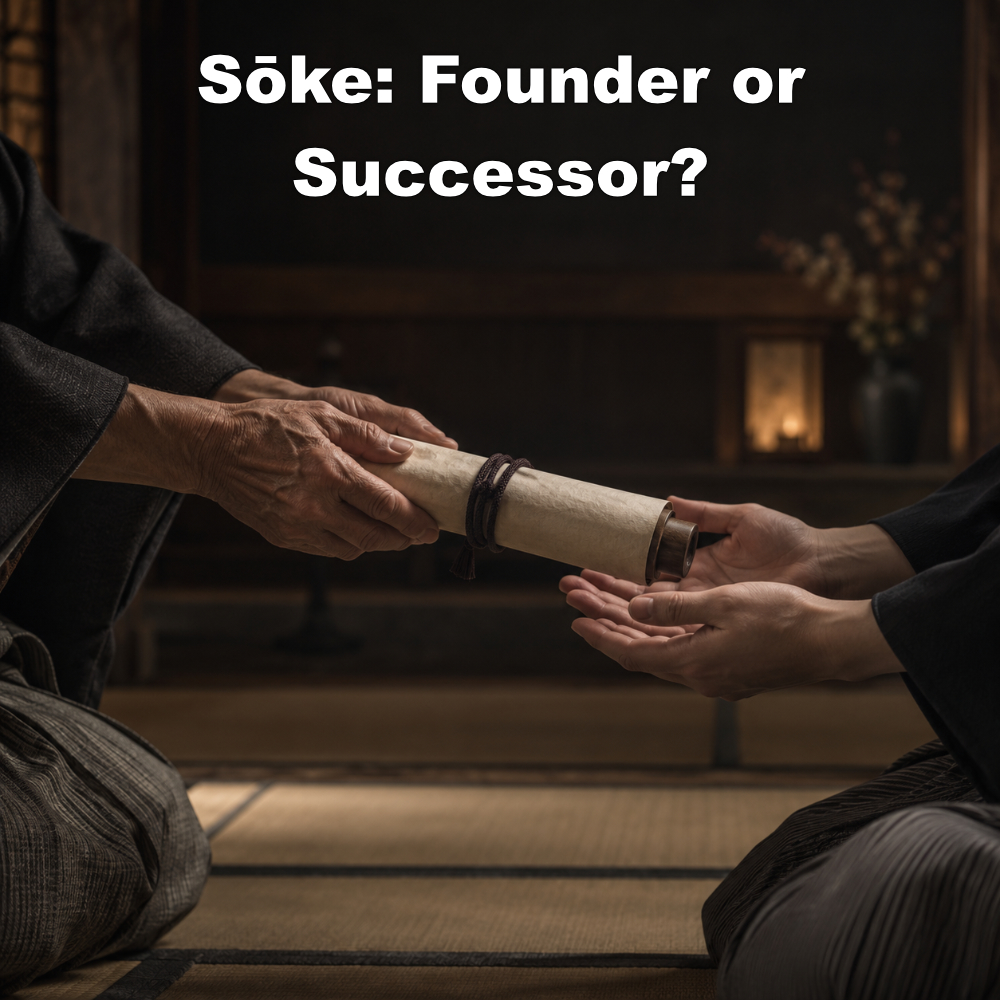
Every so often I come across a martial arts website where the head of an organization is described as both the founder of the system and its Sōke.
For most people there is probably nothing unusual about that. Within modern martial arts, Sōke is often understood to mean something like “grandmaster”, “headmaster”, or the person at the very top of a style.
If you created the style and you are its highest authority, calling yourself Sōke may therefore seem perfectly reasonable.
But if you founded the system yourself, what exactly did you inherit?
The word sōke (宗家) did not originally mean “grandmaster”. Traditionally it referred to the main family or house through which a tradition was passed down, and to the person who headed it.
Founders begin traditions. Successors inherit them.
Those are not necessarily the same role.
There is, of course, nothing questionable about founding a martial arts system. Every system began somewhere. Nor is there anything wrong with being the head of the organization you created.
Japanese even has kaiso (開祖), a term used for someone who establishes a school, tradition, or branch of an art. The meaning is quite straightforward: founder or originator.
Sōke carries different baggage.
The word may be used differently today, particularly in Western martial arts, but I am not convinced that common usage makes that usage correct.
If we choose to use Japanese terminology, then I think we should make some effort to understand what those words actually mean and how they are used within the culture they came from.
Being in the West does not automatically give us license to take a term that has existed for centuries, give it a different meaning, and then present that meaning as though it were traditional.
Rather than describing a particular relationship to an established house or transmitted tradition, Sōke has increasingly become a personal title, often placed alongside high dan grades, Grandmaster, Hanshi, Shihan and other descriptions intended to establish someone’s standing.
Traditionally, the important thing was not simply how accomplished the individual was. In some traditions, being Sōke did not necessarily mean being the principal teacher or even the person responsible for the technical transmission of the art.
The position connected that individual to a continuing tradition.
The authority came partly from being entrusted with something that had been passed on.
In some modern organizations, the direction appears reversed.
Someone creates a new system, becomes its highest-ranked practitioner, establishes an organization around it, and then adopts Sōke as another description of their position.
There may be decades of legitimate martial arts experience behind that person. They may have trained under excellent teachers. Their new system may have recognizable roots in older traditions.
But that is martial lineage leading to the founder.
It is not the same thing as succession within the system they have just founded.
I think that distinction often becomes blurred.
Perhaps some of the confusion comes from our habit of treating Japanese martial arts terminology as though every word represents another level in a hierarchy.
Sensei. Shihan. Hanshi. Sōke.
In the West, it can begin to look like a ladder, but these terms do not simply represent increasingly senior levels of the same thing. They describe different relationships and positions.
Sōke is not simply the title waiting above 9th or 10th dan.
Nor does attaching a Japanese word to someone’s position automatically make that position more traditional.
If someone has founded their own martial art, saying so should be enough. Founder is not an inferior description. It actually tells us something useful.
Adding Sōke may sound more impressive, but unless we understand what the word is intended to mean, it may tell us very little.
Because historically, Sōke was not simply about being the most senior person in the room.
It was about what had been placed in your care.
Help Keep Applied Methods Free
Applied Methods is independently written and freely available. If you enjoy the articles and would like to support the continued writing and upkeep of the site, contributions are always appreciated, but never expected.