
Why self-protection begins long before physical contact.
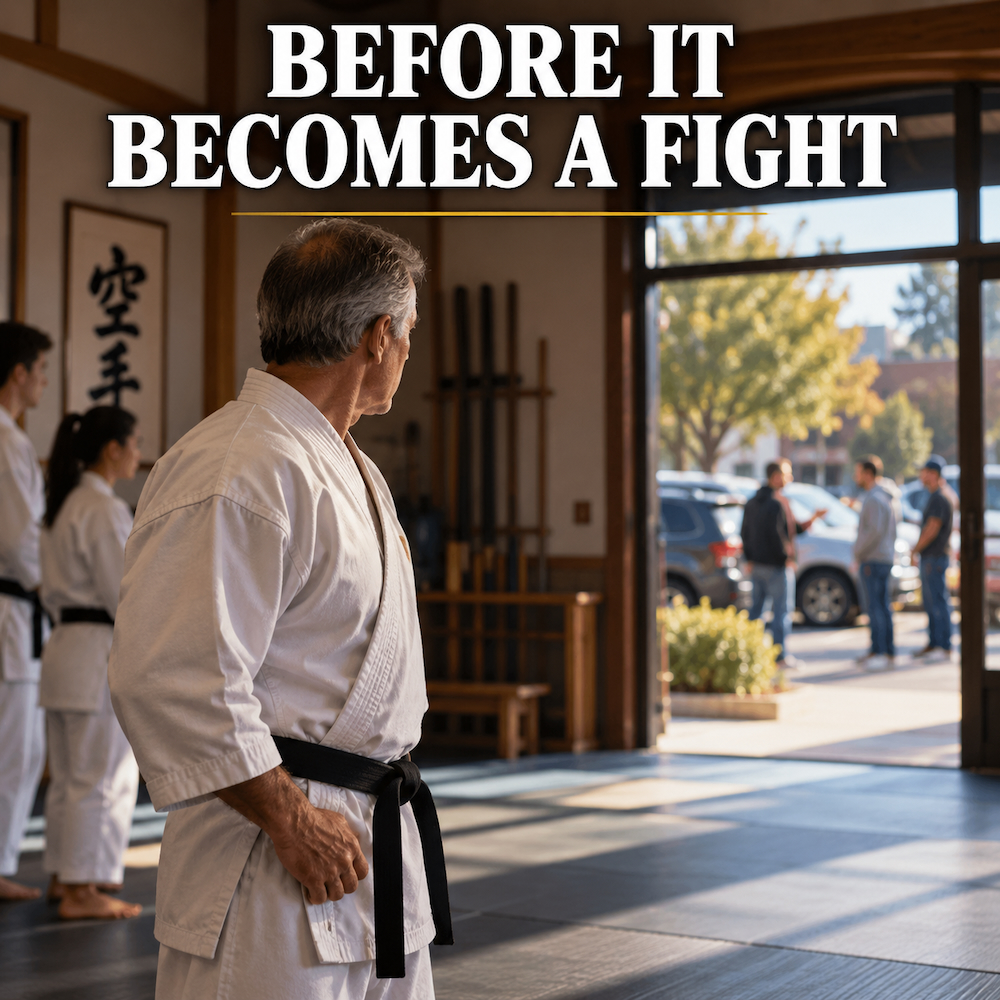
There was another shooting near me recently. One person was killed and another injured at a shopping center in an area that is not generally known for that kind of violence.
From what has been reported so far, the people involved appear to have met there. An altercation followed, then gunfire.
Whatever caused it, it reminded me of something I have written about before.
Violence does not have to be directed at you before it becomes your problem.
You could be walking through a parking lot, sitting in a restaurant, filling your car with fuel, or shopping with your family when something involving other people suddenly turns violent.
You are not part of the argument. Nobody is trying to rob you, or challenged you to a fight.
But you now have a self-protection problem.
That is perhaps where many “self-defense” classes go wrong. They begin at the moment of physical contact.
Real self-protection often begins considerably earlier, and the entire objective may be to make sure physical contact never happens. Standing there prepared to fight with your hands up in a high guard is not going to help you here.
Self-defense asks, “What do I do when someone attacks me?”
Self-protection asks, “How do I avoid being harmed?”
Sometimes they overlap, but they are not the same thing.
It is easy to build a class around techniques. A wrist is grabbed, so you perform an escape. A punch comes in, and there is a rehearsed response. You are grabbed from behind, so out comes the next technique.
Attacker. Defender. Technique.
It looks like self-defense.
But real violence rarely presents itself that neatly.
Trouble may be developing twenty feet away from you. An argument may be getting louder. A weapon may suddenly appear. The sensible response might simply be to leave.
That is self-protection too.
When firearms are involved, the difference becomes even clearer.
If shots are fired in a parking lot, your ability to punch, kick, throw, or apply a joint lock is unlikely to be the answer. Getting away from the danger matters. Knowing where the exits are matters. And knowing the difference between concealment and something that may actually provide cover matters.
None of that looks much like a martial arts class.
Yet it may save your life.
I see so many martial arts schools offering “self-defense” classes. There is nothing wrong with that in itself, but I do wonder what people believe qualifies someone to teach the subject.
A few years of martial arts training may give someone useful physical skills. It does not automatically give them an understanding of violence.
Kata, sparring, pads, combinations, and defensive techniques all have value, but they are not the whole subject.
Real violence brings fear, surprise, confusion, weapons, more than one person, confined spaces, bystanders, and consequences that continue long after the physical encounter has ended.
The person using violence usually has an objective. They may want your wallet, your car, access to somewhere, or simply to hurt you.
Your objective should be much simpler.
Get home.
That changes how you look at the problem.
If handing over a wallet gets you out safely, you have protected yourself without fighting. If you see an argument developing and leave before it reaches you, you have done exactly the same thing.
And if shots are fired between people you have never met and you get yourself and your family out of the area, you have protected yourself without performing a single martial arts technique.
That does not make physical training unnecessary.
Avoidance can fail. You may have nowhere to go. Someone may already have their hands on you. At that point physical skills matter, which is exactly why we train them.
But physical technique is only part of self-protection. It should not define it.
If we genuinely believe that avoiding violence is preferable to fighting, why do so many self-defense classes begin after avoidance has already failed?
Perhaps the first questions should be much simpler. What is happening around me, do I need to remain here, and can I leave before this develops any further? If I am with other people, where is the safest way out, and what can I do now to prevent this becoming physical at all?
The best self-protection may be the one nobody ever sees.
Because you never needed to fight.
Help Keep Applied Methods Free
Applied Methods is independently written and freely available. If you enjoy the articles and would like to support the continued writing and upkeep of the site, contributions are always appreciated, but never expected.
There is an excellent series of books by a former federal air marshal named Gary Dean Quesenberry, starting with “Spotting Danger Before It Spots You: Build Situational Awareness to Stay Safe”. There is one in the series for training teenagers in situational awareness, children and travelers. They’re worth reading.
The thing that’s always disturbed me most is this:
Me: “You know, nothing says you have to finish the fight. You’re better off just to disable or distract the attacker long enough to get away.”
Teenage boy: “That’s the stupidest idea I’ve ever heard!”
Another sensible and thought provoking article. In relation to the fear element: I’d be really interested to hear your strategies for dealing with “adrenal rust”. I’ve found, as I age (now 50 years old) my body and mind become more susceptible to normal physiological fight-or-flight symptoms (“adrenal rust”) due to a lack of routine exposure to extreme stress.
How do you maintain the ability to function through physiological fight (freeze) or fight responses without experiencing them as frequently as you did during your days in professional security work or competition fighting. And how should people who’ve rarely experienced such situations train to enable functionality during them?
That is where unpredictable attack and response drills become useful. The student does not know exactly what is coming or when, so they have to read what is happening and respond rather than simply perform a rehearsed technique.
We then add resistance, pressure and changing conditions progressively. You cannot safely recreate the full stress of real violence, but you can make people increasingly comfortable functioning when things are uncertain and not going to plan.
The aim is not to remove the adrenaline response, but to be able to keep thinking and acting through it.