A throw, a stance, and what we think we’re seeing.
When we first begin learning karate, almost everything we’re taught is given a name. We learn punches, blocks, kicks, and stances. Each has its own terminology, and those names help us organize what we’re learning.
We need a common language if we’re going to teach and communicate effectively. A student needs to know what their instructor is asking them to do, and terminology provides a convenient way of identifying movements and positions.
But how often do we consider what happens when the name we give something begins to determine how we understand it?
Once we’ve attached a label to a movement, that label can become difficult to see beyond. We learn something as a block, and from that point forward, we think of it as a block. We see a closed fist and naturally assume that it must be intended for striking.
The description becomes the explanation, even though the two are not necessarily the same thing.
This is particularly noticeable when people begin examining the movements found in kata. A movement that resembles a punch might be used to strike, but depending on the circumstances, the same movement could also form part of an action involving control, pulling, or unbalancing another person.
That doesn’t mean we can simply invent whatever application we like. Any interpretation must make mechanical sense and be supported by what happens when we work with another person. But if we’ve already decided what a movement must be because of its name, we may never consider anything else.
I think the way we teach stances provides an even clearer example of this problem.
Consider how students are introduced to the various stances in karate. They’re shown where to place their feet, how to distribute their weight, which direction to face, and how deeply to bend their knees. They’re corrected until they can reproduce the required position with reasonable accuracy.
There’s nothing wrong with this as an introduction. Students need a starting point, and learning how to position the body is part of that process. The difficulty comes when you begin treating those positions as though they are the objective, rather than a means of understanding movement.
The word “stance” itself doesn’t help. In everyday language, it suggests something fixed, a position you adopt and maintain. In karate, this can encourage the idea that a stance is somewhere you must arrive before performing a technique.
But is that really how we move when dealing with another person?
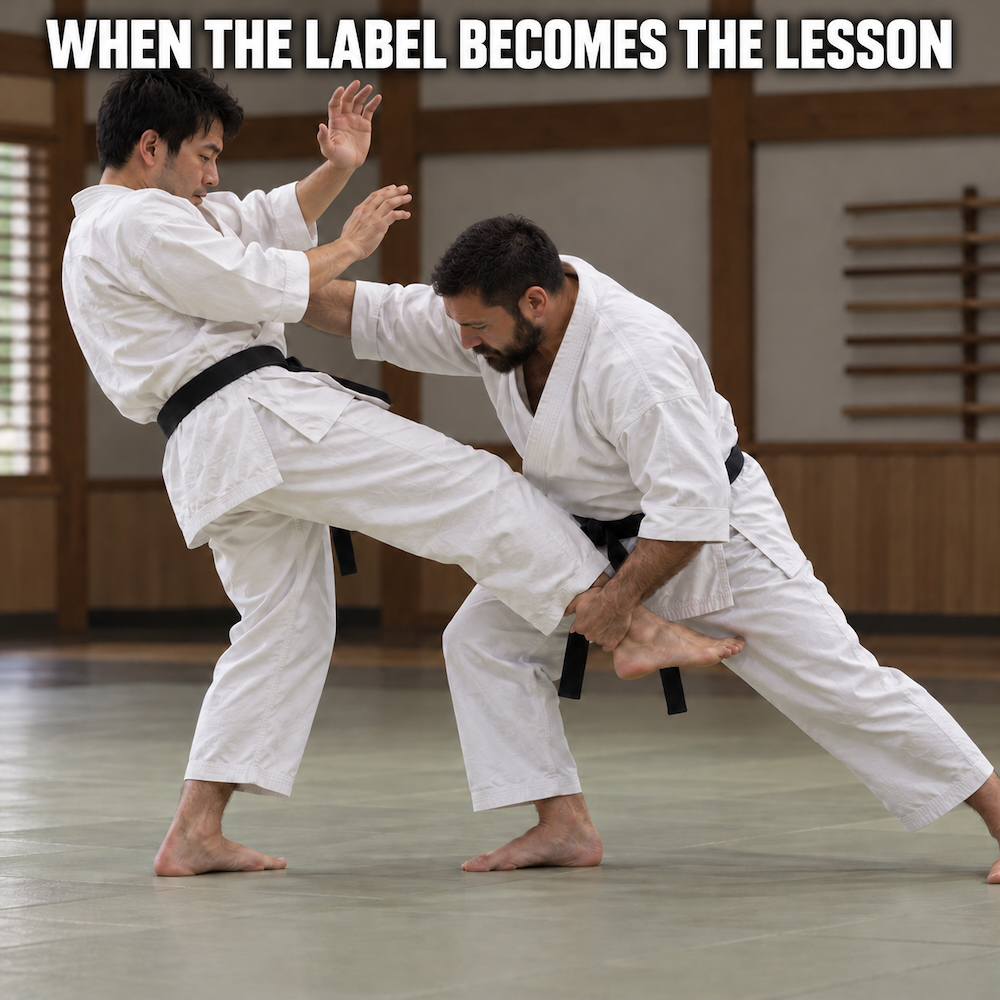
Consider a throw, for example.
To throw someone, you have to move your feet, adjust your position, change the distribution of your weight, and respond to the movement and resistance of the other person. You may need to step across, turn, lower your center of gravity, or shift your weight to take away their balance.
At some point during that action, your body might resemble a recognizable karate stance. Perhaps something very close to zenkutsu-dachi.
But you didn’t necessarily move into zenkutsu-dachi to perform the throw. You moved to throw the person, and during that movement, your body passed through a position that resembled zenkutsu-dachi.
There’s an important difference.
Sometimes we teach the visible result of an action as though it were the action itself.
A stance can be understood as a snapshot, a moment in time during a movement. It may show us how the body is positioned, where the weight is being transferred, or how we’re using our structure to influence another person’s balance.
But the snapshot doesn’t tell the whole story. It doesn’t show what happened immediately before that moment, what caused the position to develop, or what happens next.
If you concentrate only on reproducing the position, you risk missing the movement that gives it purpose.
A student might demonstrate an excellent zenkutsu-dachi when standing alone, yet struggle to manage their balance or move effectively when someone is pulling, pushing, or resisting them. The ability to reproduce a position doesn’t automatically mean they understand how to use it.
None of this means you should abandon terminology or stop teaching recognizable positions. They’re useful starting points, but you need to remember what they’re for.
A name identifies something. It doesn’t necessarily explain its purpose. A position shows us where the body is at a particular moment, but not necessarily what brought it there.
When the label becomes the lesson, we may become very good at reproducing what we’ve been shown without ever understanding why we’re doing it.
Help Keep Applied Methods Free
Applied Methods is independently written and freely available. If you enjoy the articles and would like to support the continued writing and upkeep of the site, contributions are always appreciated, but never expected.