Looking beyond the movement we practice.
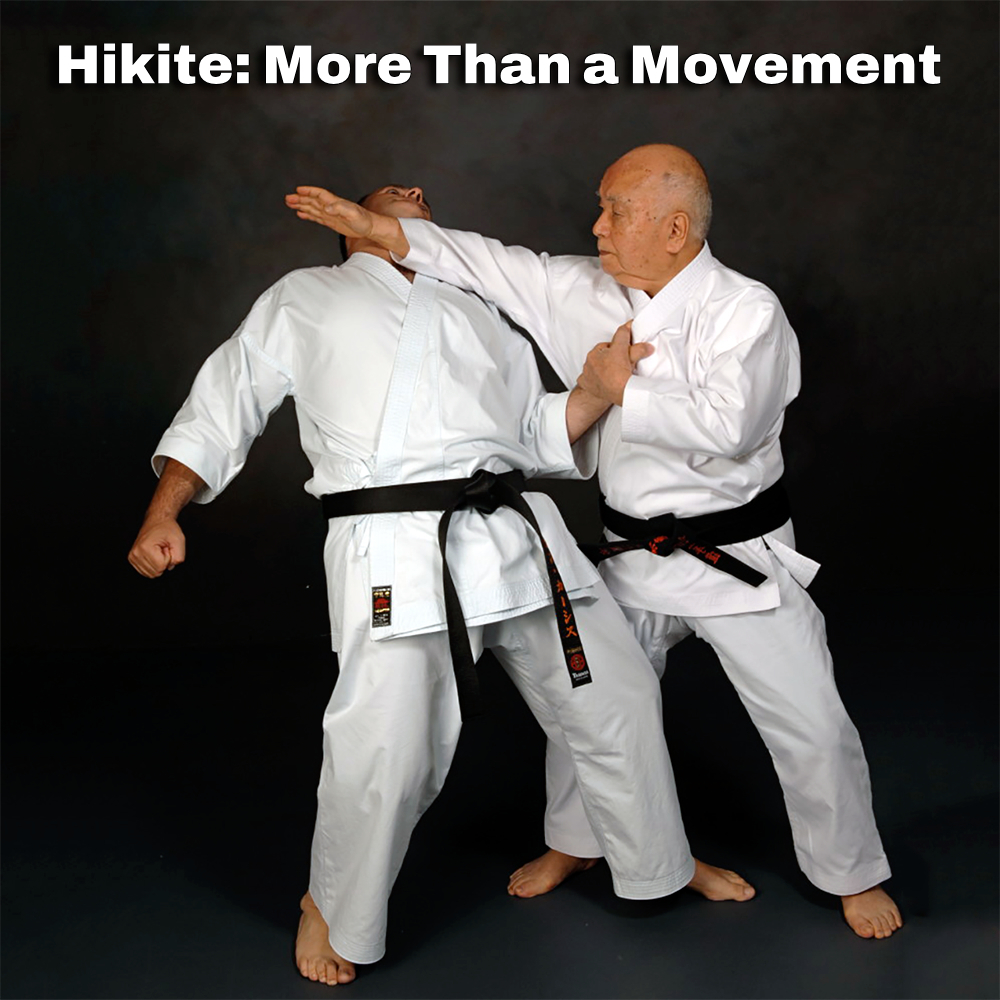
One of the most familiar movements in karate is the withdrawing hand. We see it in kihon, throughout kata, and in countless demonstrations. One hand moves forward while the other is pulled sharply back to the hip or floating ribs.
Students are taught this movement from their earliest lessons. The fist must be closed, the elbow kept close to the body, and the hand withdrawn to what is considered the correct position. Instructors correct it repeatedly, often spending considerable time making sure the movement looks as it should.
But what are we actually teaching?
When I began karate in the 1970s, I was told that pulling the opposite hand back quickly helped generate power in the punch. Like most beginners, I accepted the explanation and practiced accordingly. It certainly felt powerful, particularly when performed sharply and with considerable effort.
The problem is that feeling powerful and delivering power are not necessarily the same thing.
The withdrawing arm can influence the coordination and movement of the body, but that doesn’t establish that pulling an otherwise unused hand to the hip automatically makes the other hand strike harder. Effective striking depends on how the body works together, including structure, timing, movement, and the delivery of force into the target.
I’ve written about this explanation many times, so I don’t intend to repeat those arguments here. What interests me more is what happens when we give the withdrawing hand something useful to do.
The Japanese term hikite is commonly translated as “pulling hand”. Yet in much of modern karate practice, we seem more concerned with where the hand finishes than with what it might actually be pulling.
Consider a simple exercise with a partner.
Your partner grabs your clothing. You take hold of their wrist or forearm and draw it towards you while adjusting your position. Their shoulder turns, their posture changes, and their balance may be affected. Your other hand can now work while the first maintains control.
Suddenly, the withdrawing movement has a purpose.
Of course, your partner may resist, move with the pull, attempt to recover their balance, or use their other hand. The movement must adapt to what they’re doing rather than expecting them to cooperate.
Drawing the hand towards the hip can be a useful way to apply a strong pull, particularly when trying to disrupt an opponent’s posture or balance. But the important consideration isn’t where the hand finishes. It’s what the action achieves. Depending on the circumstances, the hand may need to remain higher, move across the body, or maintain control elsewhere.
This brings us to something Motobu Chōki emphasized: meotode, often translated as “husband and wife hands
Motobu considered the coordinated use of both hands an important principle of karate. Rather than treating one hand as active while the other remains withdrawn, the hands work together in attack and defense.
I think this is particularly relevant to our understanding of hikite.
One hand may control while the other strikes. One may clear a limb while the other maintains contact. Both might work together to disrupt balance or manipulate an arm. What matters is their relationship and the effect they have on the person in front of us.
This doesn’t mean that every movement withdrawing towards the hip represents exactly the same application. Nor does the translation of hikite establish the original intention behind every example found in kata. But it does give us a useful direction for practical study.
When practicing kata alone, we reproduce the movement, its direction, timing, and relationship with the other hand. What we cannot reproduce without a partner is the physical interaction that gives the movement its purpose.
I have no objection to students learning the formal movement. There’s value in developing coordination, body mechanics, and consistency. But if teaching stops at making the hand return correctly to the hip, we’ve only taught part of what they need to understand.
We need to introduce another person, allowing students to experience what happens when the withdrawing hand actually controls something. They should feel the difference between pulling through empty space and applying that movement against someone who has their own intentions.
For me, this is where hikite becomes much more interesting. It stops being an argument about the correct position of a fist and becomes a study of how we use our hands together against another person.
And that brings us back to a question I believe every instructor should consider.
When we teach a student to withdraw their hand, are we teaching them to perform a movement, or are we teaching them how to use that hand?
Help Keep Applied Methods Free
Applied Methods is independently written and freely available. If you enjoy the articles and would like to support the continued writing and upkeep of the site, contributions are always appreciated, but never expected.