A familiar movement, an old training memory, and a different way of looking at things.
Something occurred to me recently while I was training, and I’ve been giving it quite a bit of thought.
We generally regard karate as a defensive art. Someone attacks, we respond. Much of the way karate has been taught for generations follows that pattern. An opponent punches, we “block”, and then counterattack.
But what if we’ve been looking at some of this the wrong way around?
I was reminded of my early training. We practiced exercises called randori no kata, which eventually led to nanahon kumite, a series of seven prescribed attacks and responses. They weren’t called step-kumite, but in many respects that’s exactly what they were.
Something I remember particularly well was the emphasis placed on the attack itself.
We were expected to attack decisively. The punch had to be strong, accurate, correctly timed, and delivered with genuine commitment.
The person defending couldn’t simply move out of the way as soon as the attack began. Move too early, and the attacker could see that movement and adjust their punch. The defender had to wait until the attacker was sufficiently committed that changing direction became difficult.
Move too late, and you got hit.
I remember a brown belt returning to training after some time away. He asked the instructor whether he could wear his brown belt, and was told to put it on and they would see how he got on.
He was partnered with me.
Before we started, I said to him, “Are you okay with this drill? And remember, get out of the way when I attack.”
Unfortunately, his timing wasn’t quite what it had been. I caught him square in the face, and down he went.
That incident demonstrated the importance of timing, even when someone knew exactly what was coming.
I’ve argued for years that traditional step-kumite, as commonly practiced, has considerable limitations when preparing someone for actual violence. My opinion hasn’t changed.
But remembering those exercises made me consider something else. We tend to examine them from the defender’s perspective, concentrating on the “block”, evasion, and counterattack. Yet we also spent an enormous amount of time learning to deliver the attack effectively.
Was there something important in that which we’ve overlooked?
It made me think about the stepping punch itself. What if we considered it not simply as an artificial attack for someone else to defend against, but as a way of learning to advance and strike decisively?
Imagine someone whose behavior makes it clear that an attack is imminent. Rather than waiting for the first punch and then attempting to defend against it, the karate practitioner takes the initiative, advancing just enough to deliver a decisive straight punch. The intention isn’t to start a fight, but to prevent an imminent attack from developing in the first place.
What if that was one of the purposes behind the stepping punch?
Look at a boxer advancing while punching. The feet adjust the distance, the body moves, and the punch arrives as part of that coordinated action. There’s no enormous step or deliberate attempt to finish in a particular stance. The footwork allows the boxer to position themselves and deliver the punch effectively.
Now consider how we generally teach oi-zuki in karate.
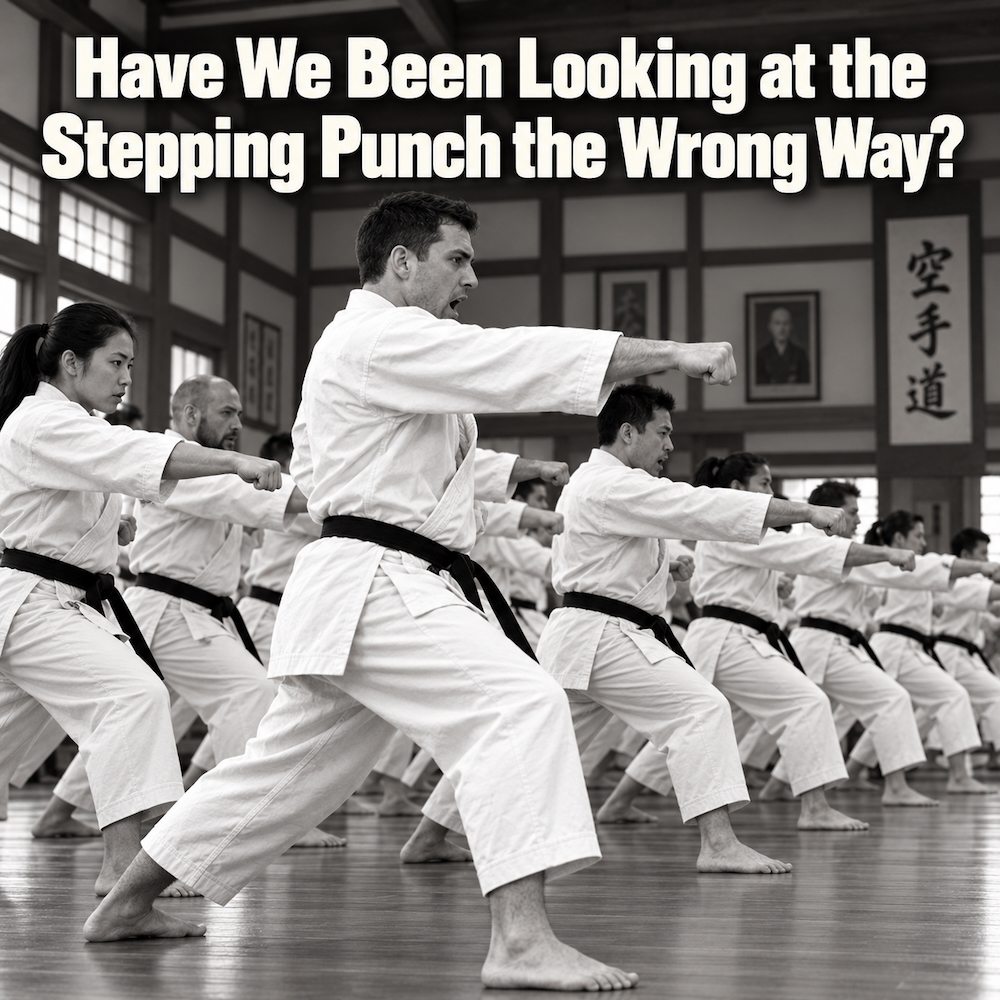
The student takes a large step, coordinates the body and arm, and finishes in a recognizable stance. But why such a large movement?
Perhaps there’s a perfectly reasonable explanation.
When teaching beginners, particularly in large classes, exaggerated movements make things easier to see, understand, and correct. The instructor can observe the coordination of the body, the timing of the step, and the delivery of the punch. The student has an opportunity to learn how those elements work together.
There’s nothing inherently wrong with that.
But what if the formal stepping punch was originally a way of developing the ability to deliver a decisive strike while advancing, and subsequent generations began treating the training method as the fighting method itself?
There may, of course, be other reasons for the exaggerated step.
In application, the movement might be considerably smaller. The feet adjust the distance, the body advances, and the strike arrives as part of one coordinated action. Much like the boxer.
Of course, taking the initiative isn’t always possible or appropriate, and there will be occasions when we have no choice but to respond to an attack already underway. Nor am I suggesting that a single punch will necessarily end a confrontation.
But perhaps we’ve become so accustomed to seeing the stepping punch used as the opening attack in a defensive exercise that we’ve overlooked something important about the movement itself.
The principle of advancing and striking remains useful, even if the formal movement bears little resemblance to how we might actually use it.
I don’t know whether this was the original intention behind oi-zuki. It’s simply a thought that came from remembering something I practiced decades ago and looking at it from a different perspective… Just a musing.
Perhaps the problem was never that we made the stepping punch larger to teach it.
Perhaps the problem was that we never taught students how to make it smaller again.
Help Keep Applied Methods Free
Applied Methods is independently written and freely available. If you enjoy the articles and would like to support the continued writing and upkeep of the site, contributions are always appreciated, but never expected.