Why Karate Needs More Questions, Not Fewer
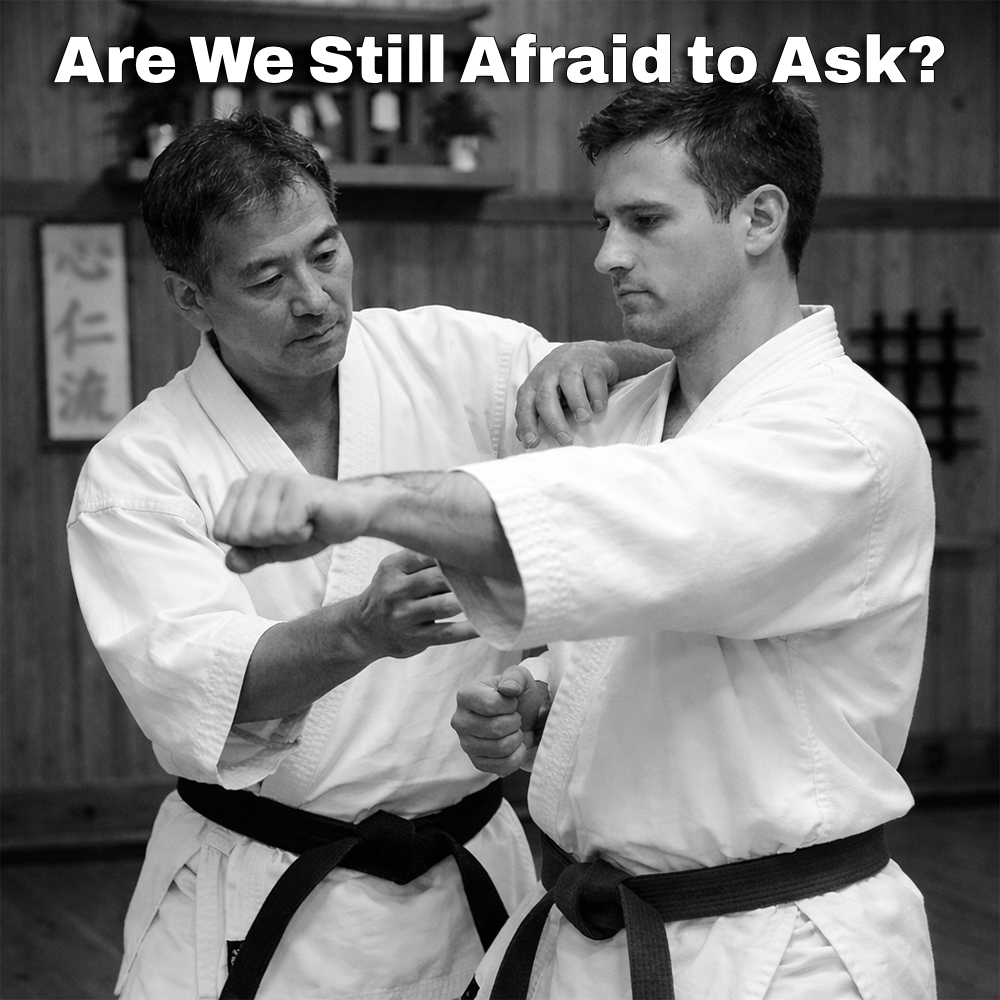
Every so often, particularly on social media, I come across an explanation about karate that makes me wonder whether we’re asking enough questions.
Someone offers an explanation, often with considerable confidence, and because of their grade, reputation, or lineage, it seems to be accepted without much examination. Other people repeat it, and before long, what may have started as one person’s interpretation becomes something everybody seems to know.
But how often do we stop and ask whether the explanation actually makes sense?
When I began karate in the 1970s, questioning a senior instructor wasn’t something you generally did. My first instructor was Japanese, considerably older than me, and very strict. English wasn’t his first language, and he wasn’t particularly approachable. I was young, of course, and didn’t have the experience or confidence to question much anyway. You listened, followed instructions, and trained.
There’s a cultural aspect to consider here, too. In some traditional Japanese martial arts environments, openly questioning an elder or senior instructor can be regarded as disrespectful, particularly if it appears to challenge their authority. But that doesn’t mean everyone shares that attitude, or that asking a question is necessarily disrespectful.
Looking back, I think this reluctance to question is very much dependent on the individual teacher. Some welcome it, while others seem to regard almost any question as a challenge to their knowledge or position. Much later, I was fortunate to encounter teachers who encouraged questions, and I learned a great deal from that approach.
And I wonder whether the problem goes deeper than that.
Perhaps some instructors are reluctant to question what they themselves were taught. After all, if you’ve spent decades studying under a respected teacher, particularly someone with an established Okinawan or Japanese lineage, questioning their explanations might feel disrespectful. Almost as though you’re questioning the teacher rather than the information.
There’s also the matter of loyalty. When someone has given you years of their time and knowledge, you naturally want to respect what they’ve passed on. I certainly understand that.
But respecting a teacher doesn’t mean believing they were infallible.
Teachers are human. They have their own experiences, interpretations, and limitations. Some explanations may have been passed down through several generations without anyone stopping to examine them. Others may have been developed to explain movements whose original purpose was no longer clearly understood.
That doesn’t necessarily make those explanations worthless, but neither does it make them correct.
And when we become instructors ourselves, we have a responsibility to consider what we’re passing on to our students.
It’s perfectly reasonable to teach someone how a particular movement is performed. But if we also claim to understand its purpose, shouldn’t we be able to explain why we’re teaching it that way?
If we’re teaching something as a practical method of self-protection, we should be prepared to examine whether it actually works in the circumstances for which we’re recommending it.
And if we don’t know the answer?
I see nothing wrong with saying so.
I’ve been studying karate for more than fifty years, and there are still things I question, things I reconsider, and things I understand differently from how I understood them years ago. I would be rather disappointed if that weren’t the case.
The difficulty arises when an instructor feels obliged to have an answer for everything, or when their position makes it uncomfortable for anyone to suggest that an explanation might be incomplete or mistaken.
Students quickly learn what is acceptable in a dojo. If questions are welcomed, they’ll ask them. If questions are dismissed, ridiculed, or treated as disrespectful, they’ll eventually stop asking.
But that silence shouldn’t be mistaken for understanding.
There’s another consequence, too. Those students may eventually become instructors themselves, passing on the same explanations with the same certainty, without ever having examined them.
And so the cycle continues.
I have enormous respect for the teachers who helped me along the way, including those whose methods I eventually moved away from. I can appreciate what they taught me without believing that everything they taught was beyond question.
In fact, some of the most valuable lessons I’ve learned came from recognizing what I wasn’t being taught.
I don’t believe that questioning a teacher should be an act of defiance. Nor should an instructor feel threatened when a student asks why. Sometimes a good question makes us reconsider something we’ve accepted for years, and surely that’s an opportunity to learn rather than something to be discouraged.
Karate has a long history, and preserving that history has value. But preserving what we’ve inherited shouldn’t prevent us from re-examining it.
If anything, I would suggest that a teacher who encourages students to think independently is doing far more for the future of karate than one who expects unquestioning acceptance.
Perhaps we should be less concerned about students questioning what we teach and more concerned about what happens when they stop asking.
And as instructors, maybe we should ask ourselves whether we’re still willing to question what we were taught.
Help Keep Applied Methods Free
Applied Methods is independently written and freely available. If you enjoy the articles and would like to support the continued writing and upkeep of the site, contributions are always appreciated, but never expected.