What we wear, where we stand, and the realities of practical karate.
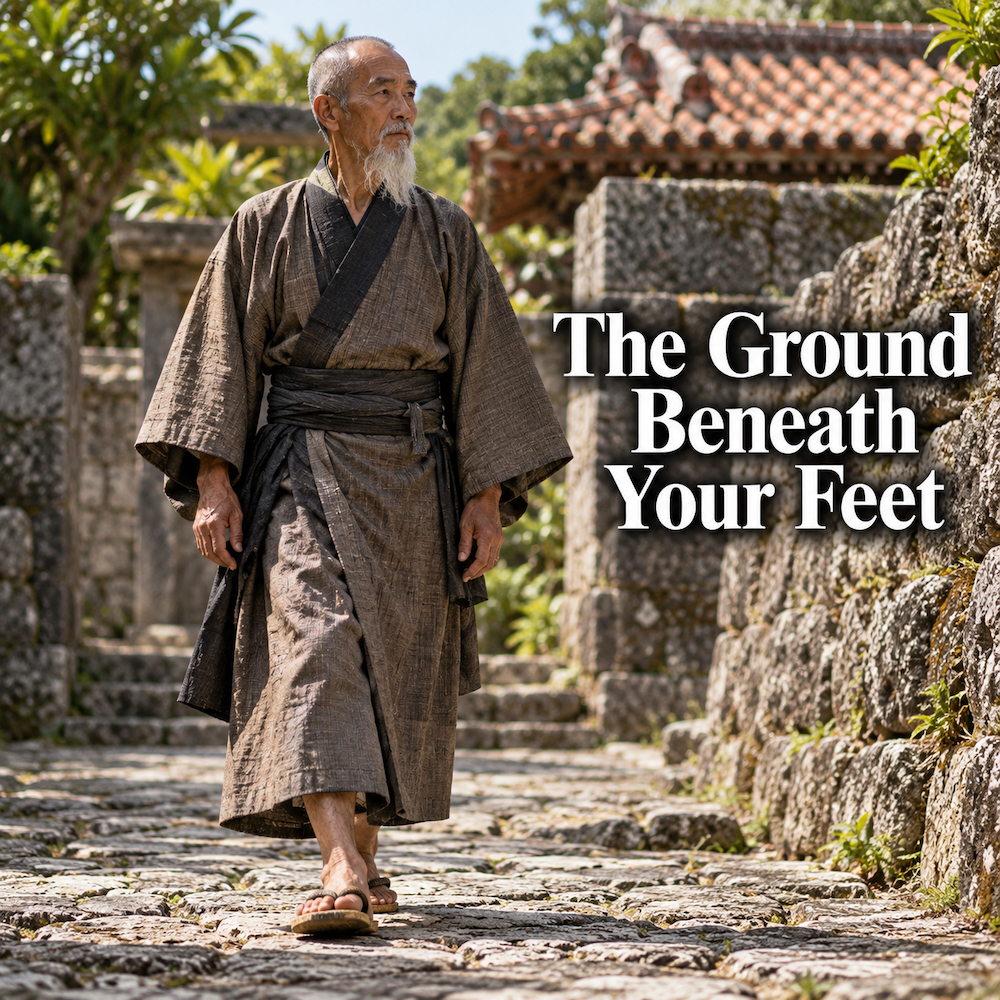
When looking at the origins of karate on Okinawa, something that’s often overlooked is what those early practitioners actually wore on their feet.
Much of karate’s early recorded history is associated with members of the Ryukyuan upper classes, including officials connected to the royal court. They would have worn the clothing and footwear appropriate to their position, which raises an interesting question.
How did they move when wearing sandals or other traditional footwear? Were those sandals restrictive? Could they be slipped off easily? And if they found themselves in a confrontation, would they really have had the opportunity to remove them?
I don’t pretend to know all the answers, but these are the sorts of questions that have always interested me when considering how karate might actually have been used.
After all, the people who practiced karate weren’t permanently barefoot, dressed in a keikogi, standing on a nice clean dojo floor.
Neither are we.
Back in the 1970s, I deliberately sought out the lightweight slippers commonly associated with Chinese Kung Fu. I wore them all the time because they were light, flexible and comfortable to move in. I liked the freedom they gave my feet.
Over the years, I’ve also experimented with practicing karate in different types of trainers, and the differences can be quite surprising.
Some are heavy and change the feel of a movement entirely. Others have so much grip that turning or pivoting becomes uncomfortable. I’ve experienced that sensation of the foot remaining firmly planted while the body continues to rotate, placing unnecessary stress on the knee.
I also own a pair of running shoes that are wonderful for cushioning, yet almost useless on certain wet surfaces or grass. They simply don’t provide the grip I would want.
The same footwear that works beautifully for one activity can become a disadvantage in another.
And that is just footwear.
Consider the clothing we wear in everyday life. Tight jeans, a heavy winter coat, a restrictive jacket or several layers of clothing and gloves in cold weather. All can influence our ability to move, reach, turn or maintain balance.
Then there is the environment itself. A wet pavement, icy ground, loose gravel, uneven grass or a staircase. Perhaps you’re standing between parked cars, in a narrow passageway or somewhere crowded with people and obstacles.
Even the weather matters. Rain, snow, poor visibility or cold hands can change the circumstances considerably.
Yet how often are these things seriously considered when discussing the practical application of karate?
We spend countless hours examining techniques, discussing distance, timing, body mechanics and the movements contained within kata. We debate what works and what doesn’t, usually in the comfortable, predictable surroundings of the dojo.
But the environment in which we practice is not necessarily the environment in which we might need to protect ourselves.
And unlike the dojo, we don’t get to choose the conditions.
I’ve found that something as simple as changing footwear can make a familiar movement feel very different. It makes me wonder how much of what we practice depends upon the conditions we’ve become accustomed to.
Perhaps this is something we have overlooked in our efforts to understand the karate of the past, too.
We spend considerable time asking what the movements of old kata were intended to accomplish, but perhaps we should also consider the lives of the people who practiced them.
Because when something unexpected happens, we won’t be asked to remove our shoes, change our clothes or find somewhere suitable to stand.
Help Keep Applied Methods Free
Applied Methods is independently written and freely available. If you enjoy the articles and would like to support the continued writing and upkeep of the site, contributions are always appreciated, but never expected.