Understanding kuzushi as a principle, rather than a particular technique.
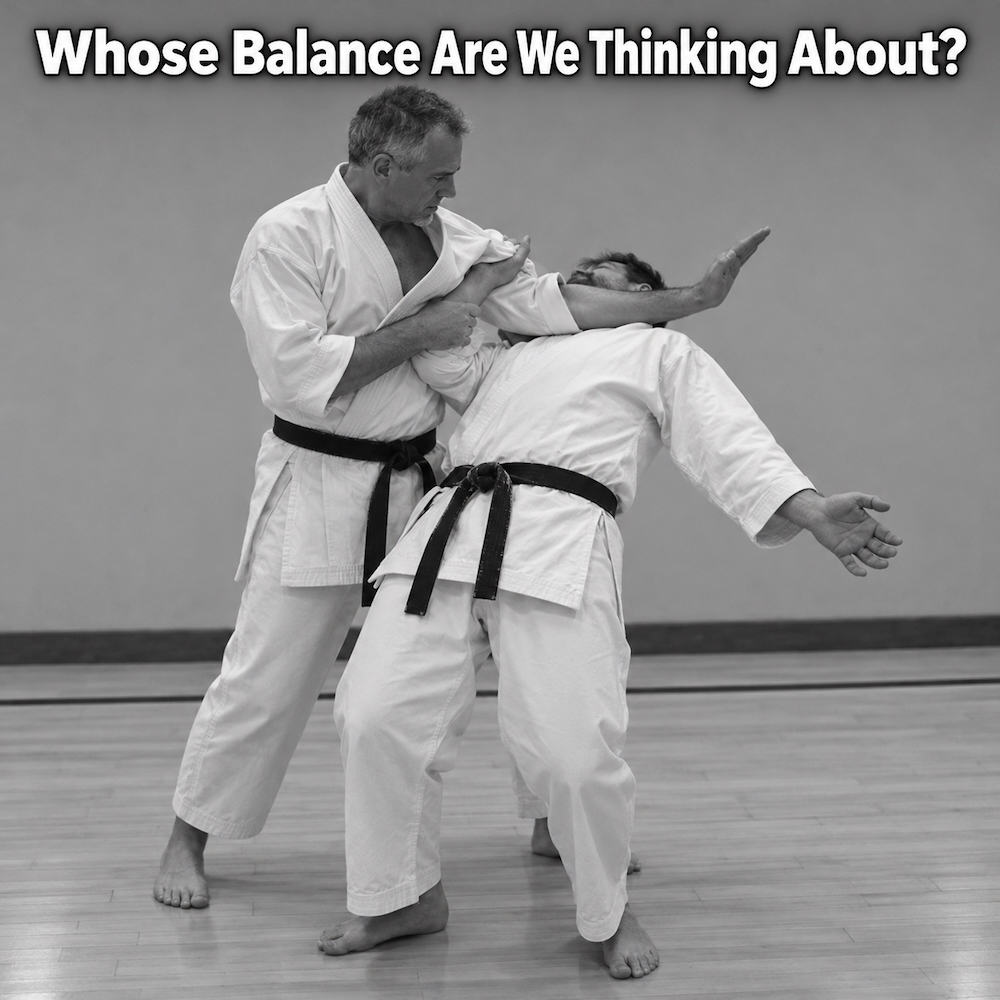
We spend a great deal of time in karate learning to maintain our own balance. We practice moving, striking, and changing direction while remaining stable. And rightly so, because without balance, much of what we’re trying to achieve becomes considerably more difficult.
But when we’re dealing with another person, our own balance is only part of the problem.
If the person in front of us remains comfortable and stable, they’re in a good position to move, strike, resist, or counter whatever we’re attempting. Disturb that balance, even briefly, and we begin to change what they’re capable of doing.
This brings us to the principle of kuzushi, something I believe deserves far more attention in our everyday training.
Kuzushi is generally understood as breaking or disrupting another person’s balance.
In close-quarter karate, affecting another person’s posture and stability can make an enormous difference. It may prevent them from striking effectively, restrict their movement, or create an opportunity for us to take further action.
And it doesn’t necessarily require a great deal of force. Sometimes a relatively small movement is enough to disturb someone’s posture, forcing them to make an adjustment to try and recover their balance.
For that brief moment, their priorities may have changed. Instead of concentrating on what they intended to do to us, they’re having to deal with what’s happening to them.
Of course, how we achieve this will depend on the circumstances.
Sometimes we may need to control someone’s balance before we can break it. At other times, the opportunity to disrupt their balance may be immediate. There’s no prescribed sequence that will suit every confrontation. The person’s actions, our position, and the circumstances will determine what’s possible.
It’s a principle we learn to use, not a sequence we learn to follow.
Whether we’re studying Naihanchi, Seienchin, Seisan, Passai, or any other kata, the principles of controlling and disrupting another person’s balance should be part of how we investigate the movements.
I’m not suggesting that every movement in kata must represent a throw or some elaborate method of unbalancing an opponent. That would be missing the point entirely.
The principle is far broader than that.
And simply recognizing what appears to be an example of kuzushi in a kata doesn’t mean we understand how to apply it.
For that, we need another person.
We need to experience how someone reacts when their balance is disturbed, how their weight shifts, and how they attempt to recover their position. We need to understand what happens when they don’t respond as expected, or when they actively resist what we’re trying to do.
It’s relatively easy to demonstrate an unbalancing technique against a compliant partner. It’s quite another matter when that person is determined to remain standing, resist our efforts, or continue attacking.
We become so concerned with identifying individual techniques within kata that we overlook the principles which allow those techniques to work.
Kuzushi isn’t something that belongs to one kata, one movement, or one particular technique. It’s something that should influence how we understand and practice karate as a whole.
Maintaining our own balance is important, certainly. But when we’re working with another person, there’s another question we should be asking.
What are we doing about theirs?
Help Keep Applied Methods Free
Applied Methods is independently written and freely available. If you enjoy the articles and would like to support the continued writing and upkeep of the site, contributions are always appreciated, but never expected.