
When the attacker has to cooperate for the technique to work, what are we really learning?
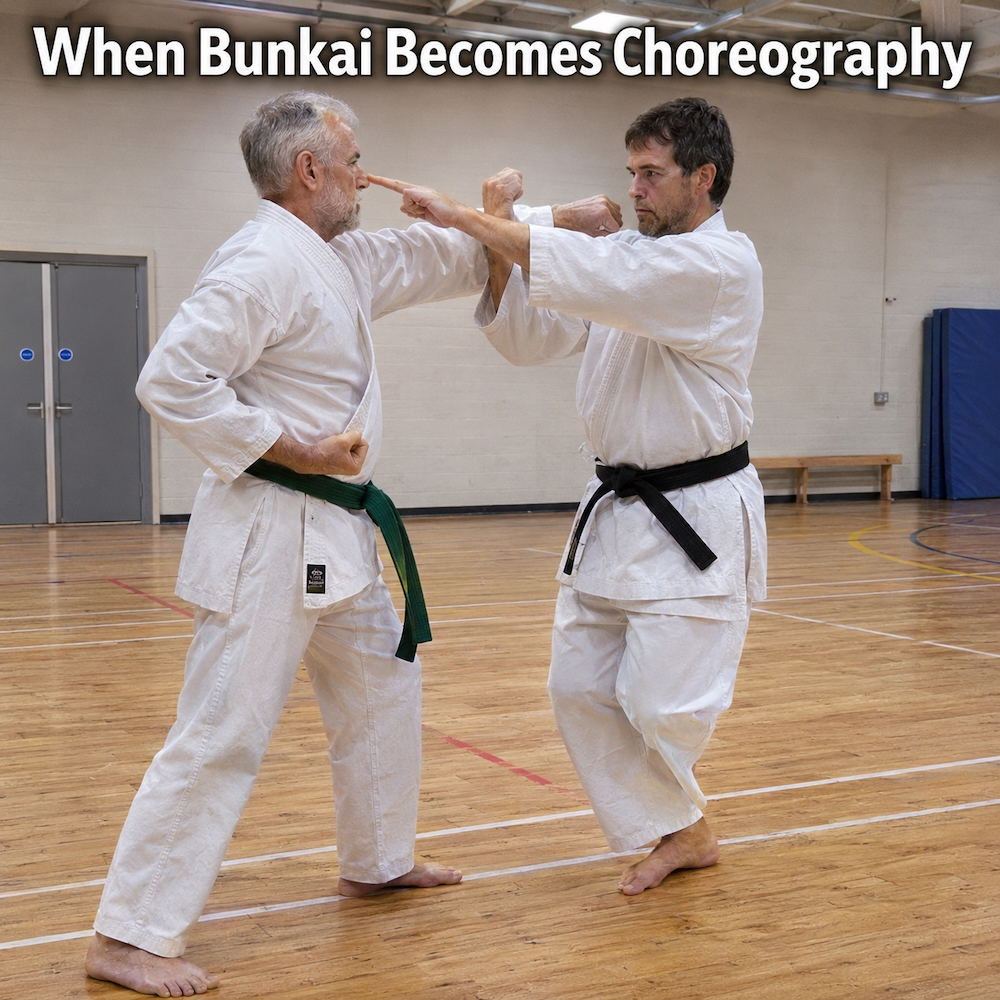
I recently came across a photo of two karate practitioners demonstrating bunkai. It was one of those images that makes me wonder what people are actually thinking when they practice this way.
The attacker had stopped dead, one hand pulled back to his hip, apparently waiting for the defender to complete his technique. The defender had adopted a cross-legged stance that served no apparent purpose, blocking a jodan oi-zuki with one arm before seemingly attempting to strike towards his opponent’s eyes with the other hand.
There was no forward momentum, no meaningful pressure, and no indication of what might happen if the attacker simply continued moving.
Everything depended upon both people doing exactly what was expected of them.
It was choreography.
And it reminded me of something I’ve written about before. Why is there so much ambiguity in karate, particularly when we start discussing the practical application of kata?
I used to teach advanced police driving. Imagine teaching someone a response to a developing hazard that depended entirely upon every other road user behaving exactly as expected. It would be dangerous. At speed, circumstances change quickly, and there isn’t time to work through a catalogue of possible responses. You need sound principles, practiced repeatedly, and the ability to adapt to what’s happening.
Why should our karate be any different?
Exploring different interpretations isn’t necessarily the problem. The problem is accepting an interpretation simply because a cooperative partner can make it look convincing.
Look at how bunkai is often taught. We identify a technique, give it a name, and then find an attack that allows us to demonstrate its application. Another technique receives another explanation, and the process continues.
Before long, students have accumulated an enormous collection of prescribed responses, many of which depend upon an opponent behaving in a very specific way.
But what are they actually learning?
Of course, there is nothing wrong with using a cooperative partner to understand a movement. We all have to begin somewhere. The problem arises when that cooperation becomes essential to the success of the technique, rather than simply a means of learning it.
The attacker should not have to make our technique work for us.
I believe much of this comes from becoming too attached to individual techniques and their names. We see a movement in kata, identify it as nukite, ko-uke or haito uchi, and immediately begin searching for an application that fits the name. Sometimes we become so concerned with reproducing its appearance that we overlook what the movement is actually trying to achieve.
For me, the value of kata lies in understanding the principles behind its movements, rather than collecting a separate answer for every conceivable attack.
When those principles are understood and practiced against realistic pressure, they can be adapted. We don’t need to recognize a particular attack and then search our memory for the appropriate technique.
And that matters, because fear, surprise, and resistance have a habit of making even familiar things considerably more difficult.
The simpler and more familiar our responses, the less we have to think about them when it matters.
I sometimes wonder whether practitioners become so accustomed to performing these demonstrations that they stop noticing how much cooperation is required to make the application appear effective. Or perhaps nobody has ever asked the attacker to behave differently.
But surely that is one of the first things we should be asking.
What happens when the attacker doesn’t do what we expect?
If the answer is that the application falls apart, then perhaps we haven’t understood the movement as well as we thought.
Help Keep Applied Methods Free
Applied Methods is independently written and freely available. If you enjoy the articles and would like to support the continued writing and upkeep of the site, contributions are always appreciated, but never expected.
Thankyou Adam! I completely agree. Most instructors cannot distinguish or do not know that difference between choreography and self-defence. As you said, choreography can have its place, but if the objective is self-defence, then the principles behind techniques should be taught and techniques should be tested live against an uncooperative opponent. Best wishes🙏