Over the years, my own approach to teaching has changed considerably.
A comment on one of my recent articles made me think again about why that change was necessary. The reader asked:
“I’m a student and this is a genuine want to learn question. Does kata or bunkai allow for attack variations or continuation of threat/attack after the supposed attack has been neutralized?”
It makes me wonder what students are actually being taught about the practical application of karate.
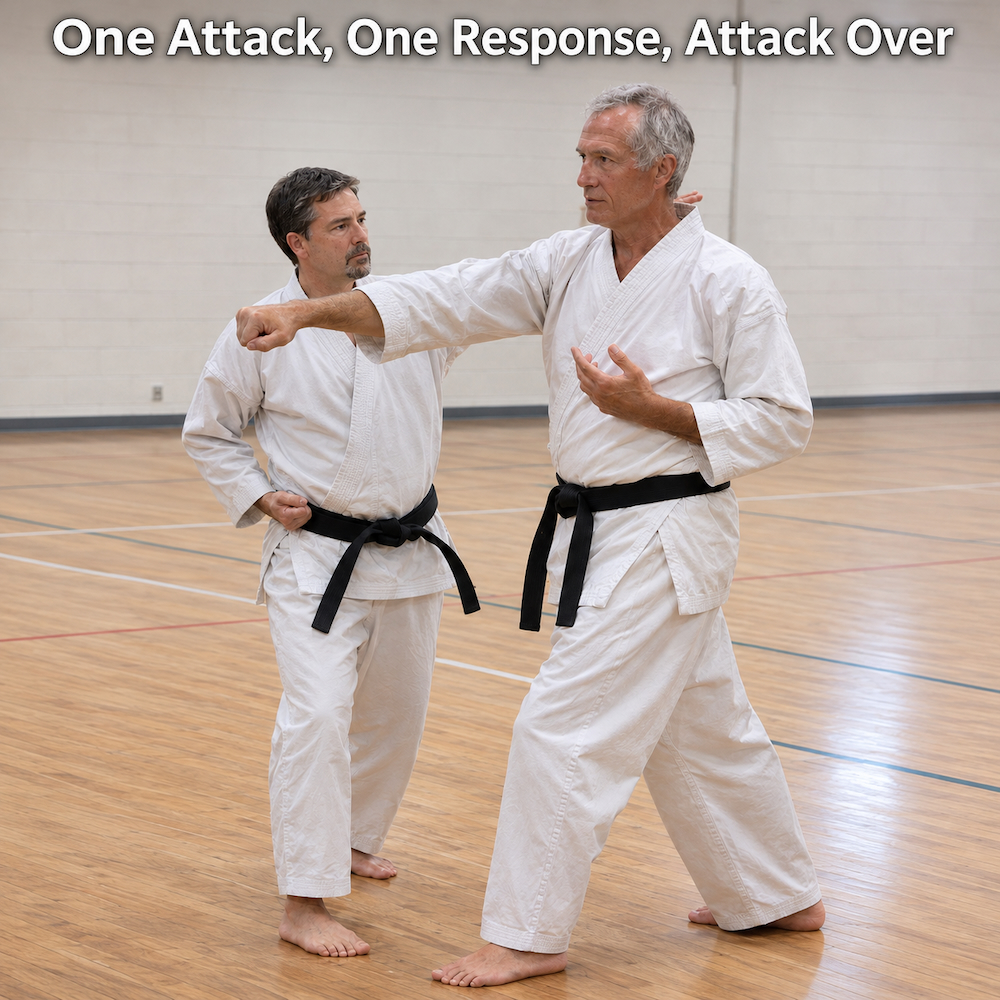
So much bunkai seems to follow the same pattern. Someone steps forward with a prescribed karate attack, the defender performs a technique, and everything stops. The attacker has done their job, the defender has completed the application, and both return to their starting positions.
One attack, one response, attack over.
But what happens when the attacker doesn’t stop? What happens when the first attempt fails, or the attacker changes what they’re doing?
Real confrontations don’t follow a script.
Where is the shouting, pushing, grabbing, spitting, swinging punches, headbutts, low kicks, hair pulling, or someone attacking from behind or from an unexpected angle? And what happens when several of these things occur together, or one immediately follows another?
And I’m certainly not suggesting we need a separate technique for every one of them. That would simply replace one collection of prescribed responses with another.
We need to teach students how to deal with the problems, not give them hundreds of answers to remember.
Personally, I start by looking at the problems people are actually likely to face, rather than beginning with kata and searching for applications.
What are the common habitual acts of violence? How do assaults typically begin? What happens when one person becomes aggressive towards another?
These are not my ideas, of course. Others have been advocating this approach for years, and my own teaching has changed as I’ve learned and reconsidered what I was taught.
We can’t predict exactly what will happen in a confrontation. But understanding the problems people actually face gives us something far more useful than an imaginary attack invented to accommodate a kata movement.
It gives us a starting point based on reality.
From there, we can examine the problems, explore ways of dealing with them, and practice against increasing resistance. We can see what happens when something doesn’t work, rather than stopping the moment a technique has been completed.
A technique can be performed correctly and still be entirely wrong for the situation.
The person in front of us doesn’t know what we’ve practiced. They won’t necessarily stand where we need them to, move in the direction we expect, or give us the opportunity to use a particular technique.
We have to deal with what’s actually happening, not what we hoped would happen.
And that brings me back to the student’s question.
If we’re teaching karate for self-protection, why should a student have to question whether our training accounts for an attacker who doesn’t stop?
The movements of kata may be fixed, but the person in front of us certainly isn’t.
Help Keep Applied Methods Free
Applied Methods is independently written and freely available. If you enjoy the articles and would like to support the continued writing and upkeep of the site, contributions are always appreciated, but never expected.