
The more we understand a kata, the less our responses may need to look like it.
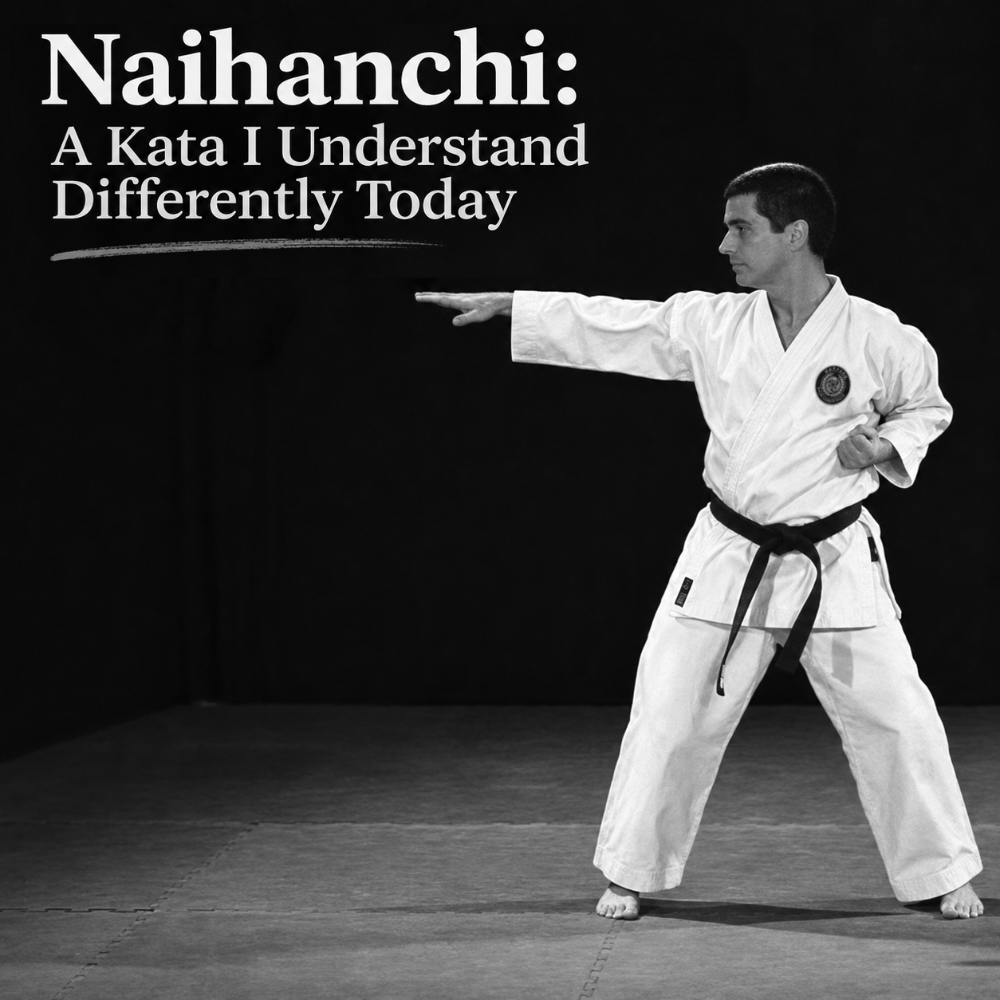
Naihanchi has always been one of my favourite kata. Its movements are relatively simple in appearance, yet there is a great deal to discover beneath the surface.
Over the years, I’ve practised it countless times, taught it to students and explored its applications during seminars and courses. But my understanding has changed as I’ve gained experience, questioned what I’ve been taught and made discoveries of my own.
There was a time when much of my attention was directed towards identifying the applications of individual movements. What did this movement mean? How could it be used? What was the opponent supposed to be doing?
Those questions still have their place, but I’ve become increasingly interested in what happens when things don’t go according to plan.
The kata is not the confrontation.
These days, when I practise and teach Naihanchi with a partner, we often begin with a common act of violence. Someone pushes, grabs, attempts to punch, or behaves aggressively in some other way.
We then explore what Naihanchi might offer us in dealing with that particular problem.
Initially, I want students to recognise the movements of the kata in what we’re practising. Otherwise, we might just as well forget about it altogether and simply practise the two-person drill.
But once those connections are understood, I don’t see any reason to remain confined to them.
In fact, when working with a partner, I often approach the exercise with a simple thought: Let’s see what develops.
And what happens can be quite different from what we originally intended.
Take something as common as a push or grab, perhaps immediately before someone attempts to punch.
If I can establish control of that initial contact, I have something to work with. I’ve created a bridge, a physical connection through which I may be able to influence the other person’s movement, structure and balance.
But there’s another consideration. He still has a free hand, and I certainly don’t want to remain in a position where he can easily use it against me.
Through my own movement, or by moving him, I want to change that relationship. As I sometimes explain it, I’m trying to move closer to what I can control and further away from what I can’t.
That initial connection may offer several possibilities. I might be able to grab, strike, lock a joint, disrupt his balance or create an opportunity for a throw.
But which of those opportunities becomes available?
Well, that depends on what he does.
He might resist, pull away, change his position or attempt something else entirely. And whatever I do in response may change his behaviour again.
Suddenly, the neat application we began with has developed into something quite different.
The attacker’s behaviour determines what happens next, rather than the kata determining how the attacker must behave.
And this is where I find the study of Naihanchi particularly interesting.
The principles are still there. The use of both hands, control, positioning, balance and the ability to generate force at close range. But how those principles are expressed can change considerably as the encounter develops.
Sometimes we recognise another movement almost immediately. At other times, we might move completely away from anything that resembles the kata, only to recognise the connections afterwards.
I don’t see that as a problem.
What interests me is whether we can make use of what we’ve learned when someone doesn’t behave as expected, rather than whether we can reproduce a particular movement exactly.
Of course, not every interpretation we explore will work as intended. Sometimes we discover that something we’ve practised is less effective than we thought, or that it depends on circumstances we cannot necessarily control.
Those discoveries are just as important as the successful ones.
And I certainly don’t feel the need to find a movement from the kata to explain everything that happens. The kata doesn’t have to provide an answer to every problem for it to remain valuable.
Perhaps that’s one of the biggest changes in my own understanding. I no longer look at Naihanchi, or any other kata for that matter, simply as a collection of movements with particular applications waiting to be discovered.
I see it as something that gives me a framework to explore, question and occasionally move beyond.
I still find myself returning to Naihanchi, not because I believe it holds some secret answer to every problem, but because there is still something to learn from it.
Perhaps that’s what makes its apparent simplicity so deceptive.
The more deeply we understand Naihanchi, the less we may need to make everything we do look like Naihanchi.
Help Keep Applied Methods Free
Applied Methods is independently written and freely available. If you enjoy the articles and would like to support the continued writing and upkeep of the site, contributions are always appreciated, but never expected.
My favourite kata. I’m old, bulky, inflexible, far from agile. I can’t jump around and dazzle with speed. But I do love close quarters stuff. My sensei and training partners agree naihanchi is definitely my kata.