
The responsibility to prepare students, and the importance of learning to question for ourselves.
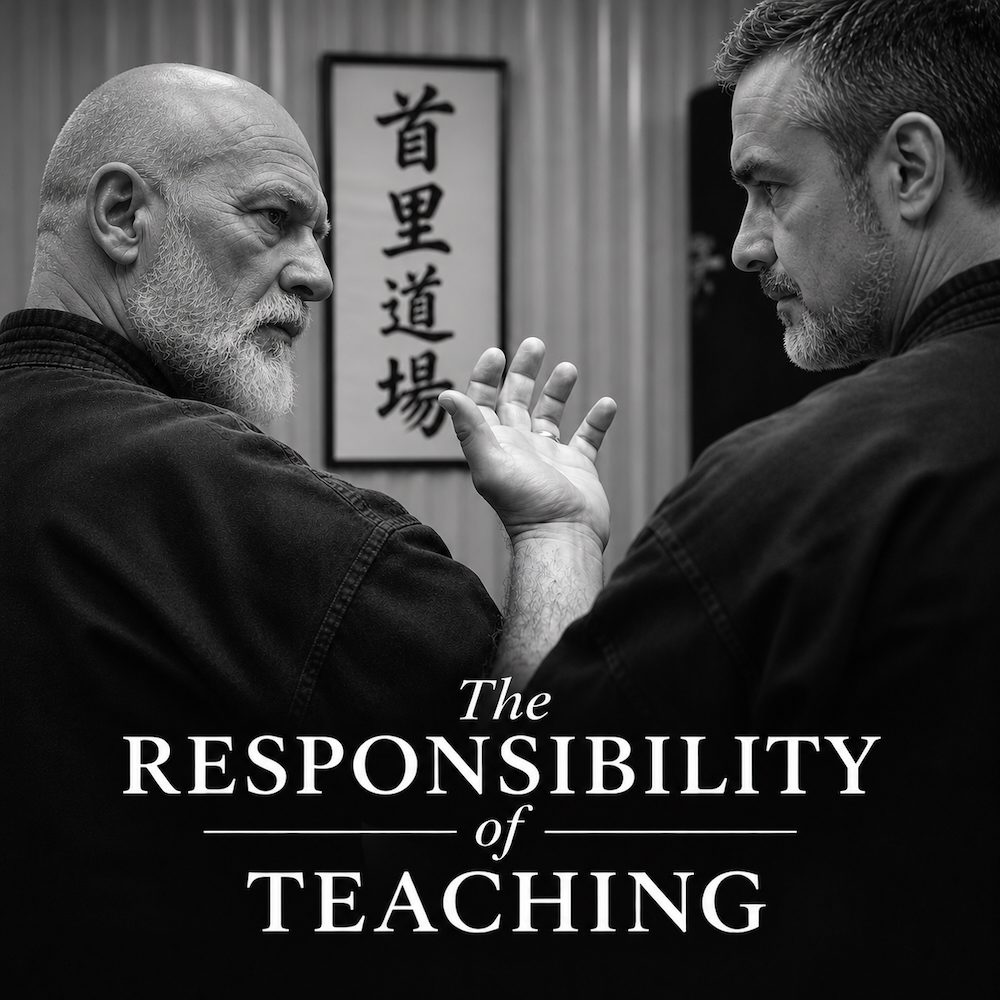
Students come and go. Some stay for decades, while others are with us for only a relatively short time. That’s the nature of teaching.
There is value in preserving the traditions of karate, but I think we also have to consider why people come to learn it in the first place.
For many, that reason is self-protection.
And if that’s why someone has come to us, then surely our responsibility is to prepare them as well as we can for that purpose, however long they remain with us.
What matters is whether the knowledge and skills the student has acquired are appropriate for what they came to learn.
I don’t want students spending years practising something, only to discover later that it has little relevance to the situations they were hoping to prepare for.
Teaching isn’t simply about passing on information, demonstrating techniques or telling someone what to do. It’s about helping students understand what they’re doing, why they’re doing it, and perhaps more importantly, recognising when something doesn’t make sense.
I’ve spent many years questioning how karate is taught and practised, including my own approach to teaching. There are things commonly taught as self-defence that, in my view, have very little to do with preparing someone for the realities of violence.
That concerns me.
It’s not enough that something looks convincing in the dojo, follows a particular tradition or has been passed down through generations. We should be able to explain what it is intended to achieve and why we believe it has merit.
But there’s another side to teaching that I’ve found increasingly difficult over the years.
Sometimes I feel that if I can’t get a point across to a student, I’ve failed as a teacher.
Perhaps I haven’t explained it particularly well. Perhaps I need to demonstrate it differently or find another way of approaching the subject. I have no problem with that. A good teacher should be prepared to question their own methods just as readily as they question those of others.
But what happens when the information is there, the explanation has been given, and the student simply isn’t interested in questioning what they already know?
When I see the same misconceptions repeated, particularly when they concern self-protection, I sometimes feel compelled to explain things all over again. Perhaps I believe that if I can just find the right words, or offer another example, the person will begin to see what I’m trying to explain.
And sometimes that works.
But I’ve also had to recognise that there’s a difference between someone not understanding what I’m saying and someone not wanting to reconsider what they already believe.
My dad used to say:
“Don’t raise your voice, improve your argument.”
I’ve always thought that was good advice, and it applies just as much to teaching. Finding better ways to explain something is part of the job. But even a better explanation doesn’t guarantee that someone will reconsider their beliefs.
I’ve sometimes wondered whether we expect too much of teachers and too little of ourselves as students. It’s easy to wait for someone to provide the next explanation or demonstrate another technique, but surely learning involves more than simply receiving information.
Students also have a responsibility to explore what they’re being taught, ask questions and make an effort to understand things for themselves.
I can share my experience, explain my reasoning and encourage people to question what they’ve been taught. I can acknowledge when I’ve made mistakes, and I should be willing to reconsider my own understanding when presented with something that challenges it.
What I cannot do is question things on someone else’s behalf.
That doesn’t mean I care any less. When I see things being taught as self-protection that I believe may give someone a false sense of security, it still concerns me. I don’t imagine that will ever change.
I want students to feel free to question me, too. And if they eventually discover something that challenges what I’ve taught, I hope they’ll have the confidence to say so.
I can keep questioning my own methods and trying to explain things as clearly as I know how.
But at some point, the questioning has to become your own.
Help Keep Applied Methods Free
Applied Methods is independently written and freely available. If you enjoy the articles and would like to support the continued writing and upkeep of the site, contributions are always appreciated, but never expected.
Sensei Carter, thank you for this post. As always, excellent food for thought.
It brought to mind this episode: Myself and a friend were discussing something I didn’t understand. He tried to help me understand. I still didn’t get it. “Please explain it again,” I asked him.
A bit frustrated, he said:
“I can explain it for you, but I can’t UNDERSTAND IT for you.”
This wise statement brought me to a kind of sudden enlightenment about explaining and understand, if not about the original thing we were speaking about.
Thank you for sharing that experience. Your friend’s observation certainly gets to the heart of what I was trying to express.
I think there’s an important distinction between someone who genuinely wants to understand but is struggling, and someone who is unwilling to question what they already believe.
As teachers, we should always be prepared to find another way of explaining something. But ultimately, understanding requires effort from the student too.
Thank you again for your thoughtful comment.
All the best.