What we inherit matters, but that does not mean it should remain unchanged.
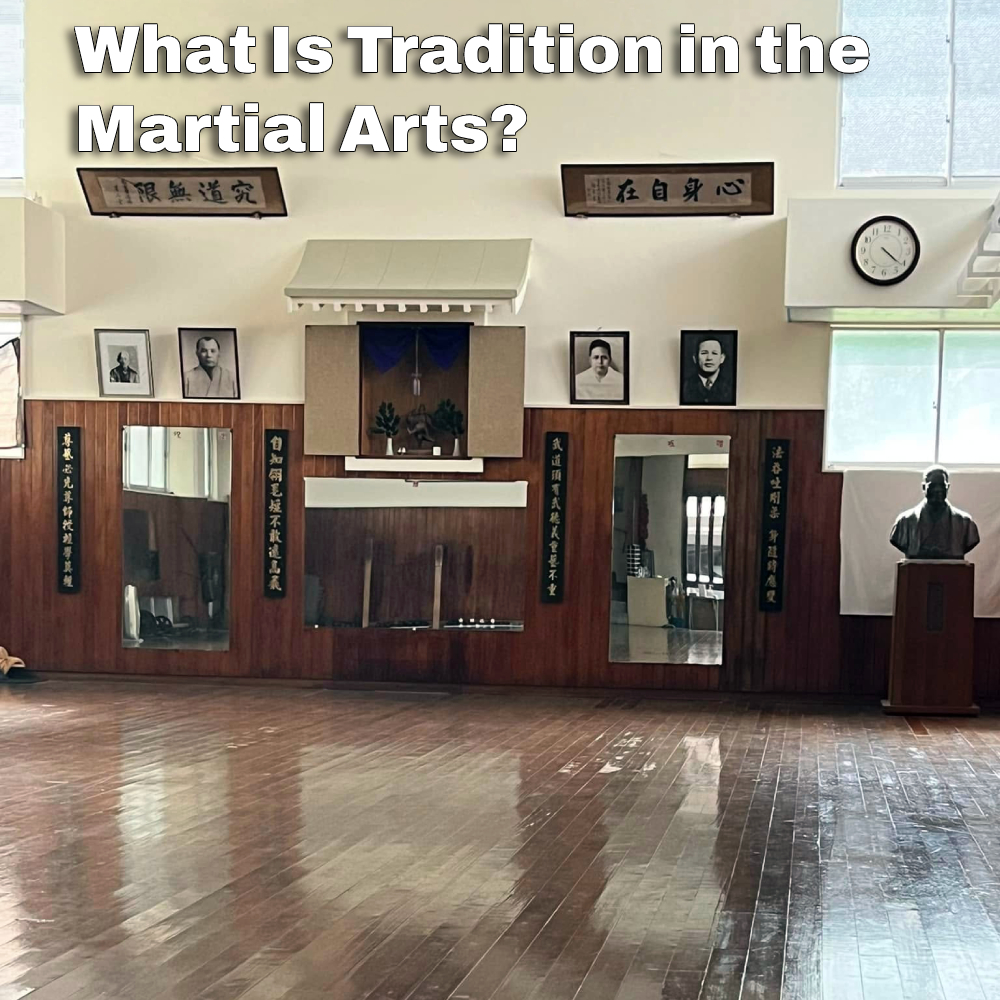
What is tradition, or traditional, in the martial arts? Who decides what it is?
Tradition can be described as:
“an inherited, established or customary pattern of thought, action or behavior.”
But what we refer to as “traditional” in the martial arts often isn’t as old or unchanging as we might imagine.
Many of the people we now regard as traditional masters were themselves innovators. They did not necessarily go on to teach the art exactly as it had been taught to them. Karate has continually changed, while certain underlying concepts and principles have remained.
How you bow, what you wear to training, how you greet your seniors, colored belts, the techniques themselves and even some of the thinking behind them may all appear traditional. Yet many of these are relatively modern practices.
Every style has its own stories that are passed down. They may be about the founder of the system, another notable practitioner, how particular techniques were once used, or how the system came to be. Some of these stories have been passed down for generations, while others are much newer.
The difficulty is that stories repeated often enough can eventually become accepted as fact, even when there is little way to verify them beyond, “My Sensei told me”.
There are the older styles that can help us understand a piece of history. They can help us understand where a system came from and preserve a unique part of a rich cultural heritage.
And there are those who see tradition as something fixed. I am not sure that it is.
History is fixed in the sense that what happened has already happened. Tradition is something we continue to participate in, and because people continue to participate in it, it inevitably changes.
To understand what is traditional, and the nature of traditional karate, it’s important that we study the words and guidance of the people who helped form the art. But if we were to practice a system exactly as it was practiced generations ago, we might eventually be preserving history rather than responding to the reasons we train today.
Tradition should not mean a lack of evolution.
We all inherit traditions, and we all develop some of our own. They can provide a foundation, a sense of continuity and a connection to those who came before us.
But tradition alone does not make something worthy.
Something is not necessarily correct simply because it is old. Sometimes a tradition continues because it remains valuable. Sometimes it continues because nobody has thought to question it.
Perhaps the important distinction is knowing which is which.
Tradition can tell us where something came from.
It cannot, by itself, tell us whether it still works.
Help Keep Applied Methods Free
Applied Methods is independently written and freely available. If you enjoy the articles and would like to support the continued writing and upkeep of the site, contributions are always appreciated, but never expected.