The value of kata may depend less on how well we perform the sequence and more on what we understand it to represent.
Kata is a fundamental component of traditional martial arts.
However, in recent years there has been a growing trend among some practitioners to ignore kata, or at least consider it of less importance than other aspects of the art.
I believe there are several reasons for this, including limitations in some instructors’ knowledge, a lack of practical application, and the way martial arts have evolved.
Many practitioners question the practical application of kata in real-life situations. They believe that while kata can be useful for developing basic techniques, it does not reflect the unpredictable nature of a real fight. One of the reasons often given is that in a real-world situation, an opponent is unlikely to follow a predetermined sequence of techniques, making kata less effective as preparation for something unpredictable.
The problem with this way of thinking is that it misunderstands what kata represents.
Many practitioners, and instructors, view the movements in kata as a series of individual techniques, one after another. Each movement is given a name, a particular purpose is attached to it, and then the technique and sequence are followed to the letter.
Firstly, when you give something a label, your interest in exploring connections beyond that label can end. Labels can convey something absolute, and once that has been decided it can be difficult to navigate away from it.
Secondly, it is the whole movement that defines its use, from beginning to end, as a principle rather than simply a technique. The beginning of the movement is frequently as important as the obvious finishing position, yet it is often ignored or not even considered.
For many people, because kata is a stylized form performed alone without an opponent, it does not necessarily translate into real-world situations where another person may be unpredictable and the environment chaotic.
However, if you view kata as a system or theme rather than a sequence of individual techniques, following that sequence becomes much less important. The movements can be separated, explored and used according to what is happening at that particular moment rather than according to what comes next in the kata.
That makes much more sense to me.
Over time, kata appears to have drifted away from being viewed as a record of fighting methods and principles and has increasingly become an aesthetic pursuit, sometimes with little connection to the reason those movements existed in the first place.
Some martial arts styles place a great deal of emphasis on performing kata perfectly. There is nothing necessarily wrong with trying to perform kata well, but problems arise when the performance becomes the purpose rather than a means of studying what the kata contains.
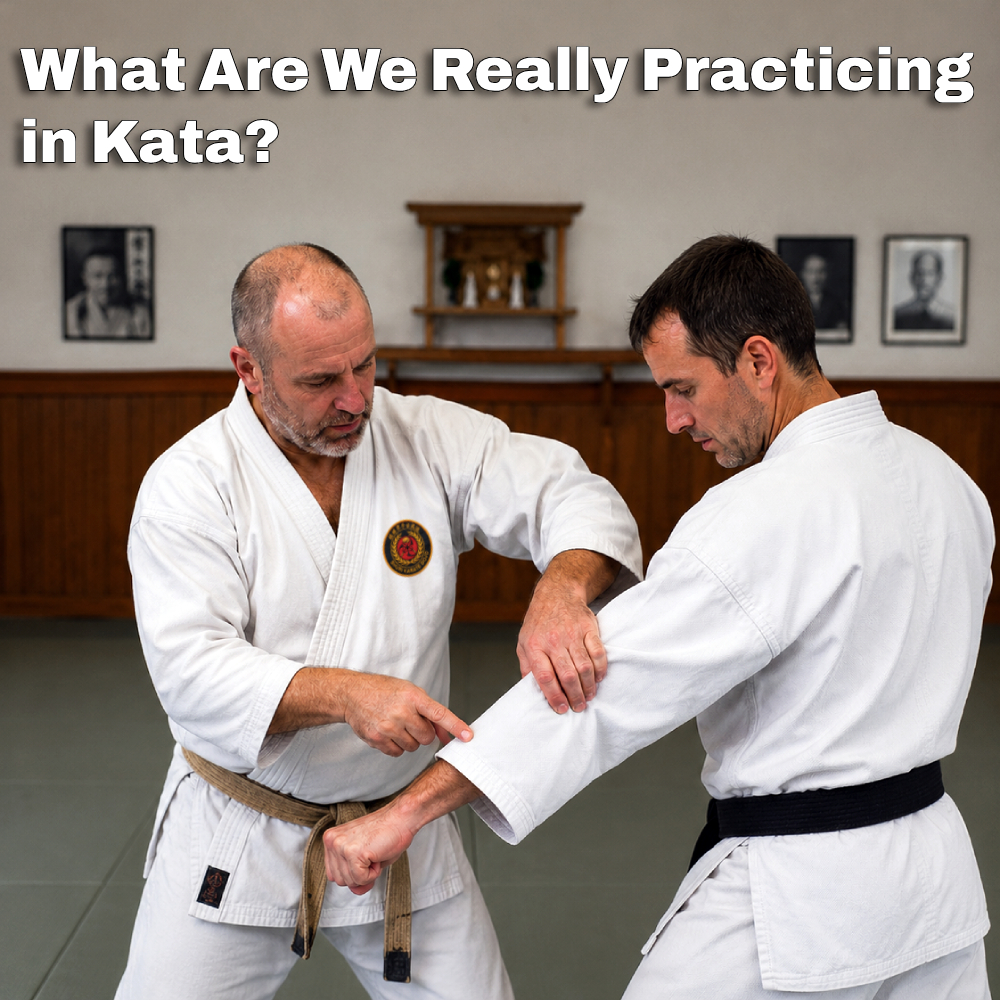
To practice karate as a pragmatic system, kata needs to be actively studied with a partner rather than simply practiced alone.
The solo performance has value, but it is only one part of the process.
Without studying the movements, exploring their possible uses and testing them with another person, kata can easily become little more than something remembered for the next grading.
For me, the value of kata has never been in following a predetermined sequence against an imaginary opponent.
The value is in what the sequence allows us to remember, study and explore.