Why the habits that make sense in a fight may work against us in self-protection
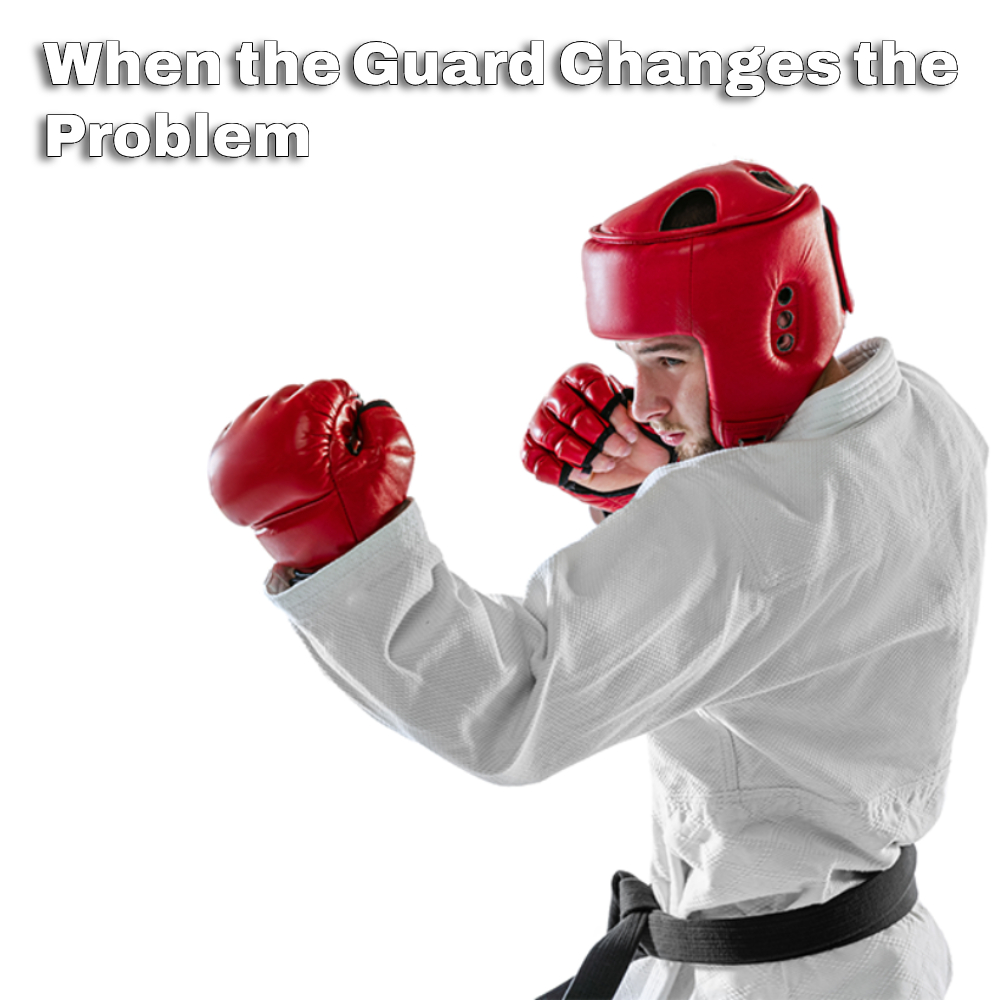
In boxing we were taught the importance of a good, tight guard. But when you put up a guard, you’ve just consented to a fight.
Self-defense is different. If you lift your hands and wait in a perfectly aligned tight guard, you’ve lost the initiative, the ability to surprise, and the ability to control the other person’s limbs. Tactically, that can be a bad place to start.
What we should do instead is subtly control distance and lines of attack during the dialogue stages. We can do that by “talking with our hands” and by deceptively positioning the body. A conventional fighting guard has very little role here.
The key is always what the context deems optimal.
A hands-up guard makes sense in consensual fighting. In self-protection, you are often so close that both hands should already be working, or you are far enough apart that escape should still be possible.
There is no moving “back and forth”, no exchange of techniques, so the place where a guard becomes useful in a fight may not exist at all in self-protection.
There is a major difference between self-defense and fighting. In self-defense, only the perpetrator wants the altercation.
This is important for practitioners and instructors to understand if their interest is in self-protection and they are teaching self-defense to their students.
Guards are used in sparring when we are practicing consensual fighting skills. But in live close-range self-defense drills, the hands need to be actively clearing a path, controlling, locating, or disrupting the attacker. You can try using a conventional guard, but in effect you may be allowing the attacker to have a turn. Leaving one hand inactive like that can quickly cause problems.
You don’t want to give the attacker that chance. You need to take control. If your hands are simply up waiting for the exchange to happen, it may already be too late. By the time you realize you are in a fight, you may already have taken several solid shots to the face, or had your clothing pulled over your head and your vision obstructed.
The experience can be jarring. Blurred vision from an errant thumb, ringing in the ears after being hit in the side of the head, the taste of blood, difficulty breathing, and a heart rate that seems to go through the roof as adrenaline floods the system.
There is nothing pretty about it.
You may hold your breath without realizing it. Your body can feel as though it has gone into shock, and when it is over you may shake, feel sick, or simply struggle to process what has just happened. The whole thing may have lasted less than a minute.
An actual violent encounter is about survival. The time you spend trying to decide what to do may be the same time the other person uses to hit you, knock you unconscious, stab you, or worse.
From a self-protection perspective, there is generally no reason to settle into a conventional fighting guard and wait for an exchange. We do not want an exchange. We want to escape, disrupt, or control the attacker.
That is the difference.
A consensual fight and an act of self-defense may both involve violence, but they are not the same problem.
Help Keep Applied Methods Free
Applied Methods is independently written and freely available. If you enjoy the articles and would like to support the continued writing and upkeep of the site, contributions are always appreciated, but never expected.