Looking beyond the familiar interpretation of karate’s blocking movements, and examining what might be happening along the way.
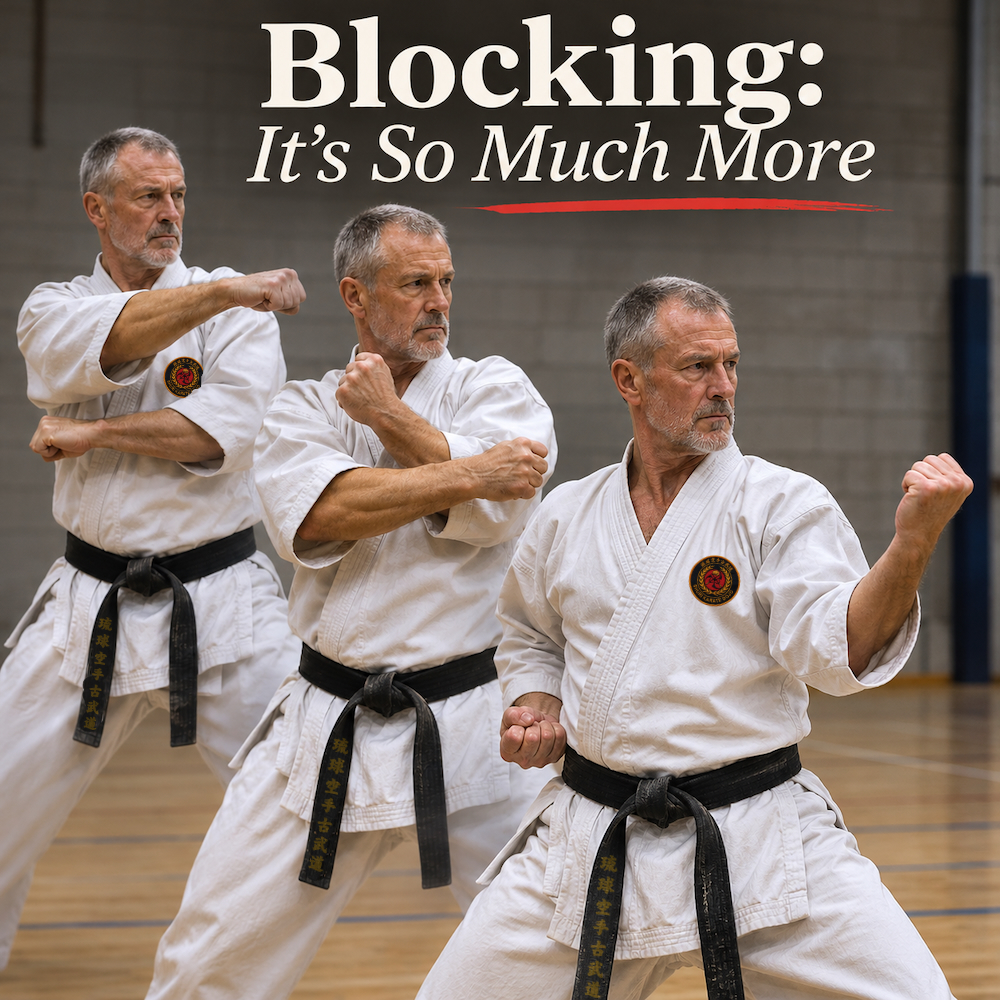
Blocking is one of the most misunderstood actions in karate.
We use the Japanese term uke, commonly translated as ‘block’, although it comes from ukeru, meaning ‘to receive’. That distinction is worth considering, because receiving something is not necessarily the same as stopping it.
Yet much of what we see in traditional karate is built around the idea of blocking an incoming attack, followed by a counterattack. Someone punches, we block, we counter, and the exchange is over.
But is that really what these movements were intended for?
Every movement in karate follows a particular path. It begins somewhere, travels through a series of positions, and finishes somewhere else. Yet we often seem interested only in the final position, with good kime.
But once we call something a block, we tend to see it as a block. And that can prevent us from looking any further.
When examining a movement, I encourage students to look beyond its finishing position. Where does it begin? What path does it follow? Why does it travel that way? And what about the other hand? We’re not simply bringing it back to the hip. That hand may already be controlling, pulling, or disrupting the opponent, often before the so-called blocking hand even begins its movement.
Sometimes the beginning or middle of a movement is far more interesting than where it finishes.
Take the so-called middle block, the inside-to-outside movement known by different names depending on the style.
I appreciate that stopping a straight punch to the middle of the body is only one of the conventional interpretations of this movement, but it’s a useful example.
In its conventional form, the arm travels across the body before moving outwards. But why?
If its purpose is to stop a straight punch aimed at the middle of the body, why would we first move our arm away from the direction in which we apparently need it?
Surely that makes the response slower, particularly when the attack is unexpected.
Of course, if we already know which punch is coming, where it’s going, and when it will arrive, we can make the movement work. That’s what happens in much of our conventional kihon and step-kumite.
But what happens when we don’t know?
What happens when someone suddenly shoves us, grabs our clothing, or throws a punch from close range? What happens when the first action is immediately followed by another?
There simply isn’t time to recognise an unexpected attack, select an appropriate formal block, and then follow it with a counterattack in the neat sequence we so often practise.
That doesn’t mean we cannot protect ourselves by covering, deflecting, or intercepting an incoming strike. Of course we can. But those actions are not necessarily the same as the formal blocking movements we spend so much time practising.
I’m not suggesting that every movement has just one hidden application waiting to be discovered. Nor do I believe that simply changing the word ‘block’ to ‘receive’ suddenly makes everything practical.
The important thing is to examine what the movement can actually accomplish when another person is involved, particularly when that person isn’t cooperating with our intended response.
You may find that some of the movements you’ve been practising for years have possibilities you hadn’t considered. You may also discover that some of your familiar explanations don’t hold up particularly well.
Both are useful discoveries.
Perhaps we’ve spent too much time learning how to perform blocks, and not enough time asking what those movements might actually be doing.
The moment you stop seeing a block as just a block, you begin to see what else might be there.
Help Keep Applied Methods Free
Applied Methods is independently written and freely available. If you enjoy the articles and would like to support the continued writing and upkeep of the site, contributions are always appreciated, but never expected.