If the original meaning is uncertain, what makes an application useful?
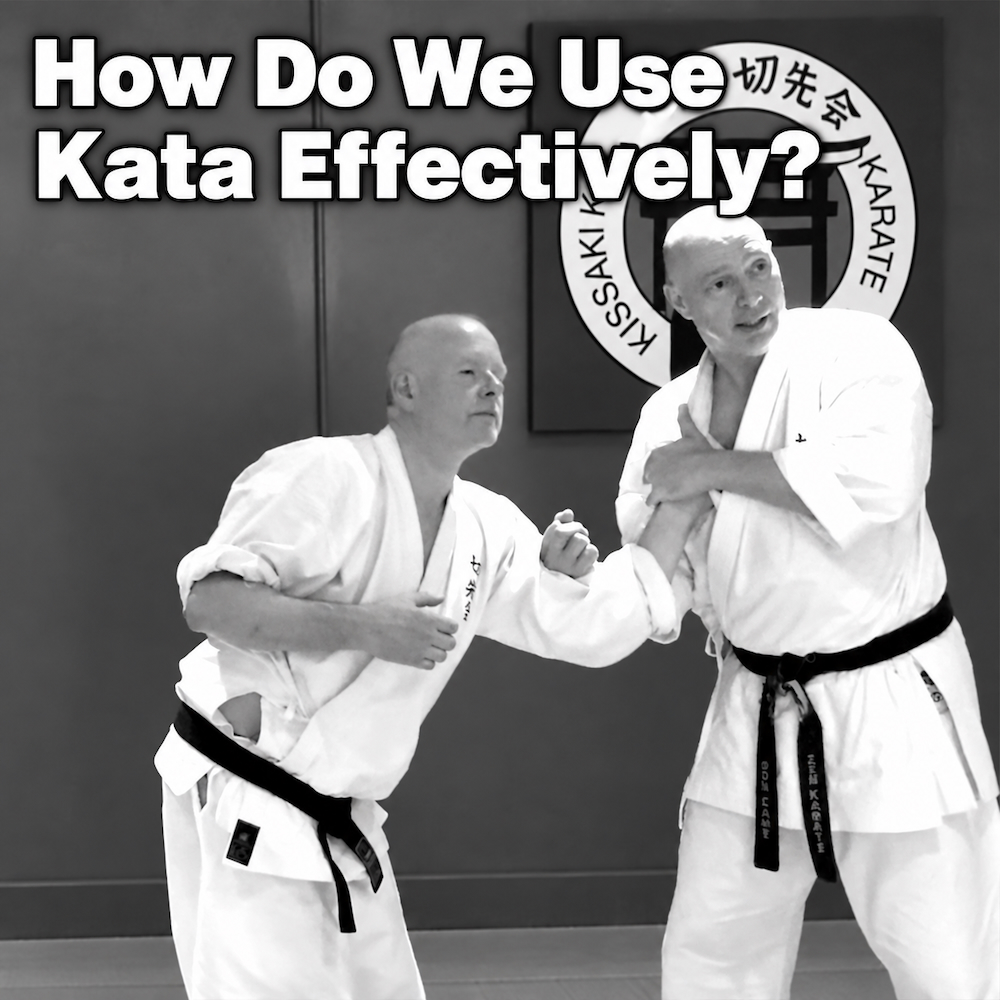
When I talk about using kata effectively, I don’t mean the bunkai demonstrations sometimes seen at tournaments or in dojo, where one person stands in the middle while attackers come from different directions with predetermined attacks.
I mean how we use kata to explore something that might actually help when things go wrong.
Someone once asked me a simple question:
“How do you extract the combative information from kata when nobody really knows exactly what it was originally meant to do? Wouldn’t everyone arrive at different interpretations?”
It’s a fair question.
No, we cannot know with certainty what every movement in every kata was originally intended to represent. But perhaps that is not the problem we think it is.
The mistake, I believe, is starting with the kata movement and immediately asking, “What attack is this defending against?”
That is how we so often end up inventing an attack that fits the movement, then calling the result bunkai.
I prefer to begin somewhere else.
I begin with the problem.
Take a very common example. Someone pushes or grabs with the left hand and follows with a wild swinging punch from the dominant right hand.
The first action might be a push or a grab of the clothing. It might become a grab and pull instead. The right hand might swing slightly higher or lower.
But the underlying problem remains much the same.
One hand is making contact with me, controlling me or disturbing my position, while the other is delivering the more dangerous attack.
I don’t necessarily need a different response because the push became a grab.
What I need is a movement that deals with the problem.
That changes the way I approach kata.
Rather than looking at a movement and inventing an attack for it, I take a common problem and ask whether a movement I already have can give me a simple and adaptable way of dealing with it.
Start with the problem, work the movement with a partner, vary the situation, then add resistance and pressure.
Not the other way around, where we start with a kata movement, invent an attack that makes it work, and call that bunkai.
If I take a movement from kata and it only works when my partner attacks with exactly the expected hand, at exactly the right height, from exactly the right position, I haven’t learned very much.
But if the same movement continues to work when the push becomes a grab, the grab becomes a pull, the punch changes height, the timing changes, and my partner begins resisting what I am trying to do, then I have something worth training.
That is also why I don’t think of kata movements as fixed techniques.
The same movement may be applied higher, through the middle, or lower down depending on what is happening in front of me. Its point of contact changes according to the problem, while the underlying movement remains essentially the same.
That suggests something important.
Kata records a movement. It does not necessarily dictate the exact point on another person where that movement must be applied.
If every change in height, angle or circumstance required a completely different technique, we would need an enormous catalogue of responses.
We don’t.
We need a relatively small number of movements that can be adapted to a range of related problems.
This also raises an interesting question about choosing kata.
If we genuinely do not know the original meaning of every movement, how could we say that one particular kata contains the answer to a push and right-hand swing, while another contains the answer to a grab, a tackle or a headbutt?
How would we know which kata to choose?
Suppose, for argument’s sake, that we only had one kata.
Would we be able to build a useful defensive method from it?
I think a good kata should take us a surprisingly long way, not because it contains a separate technique for every possible attack, but because its movements express principles that can be reused.
It is also worth remembering that the large kata syllabuses and clearly defined styles we are familiar with today came later. Earlier karate was often passed more personally from teacher to student, with kata forming an important part of preserving those methods.
Perhaps, then, it makes more sense to think of a kata not simply as a collection of techniques, but as a record of a fighting method. Its movements preserve particular ways of moving and principles for dealing with the problems those practitioners faced, or believed they might face.
That would explain why relatively few movements can produce so many possibilities.
If the kata preserves principles rather than fixed answers, the movements can be adapted. The height or angle may change. What we make contact with may change.
But the underlying movement and the principle behind it can remain.
We don’t need a different kata movement for every possible attack. We need movements we understand well enough to adapt when the problem changes.
If a movement helps us solve a problem, we have learned something useful.
That does not prove that our interpretation is historically correct.
It proves something more relevant to the way I train.
It works.
So perhaps the question should not be:
“What technique is this movement supposed to be?”
Perhaps it should be:
“What problem am I trying to solve, and can this movement help me solve it?”
Help Keep Applied Methods Free
Applied Methods is independently written and freely available. If you enjoy the articles and would like to support the continued writing and upkeep of the site, contributions are always appreciated, but never expected.