
What we know, what seems likely, and where the evidence runs out
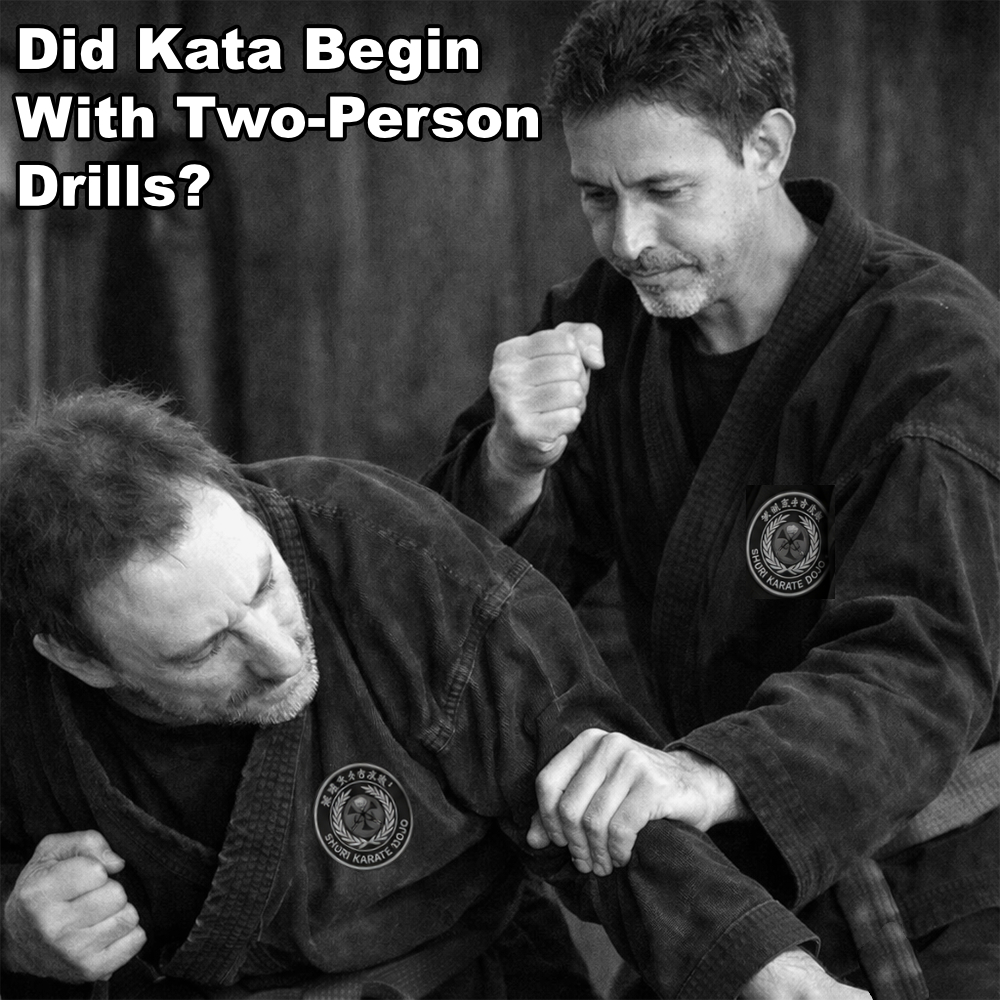
A question came up recently that I think is worth considering:
How do we know the creators of kata built them from two-person drills?
The simple answer is that we don’t.
We have no complete historical record showing how every kata was created. In many cases we don’t know precisely who created the kata, what they originally called it, what changes were made during transmission, or what every movement was intended to represent.
So if we are looking for a document telling us that a particular teacher developed a series of two-person drills and then assembled those drills into the kata we practice today, we are probably going to be disappointed.
For me, the strongest argument comes from considering how combative skills are actually learned.
If I want to teach somebody how to control an arm, disrupt balance, strike from close range, escape from a grip, or put somebody on the floor, I need another person.
I can explain and demonstrate the principle. But sooner or later the student has to feel the position, the pressure, the resistance and the reaction of another human being.
The method has to exist before it can sensibly be practiced alone.
Once a student understands that method through working with another person, there is nothing unusual about practicing the movement alone afterwards. It becomes a way of remembering the lesson, refining the movement and rehearsing it without needing a partner.
Put a number of those movements together and we begin to have something resembling kata.
We cannot say with certainty that every kata developed exactly that way. Karate did not emerge from one person, at one time, following one teaching method. Forms travelled, changed and were taught differently by different people.
But the principle makes sense.
The alternative raises some interesting questions.
If kata were created first as solo sequences, where did the movements come from?
Why would somebody create a collection of movements supposedly concerned with fighting before establishing what those movements were meant to accomplish against another person?
There is a strong case for the practical method having existed first, with the solo representation coming afterwards.
That is not historical proof, of course. It is an inference based on how physical skills work.
There are other clues.
Older karate writings make it clear that kata was not intended to exist entirely separately from application. We also have evidence that paired practice formed an established part of Okinawan karate training.
That doesn’t tell us how every kata was created, but it does show that solo kata and practice with another person were not necessarily separate worlds.
It also helps explain something else.
Many kata movements become difficult to understand when we start with the solo movement and then try to invent an attack that makes it work.
A hand moves here, a foot steps there, the other hand returns to the hip.
What does it mean?
If we assume the solo movement came first, almost anything can be made to fit.
But turn the process around.
If the movement already had meaning before it was ever practiced alone, things begin to look rather different. Movements that can appear awkward or obscure in isolation may make much more sense when viewed as part of an interaction with another person.
If those movements came from practical methods, then it also makes sense to consider the kinds of physical violence those methods were intended to deal with. Grabbing, striking, pushing, pulling, controlling, clinching and attempts to put somebody on the ground are not modern inventions. They are recurring features of interpersonal violence.
Seen in that context, some of the movements contained within kata begin to look considerably less obscure.
That still doesn’t tell us what every movement originally meant, or whether every kata developed in exactly the same way.
But it gives us a more reasonable starting point than assuming somebody first created an abstract sequence of movements and only afterwards worked out what those movements might be for.
So, did kata begin with two-person drills?
I think that is very likely.
Can I prove that every kata was created that way?
No.
And I don’t think we need to pretend that we can.
For me, the important principle is much simpler.
It makes far more sense that people first understood how to do something with another person and then found a way to remember and practice it alone, than that they created solo movements first and left everyone else to work out what they were for.
Help Keep Applied Methods Free
Applied Methods is independently written and freely available. If you enjoy the articles and would like to support the continued writing and upkeep of the site, contributions are always appreciated, but never expected.
Sensei Carter, thanks for this very interesting post.
I am embarrassed to admit that, though I began my training in karate many years ago and of course did kata, I later rejected kata as a viable training method after becoming a fan of Bruce Lee and his philosophy. Bruce didn’t think much of kata…
But of course it DOES make sense to have people understand simple principles of movement and structure, and learn effective responses to likely attacks, using a simple (at first) series of movements each partner must correctly deal with. And then to continue practicing these movements with partners in a pre-arranged pattern to isolate the movement(s) in question so they can be “burned into” the students’ bag of tricks.
And of course, kata can evolve, and seems to have actually evolved, from this 2-person exercise into a way of practicing the movements solo, when a partner isn’t available, imagining the attacks a partner is making while “keeping one’s tools sharp” via the solo kata movements.
In some ways this may be analogous to the shadow boxing a boxer does.
But I’m no expert on kata and perhaps am missing the mark, but I believe your conclusions make a lot of sense. And I no longer dismiss kata as part of a good martial arts education.