Seniority brings experience, but respect, understanding and the ability to help others are not guaranteed by rank or years of training.
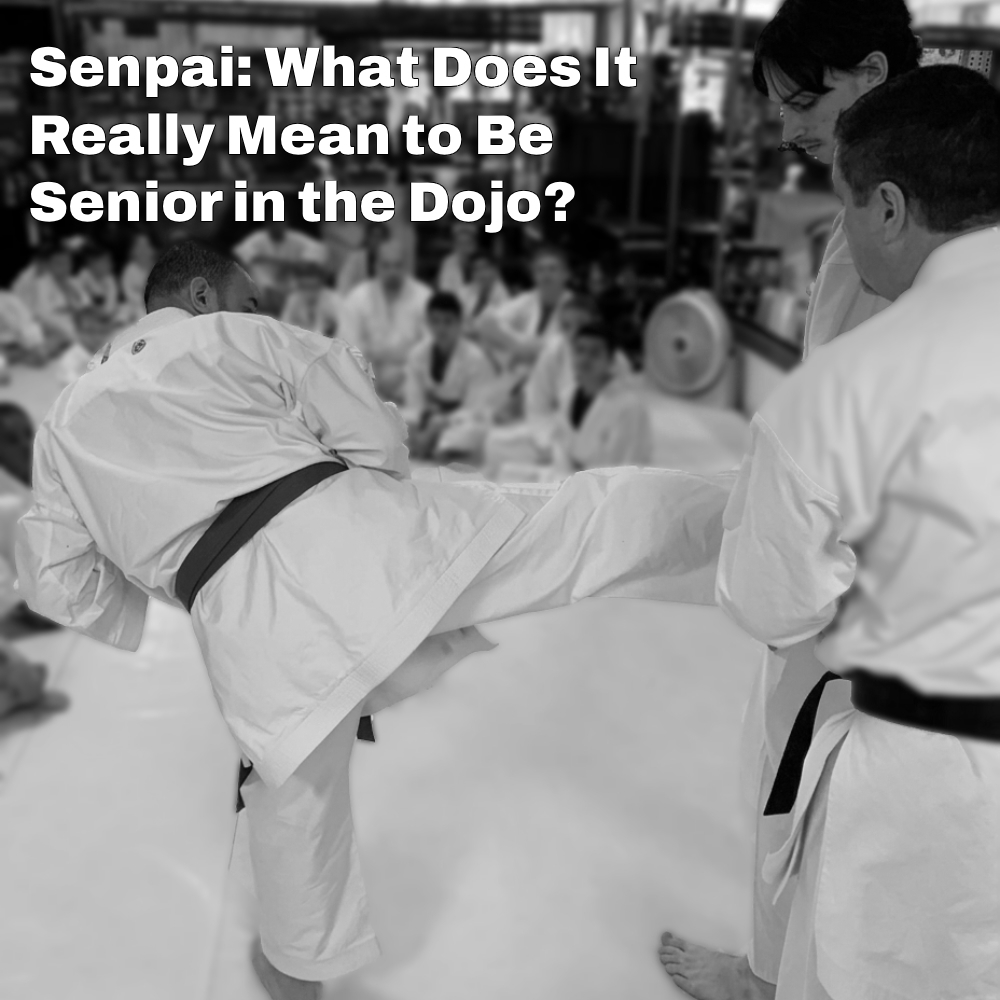
Many years ago, I wrote an article about the role of the senpai in a traditional karate dojo. At the time, I described someone who had trained for many years, understood the instructor’s methods and philosophy, helped less experienced students, and set an example for others to follow.
Those qualities remain just as important to me today. But I think the subject deserves a little more consideration, particularly when we look at what seniority actually means within the dojo.
The Japanese term senpai (先輩) refers to someone who is senior in experience or length of association, while kohai (後輩) refers to someone who is junior. The relationship is not unique to martial arts and exists in other areas of Japanese society.
In karate, however, that relationship is sometimes interpreted as giving the senior student an authority that comes simply from having trained longer or holding a higher grade.
But does being senior necessarily make someone worth following?
I’ve known students who have trained for many years and developed considerable technical ability, yet struggled to help others understand even the simplest things. I’ve also known students with far less experience who demonstrated patience, understanding and a genuine willingness to help those around them.
Time spent training is important, but time alone doesn’t necessarily produce understanding.
Nor does wearing a higher grade automatically make someone a good example.
A senior student may know the instructor’s methods extremely well. They may have practised the same techniques, kata and drills for years, and be able to demonstrate them exactly as they were taught.
But there’s a difference between knowing what you’ve been taught and understanding why you’re doing it.
And there’s another question worth considering.
Should a senior student simply repeat what the instructor has taught, or should they understand it well enough to question it when necessary?
I would hope it’s the latter.
I’ve always encouraged questions in my teaching, often beginning with what, why or how. Questions that invite a simple yes or no rarely tell me very much about what someone actually understands.
And being experienced doesn’t mean we no longer have anything to learn. Sometimes the very habits and assumptions we’ve accumulated over the years can prevent us from recognising a different approach.
There is nothing wrong with bringing previous experience into our training. The question is whether we’re prepared to reconsider what we think we know.
Of course, helping less experienced students remains an important part of the senpai’s role. But helping someone learn isn’t necessarily the same as correcting everything they do.
Sometimes the most useful thing a senior student can do is listen, offer a little guidance, or allow someone the opportunity to work something out for themselves.
I’ve always believed that the way someone treats a beginner tells you quite a lot about their character.
It’s easy to appear respectful when standing in front of a senior instructor. But how does that same person behave towards someone who has only just walked through the dojo door?
Are they patient? Do they make the newcomer feel welcome? Can they offer help without making someone feel inadequate?
Or do they use their seniority as an opportunity to demonstrate how much more they know?
Respect is often spoken about in traditional martial arts, but I don’t believe it should be demanded simply because someone has trained longer or holds a higher grade.
Respect is something we demonstrate through our behaviour, and something we earn through our actions.
That applies just as much to the instructor as it does to the students.
I also think it’s important to remember that being a senior student doesn’t necessarily mean someone wants to become an instructor. Some people simply enjoy training. They may be dedicated, reliable and highly skilled without having any desire to teach or assume responsibility for others.
There’s nothing wrong with that.
We shouldn’t confuse seniority with an obligation to become something a person never intended to be.
Over the years, I’ve come to appreciate students who may never have been the most technically gifted, but who turned up consistently, worked hard, supported others and contributed quietly to the dojo.
They didn’t need to draw attention to themselves. Their commitment was evident in what they did.
And sometimes those people were far more valuable to the atmosphere of a dojo than someone with an impressive grade and a desire to be recognised.
After all, the purpose of seniority shouldn’t be to establish how important someone is.
It should be reflected in how they use their experience to help others.
Being senior tells us how long someone has been there. It doesn’t necessarily tell us what kind of person they’ve become.
Help Keep Applied Methods Free
Applied Methods is independently written and freely available. If you enjoy the articles and would like to support the continued writing and upkeep of the site, contributions are always appreciated, but never expected.