
Why learning to fight is only part of learning to protect yourself.
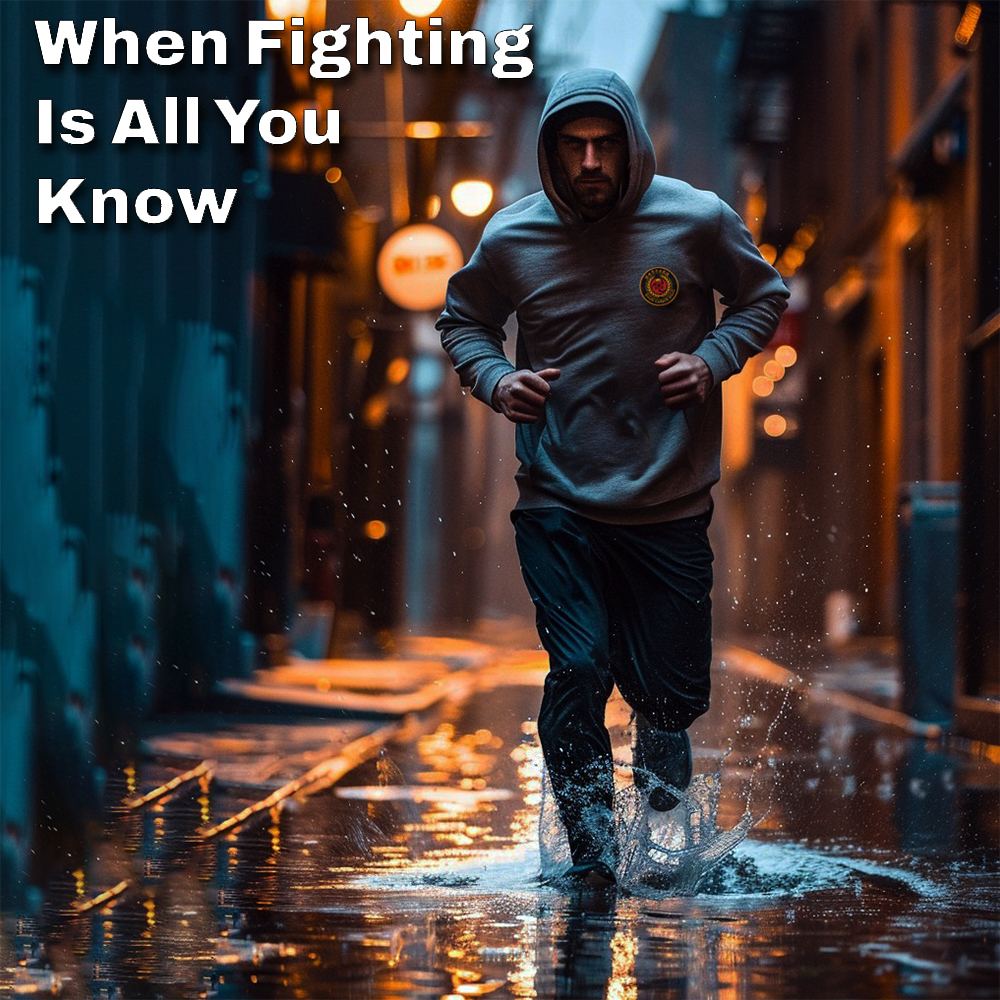
Some years ago, I wrote about an incident that happened in 1985, when I was out running and ended up being pushed into the road during a confrontation with two individuals.
A reader commented that my first mistake had been not crossing the road in anticipation of trouble.
It was a reasonable observation, but one made with the benefit of hindsight.
Neither individual had initially appeared particularly threatening. I could have crossed the road, turned around, or taken another route entirely. But I was out running, minding my own business, and had no particular reason to believe anything was about to happen.
It’s easy to look back at an incident and identify all the things we might have done differently. It’s rather more difficult when you’re actually there, making decisions with only the information available to you at that moment.
Looking back now, much older, I can see just how badly that encounter could have ended.
But I was a relatively young man at the time, confident in my physical abilities, with years of training and competition behind me.
And when confrontation occurred, I responded much as I had been trained to respond.
I fought.
At that stage of my life, much of my training had been concerned with fighting, dominating an opponent and winning. Those were qualities that had served me well in competition, but they didn’t necessarily provide the best answers when dealing with violence outside the dojo.
I didn’t fully appreciate that distinction then.
It’s not that I necessarily made the wrong decision. I can’t know whether another response would have produced a better outcome. But I do know that, today, I would approach the situation with a very different understanding of what self-protection actually means.
Being capable of fighting and knowing when to fight are two very different things.
Years later, when I first came to the United States, I was invited to teach and train at a Kyokushin dojo.
It was an interesting experience.
The emphasis was overwhelmingly on fighting. From what I experienced, self-defence was largely approached through physical confrontation, with much less attention given to the circumstances that might lead to it, or how it might be avoided.
I tried to introduce some of those other considerations into the training. Interestingly, the less experienced students were generally quite receptive, while some of those who had been training for much longer were less convinced.
I could understand that.
When you’ve devoted a considerable part of your life to developing particular skills, being told that those skills might not always provide the best solution can challenge some deeply held beliefs.
But recognising the limitations of what we’ve been taught doesn’t mean the training was wasted.
It simply means there’s more to learn.
What struck me was that I was looking at an approach very similar to the one that had shaped my own response back in 1985.
The difference was that my understanding had changed.
None of this is to suggest that fighting skills are unimportant. Quite the opposite. If physical confrontation becomes unavoidable, those skills are essential.
But fighting is only one part of self-protection, and not necessarily the most important part in every situation.
Awareness and anticipation are important parts of self-protection. Recognising potential danger early can give us opportunities to avoid confrontation altogether. Of course, we cannot anticipate everything. Sometimes situations develop without warning, despite our best efforts.
What we can do is develop a broader understanding of the choices available to us.
And those choices need to be reflected in how we train.
If our training only ever presents a physical problem followed by a physical solution, we’re hardly preparing ourselves to consider anything else.
The purpose of self-protection isn’t to prove that we can win a fight. It’s to give ourselves the best possible chance of getting home safely.
I still practise and teach physical skills. That hasn’t changed. What has changed is the place those skills occupy within my understanding of self-protection.
At my advancing age, I don’t look back at that young man in 1985 and condemn his actions. He responded according to his experience, his confidence and what he understood at the time.
But I do recognise that there were things he hadn’t yet learned.
And perhaps that’s one of the most valuable lessons I’ve taken from all these years of training.
Experience isn’t simply about becoming better at what we already do. Sometimes it’s about recognising that what we’ve always done isn’t necessarily the best answer.
Help Keep Applied Methods Free
Applied Methods is independently written and freely available. If you enjoy the articles and would like to support the continued writing and upkeep of the site, contributions are always appreciated, but never expected.
I admit that my understanding of self defence was interpreted through a jiyu kumite lens until I was well into my 40s.