
When training pushes back, what we believe gets tested.
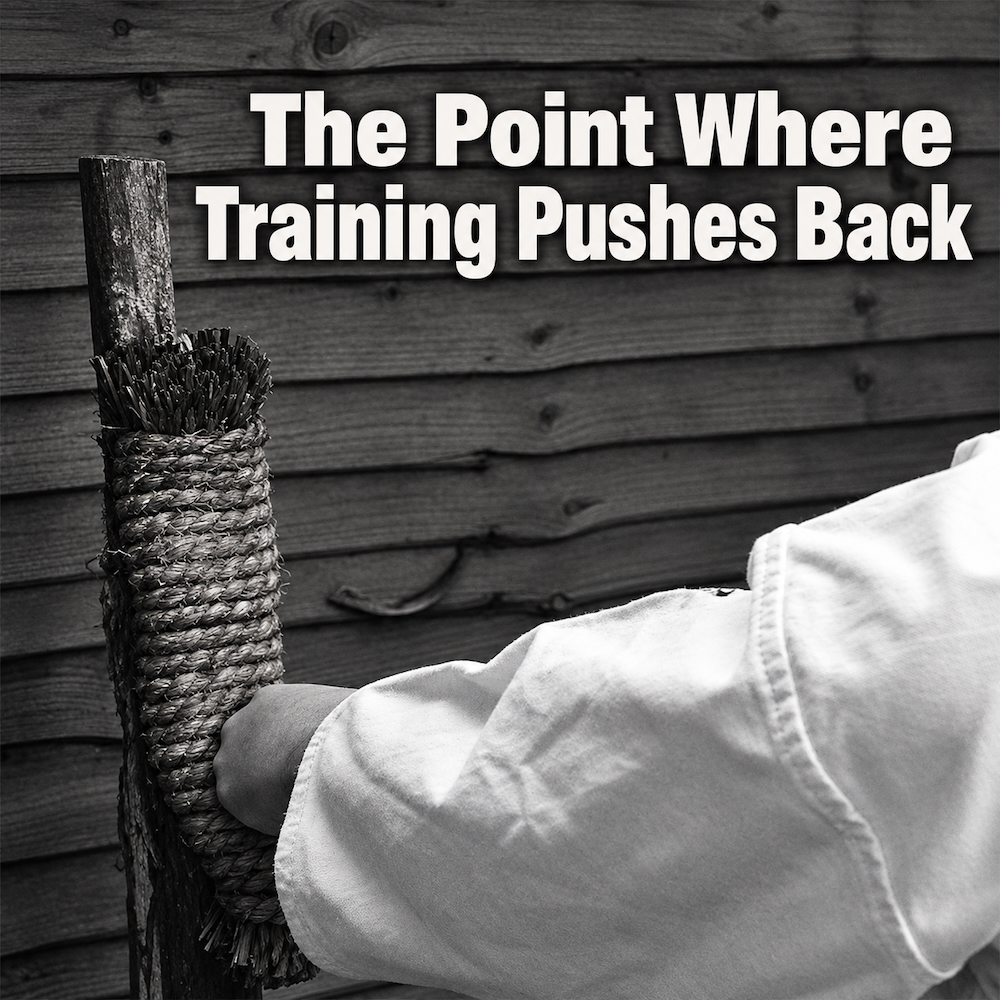
Years ago, when I still lived in the UK, I had a traditional straw makiwara fixed in my garden. I used it almost every day, often striking it hundreds of times. I liked the simplicity of it. You hit it, and it tells you something.
The makiwara doesn’t care what the technique is called, what kata it supposedly came from, or what grade you hold. You either deliver force through a connected structure or you don’t. The wrist can collapse, the shoulder can take over, or the body can become disconnected from the strike. The moment you hit something solid, those faults become much harder to hide.
You can make all sorts of movements look impressive in the air, but the moment you have to put force into something solid, the feeling changes.
That is what good training should do. It should give us information.
The makiwara is only one example. A heavy bag gives different feedback. Pads give another. A partner who is moving, resisting, grabbing, pushing or trying to hit you gives another again. None of these are complete by themselves, but each removes a little of our ability to pretend.
That matters because it is surprisingly easy to convince ourselves that something works when the training environment never really challenges it. A movement can look perfectly convincing when demonstrated slowly against a compliant partner. The distance is right, the attack arrives where expected, the partner stops at the correct moment, and everything fits neatly together.
Then the partner moves, resists, or attacks differently, and suddenly the movement that seemed so convincing does not work quite as well.
How many times have we seen an instructor say, “Let’s do that again”, when a demonstration didn’t work the first time?
That isn’t necessarily a failure of the movement. It may be a failure of timing, positioning, structure, understanding, or simply the way we were trying to use it. But something useful has been learned. The problem begins when we refuse to accept what the training is telling us.
We have probably all seen it. A technique fails and immediately an explanation appears. The partner attacked incorrectly. They moved too quickly. They didn’t grab properly. It would have worked if they had done this instead.
Perhaps. But sometimes the most useful response is simply, that didn’t work. Now we can find out why.
Training is not supposed to confirm everything we already believe. If it does, we may have designed the training so that it cannot tell us anything else. This is one reason I have always valued resistance and unpredictability in partner work. Not because every drill has to become a contest, and certainly not because beginners should be thrown into chaos before they understand what they are doing, but at some point the movement has to meet something that is not cooperating with it.
Otherwise, we are only rehearsing success.
A good partner is not there simply to make your technique look good. They are there to give you something genuine to work with. Sometimes that means pressure, a movement you weren’t expecting, and sometimes simply refusing to fall over because the drill says they are supposed to.
The same is true when we strike something. The air offers very little resistance. We can accelerate the hand, stop it wherever we like and convince ourselves that the movement is powerful. A bag, pad or makiwara answers differently. So does another person.
And that is where the training begins to become real.
Repeatedly failing in exactly the same way is not necessarily good training. Hitting something harder does not automatically improve technique, nor does adding resistance to a drill that was poorly understood in the first place.
The purpose is not simply to make training difficult. It is to make it informative.
Feedback is only useful if we are prepared to accept it. The important part is not that something failed, but that the training showed us it did.
Perhaps that is why I still like the makiwara. I still have one in the dojo now. Not because it is traditional, and not because there is anything mystical about hitting a wooden post wrapped in straw. I like it because it responds.
You cannot persuade it that your strike was better than it was.
And you cannot argue with the feedback.
Help Keep Applied Methods Free
Applied Methods is independently written and freely available. If you enjoy the articles and would like to support the continued writing and upkeep of the site, contributions are always appreciated, but never expected.

Sensei Carter, thanks for another informative post. As always, I learned something.
I believe self-protection is a THINKING PERSON’S pursuit.
Something very important to think about, as you suggest in your post:
“What does this tell me, show me, or teach me?”
“This” being feedback (negative OR positive) from a piece of training equipment, from a training partner, from a competitor in sparring or competition, in an actual self-protection encounter, or in a revelation from something you witness or read or hear that may be completely unrelated to self-protection, but from which one might nevertheless get an “Aha!” moment.
Thank you. Yes, that is really the point. Feedback is only useful if we are prepared to notice it and ask what it is telling us, whether it comes from equipment, a training partner, or something outside training altogether. All the best.