Why being able to perform a movement isn’t the same as being able to use it.
When we think about fighting, whether that’s competition, sparring in the dojo, or an encounter involving criminal violence, our attention naturally turns to the person in front of us. We consider their size, strength, speed, experience, and what they might do.
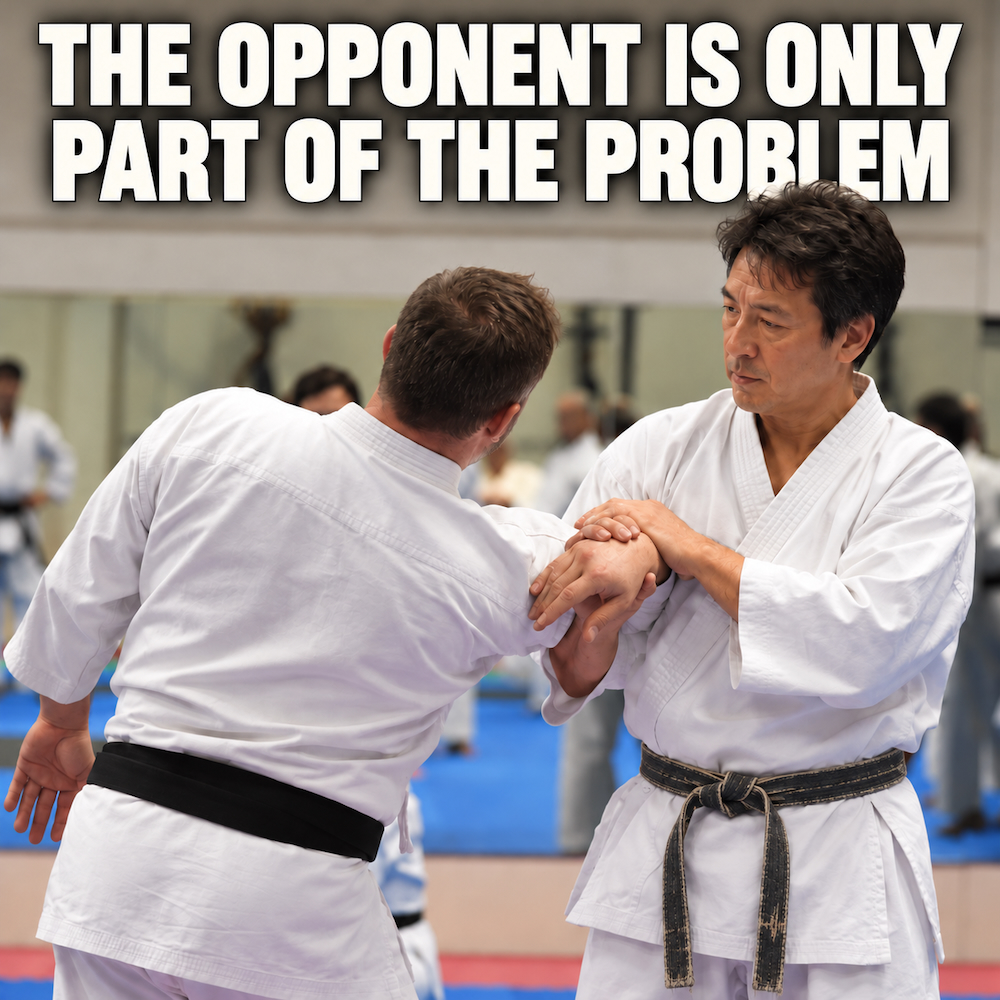
But the opponent is only part of the problem.
We tend to concentrate on physical skills because they’re the easiest to see and teach. We can demonstrate a movement, correct someone’s position, adjust their timing, and repeat the exercise until they can perform it consistently. The partner cooperates because, at that stage, we’re trying to teach something specific.
There’s nothing wrong with that. It’s how we begin learning.
Consider a simple partner drill. Someone grabs your arm, and you practice a movement that allows you to take control of theirs. You repeat it several times, making corrections as necessary. After a while, you can perform it quite well.
Now change the conditions.
Your partner doesn’t grab quite where you expected. They move, pull away, resist your control, or use their other hand. Perhaps the distance changes, or your first movement simply doesn’t work.
Suddenly, the problem is different.
The movement you learned hasn’t necessarily become useless. But the conditions that allowed you to perform it successfully are no longer there.
I often talk about introducing resistance, but resistance alone doesn’t necessarily make an exercise unpredictable. Two people can struggle against one another with considerable effort while still knowing exactly what the other person intends to do.
They may be working hard, but they aren’t necessarily dealing with uncertainty.
An opportunity that existed a moment ago may already have disappeared. A movement that seemed appropriate may no longer be viable.
And there’s something else to consider.
Fear.
It’s easy to discuss fear when we’re training comfortably in the dojo. It’s another matter when we genuinely believe someone might hurt us.
Fear can affect our breathing, attention, movement, and decisions. We may hesitate, rush, or fail to recognize something that would normally be obvious.
We’ve all seen people perform well during practice and then struggle when the pressure increases. It doesn’t necessarily mean they lack skill. They may simply be unfamiliar with functioning under those conditions.
You can’t simply decide not to be frightened. But you can learn to function despite it.
Of course, throwing a beginner into an overwhelming exercise and watching them struggle doesn’t prove very much. Nor does frightening students for the sake of making training appear realistic.
We should be developing their ability, not simply testing how much discomfort they can tolerate.
Sometimes the student will succeed. Sometimes they won’t. When something fails, that’s an opportunity to examine why, make adjustments, and try again.
And perhaps more importantly, they begin to understand that an unsuccessful first response doesn’t necessarily mean the encounter is over. They have to keep working with what’s happening rather than what they expected to happen.
When I taught advanced driving to police officers and ambulance crews, I often used to say:
Respond to what you see, not what you think you see.
It’s a principle that applies just as much to competition, dojo sparring, and criminal violence. All involve uncertainty, although the circumstances and consequences can be very different.
A competitor knows the rules, the environment, and generally who they’re facing. But they cannot predict every action their opponent will take.
Criminal violence may offer none of those assurances, and the consequences may be considerably more serious.
Stable training has its place. We need it to introduce movements, develop coordination, understand principles, and build confidence. But stability should provide the foundation for further learning, not become the permanent condition under which everything is practiced.
The opponent is only part of the problem. The changing conditions of the encounter are another. And our own response to those conditions may become an obstacle in its own right.
Help Keep Applied Methods Free
Applied Methods is independently written and freely available. If you enjoy the articles and would like to support the continued writing and upkeep of the site, contributions are always appreciated, but never expected.