
The same name now covers very different ways of training, with very different purposes.
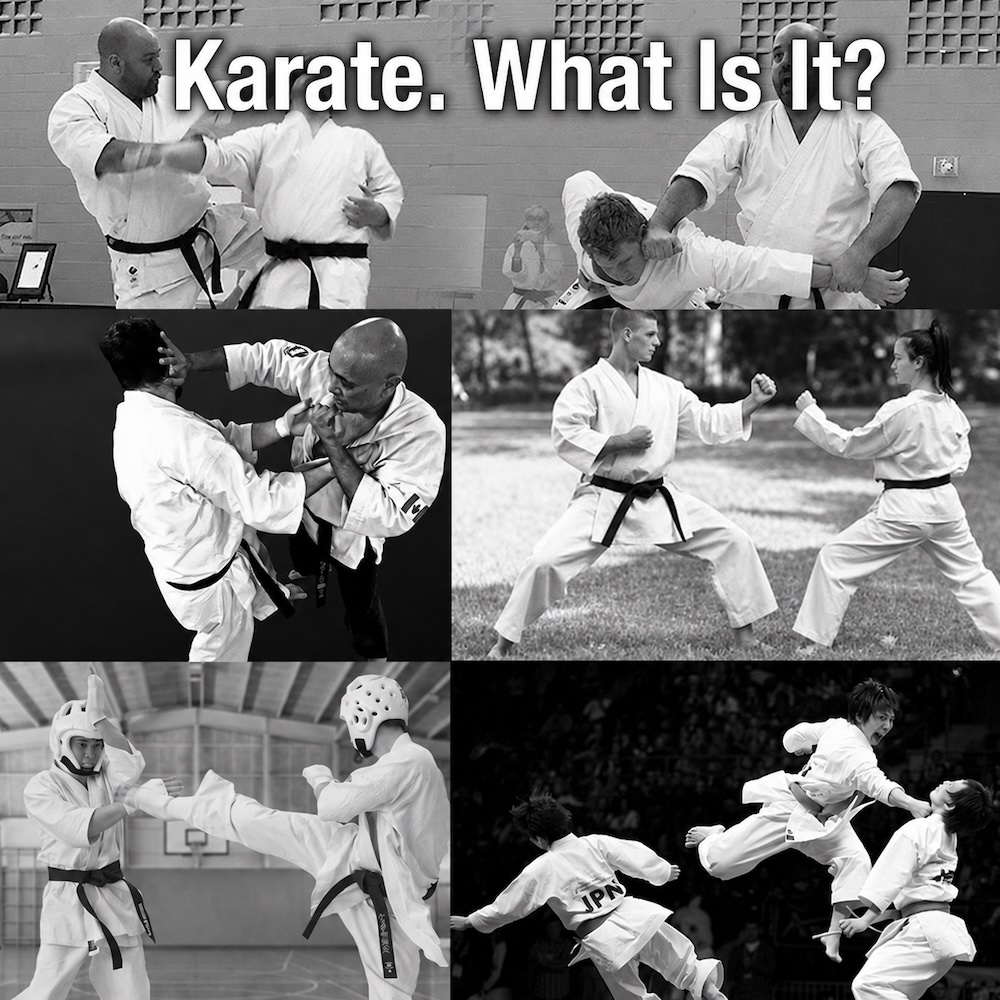
It’s funny isn’t it how two people can argue about what karate is while both are actually describing completely different activities carried out under the same name.
A few years ago I wrote about whether we should differentiate between things such as sport karate, children’s karate, practical karate and 3K karate. At the time I was really asking whether the label mattered.
I think it probably does.
Karate has become such a broad term that saying someone “teaches karate” no longer tells us very much about what they actually teach.
One person may be preparing students for competition. Another may be teaching children confidence, discipline and coordination. Someone else may be preserving kata and tradition. Another may be training primarily for civilian self-protection.
They may all be teaching karate, but they are not necessarily trying to achieve the same thing.
That is where a lot of the confusion begins.
Criticizing sport karate because it doesn’t work well for self-defense makes little sense if self-defense was never its purpose. In the same way, someone training for civilian self-protection is going to make different choices about tactics and practice methods than someone preparing for a tournament.
The problem comes when we stop making those distinctions.
Someone says karate contains throws and grappling. Another says it doesn’t because they have never seen those things in their own training. Or one person says karate works better at close range, while another says it’s about being prepared with your hands up in a high guard.
Then we argue about black belts, while one person is thinking about technical performance and another is thinking about maturity, understanding and the ability to apply what has been learned.
Perhaps they are not really disagreeing about karate at all. They are describing different versions of it.
This is why I use the term Practical Karate in my dojo. Not because I think it is somehow more legitimate than everything else, but because it gives the word karate some context. It tells people something about what the training is for.
And I think that’s the important part.
The label itself is not the issue. The purpose behind it is.
If someone tells me they teach competition karate, I have some idea what they mean. If they say children’s karate, again, I understand something about the emphasis.
But if someone simply says, “I teach karate”, I’m no longer sure that tells me enough. Most schools today mention that they teach ‘self-defense’, but often what they are really teaching is how to become good at their version of karate. Some of that may overlap with self-defense, but that is not necessarily the same thing.
It’s like saying you play a ball game. Do you use a bat or a racket? Do you use your hands or your feet? The obvious question would be, what kind of ball game is it?
Maybe that is why so many arguments about karate go nowhere.
We are using the same word, but very often we are talking about different things.
There is no reason to limit yourself to one aspect of karate alone. I’d also not want to suggest that others should either. However, we do need to clearly identify our goals and what those goals actually require.
After all, you couldn’t play rugby with a baseball bat.
Help Keep Applied Methods Free
Applied Methods is independently written and freely available. If you enjoy the articles and would like to support the continued writing and upkeep of the site, contributions are always appreciated, but never expected.
I completely agree with this. Also, I would watch more rugby if they had baseball bats.
Interesting that I was preaching a similar thing in my dojo tonight. Just back from the evejing practice…
“For where your treasure is, there your heart will be also.”
– Matthew 6:21