
What remains, what changes, and the challenge of finding your place again.
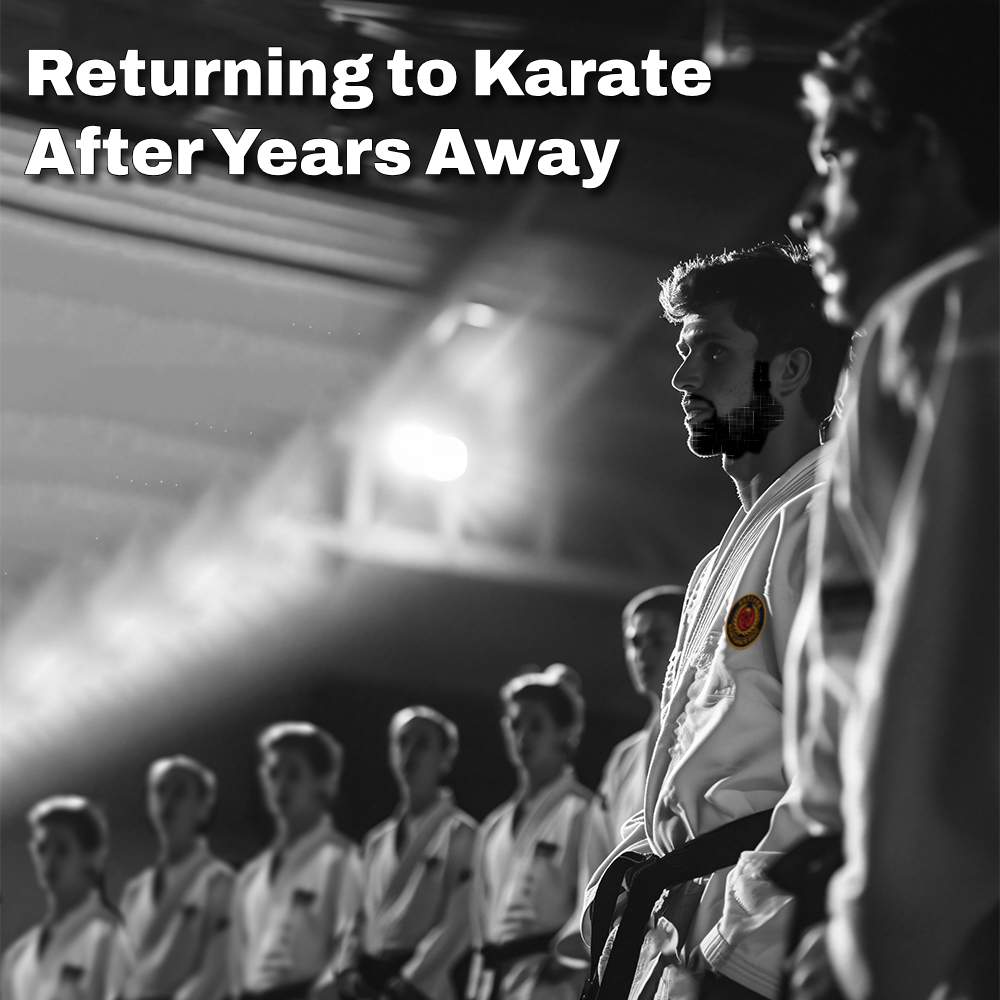
People leave karate for all kinds of reasons. Work, family, illness, or simply changing priorities can interrupt training. Sometimes what was intended to be a short break becomes several years, perhaps even decades. Yet for some, the interest never entirely disappears, and eventually they decide to return.
But returning to karate isn’t always as straightforward as walking back through the dojo door.
Over the years, I’ve had students return after considerable periods away from training. One thing I noticed was that those with more experience, particularly black belts, often recovered their previous knowledge relatively quickly. A kata they hadn’t practiced in years might initially be hesitant, with forgotten movements or pauses while they tried to remember what came next. But after working through it a few times, the memory often began to return.
The same was true of two-person drills. Once they started working with a partner again, familiar movements and responses began to reappear. Their execution wasn’t necessarily what it had been, and their timing, coordination, and physical ability often needed attention. But much of their previous understanding was still there.
There is a difference between remembering how to do something and being able to perform it to the standard you once could.
With students who had trained for a shorter period before leaving, their foundations were not always as firmly established, and material they had previously learned could be surprisingly difficult to recall. Some needed to revisit earlier kata and drills, gradually rebuilding their understanding.
For a few, returning proved frustrating enough that they eventually stopped training again.
I don’t think it was necessarily because they were unwilling to put in the work. Some appeared to feel a little lost, particularly when they looked around the dojo and saw how far others had progressed during their absence.
Someone they remembered as a beginner might now be a senior student. People who once stood behind them in line had continued training and moved beyond their previous level.
Meanwhile, they were struggling to remember something they once knew.
That can be uncomfortable. You can be genuinely pleased to see how far someone else has progressed while still feeling disappointed with yourself. Returning to a familiar dojo doesn’t necessarily mean returning to the same place within it.
Time away doesn’t stop everyone else’s progress.
Those who remained have put in the time and effort. Their progress was earned, and a returning student cannot reasonably expect to resume exactly where they left off in terms of ability. But understanding that doesn’t necessarily make the experience any easier.
A grade legitimately earned years ago remains an achievement, even if the person’s present ability has changed. But it doesn’t guarantee that they can immediately demonstrate the same standard.
What belt someone wears when they return is another consideration. I have asked returning students to train at a lower grade while I assessed what they remembered and what needed rebuilding. That isn’t about dismissing their previous achievement, but neither should a belt become an obstacle to recognizing their present ability.
The important thing is their willingness to return to the work, wherever that might mean starting.
And perhaps we should remember that returning takes a little courage, too. Someone who has been away for years may already be uncertain about coming back. They may be conscious of how much their ability has changed, or uncomfortable about training alongside people who have progressed beyond them.
They don’t need to be made to feel that their absence was a personal failing. We don’t always know what has happened in someone’s life, or why they stepped away in the first place.
I think this is where an instructor has an important part to play.
You may not be able to pick up exactly where you left off. But you can begin again from where you are now.
Help Keep Applied Methods Free
Applied Methods is independently written and freely available. If you enjoy the articles and would like to support the continued writing and upkeep of the site, contributions are always appreciated, but never expected.

I started training karate at the age sixty five years ago,i would like to thank senior fellow students and my Shihan for encouraging me to keep going, I’m currently a 3kyu.