What progress, grading and good karate can look like when the journey begins later.
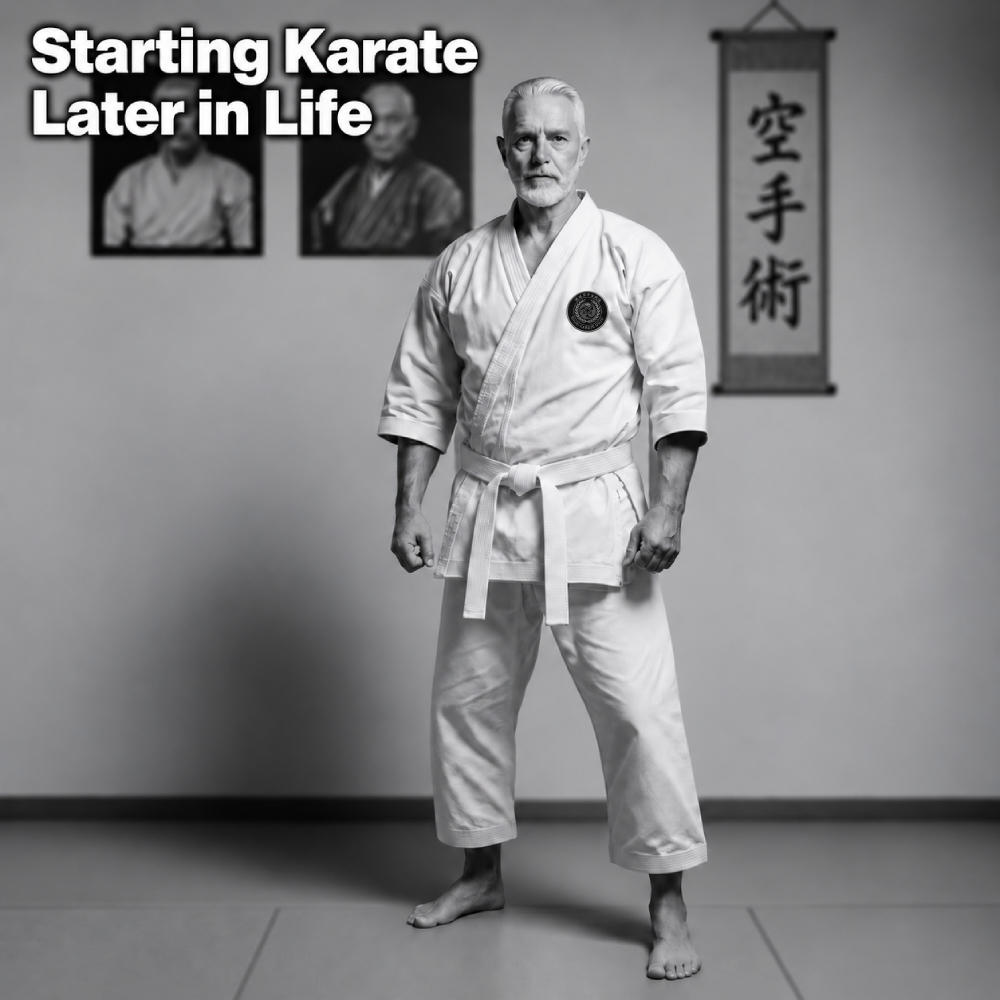
A comment on a recent article raised an interesting question.
What should someone expect if they begin karate in their sixties or seventies? And how should they feel about promotion when they know they may never move like someone who started in their twenties?
I think the first thing to say is that age changes the starting point, but it doesn’t make the training less meaningful.
Someone beginning karate at 65 is not starting with the same body as someone beginning at 25. Recovery is usually slower. Mobility may be reduced. Strength, speed and balance may not develop at the same rate. Old injuries may already be part of the picture.
Pretending otherwise helps nobody.
But I also think it is a mistake to reduce karate to those physical qualities.
Being a capable karate practitioner is not simply about how fast you can move, how high you can kick, or how hard you can hit. Those things may matter, but they are only part of it.
Older practitioners can still develop timing, balance, coordination, efficiency, awareness, judgment and understanding. They can still become more capable and technically sound.
Age may change what progress looks like. It should not make progress meaningless.
The difficulty comes when older beginners compare themselves with younger people in the dojo. That comparison is understandable, but often unhelpful.
A 65-year-old beginner may never move with the same speed or athleticism as a 30-year-old who has been training for ten years. But that does not mean the older practitioner is failing.
The more useful comparison is with the person who walked into the dojo on the first day.
Are they moving better now? Do they understand more? Is their balance improving? Can they coordinate their body more effectively? Are they becoming more comfortable with the demands of training?
That is progress.
And this is where grading becomes important.
An older practitioner should not be promoted out of sympathy, and a grade should not become a consolation prize simply because someone is older or because they are trying hard. But neither should they be denied promotion simply because they cannot reproduce the physical attributes of someone decades younger.
The grade should still represent something real.
Perhaps that means moving with better balance and control, understanding the movements more clearly, using the body more effectively, developing greater awareness and judgment, and being able to apply what has been taught at the appropriate level.
We already accept individual differences in other ways. A smaller practitioner will not use strength in the same way as a larger one. Someone with an old knee injury may have to adjust how they move. A child or young adolescent may not yet have the strength or power of a fully grown adult, but that doesn’t prevent us from recognizing their progress.
Karate has to exist within the body of the person actually practicing it.
That does not mean lowering standards. It means understanding what the standard is really meant to measure.
There is another advantage to starting later in life that is sometimes overlooked.
Some older beginners arrive with less need to prove themselves. They may be less interested in showing how tough they are and more interested in learning properly, staying capable, and continuing to train for as long as possible.
That can bring a different perspective to training.
Someone starting karate later in life does not need to train as though they are trying to become the person they were thirty or forty years ago. We train the person we are now.
Starting karate later in life does not mean you are too late. It simply means your journey begins from a different place.
The value of your karate is not in how closely you resemble someone younger. It is in what you have genuinely developed for yourself.